In-depth review
Franklin Sensors ProSensor 710 Review (2027)
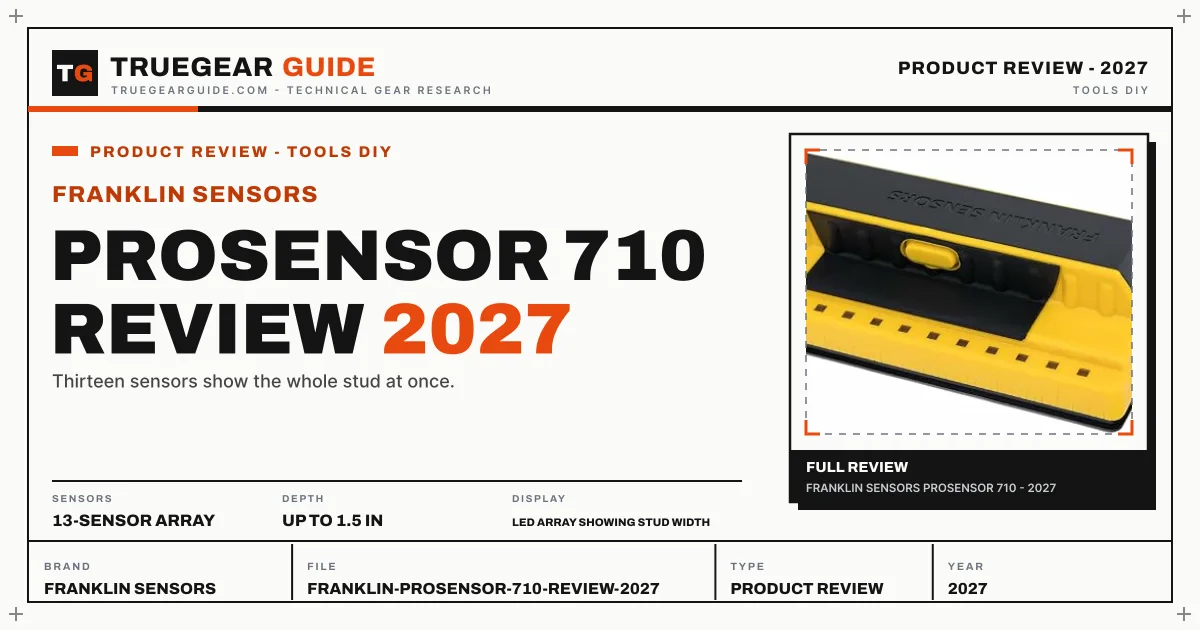
In-depth review of the Franklin ProSensor 710: 13-sensor array accuracy, speed, and limits on difficult walls.

Our verdict
The ProSensor 710 is the stud finder that makes other finders feel like guessing machines. Its array reads the wall the way your eyes read a page: all at once. For drywall framing, nothing faster or clearer exists at this price.
What we like
- 13-sensor array displays full stud width with LEDs, no calibration sweep
- Finds center and edges simultaneously
- Works on the wall instantly, no warm-up passes
- Detects double studs and irregular framing honestly
What to watch out for
- Depth rated to 1.5 inches
- LED-only display lacks a screen for other data
- Costs more than single-sensor edge finders
What owners report: Franklin Sensors ProSensor 710
Synthesized from recurring themes in long-term owner feedback.
Most praised
- Seeing the whole stud lit at once ends the tedious mark-one-edge, mark-the-other routine
- It shows doubled studs and odd framing as they are, which mount installers trust
- Placing it on the wall and reading instantly, with no calibration sweep, spoils owners for other finders
Common complaints
- Its reach stops at the same depth class as cheaper tools, so thick plaster still defeats it
- An LED-only readout gives no numbers for owners who want depth detail
- It costs more than the single-sensor finders it makes feel slow
Who it is for
Homeowners, installers, and anyone who hangs heavy things and hates patching mis-drilled holes.
The array advantage
Thirteen sensors eliminate the calibration-and-sweep ritual: place the 710 anywhere and LEDs immediately paint stud position and width beneath it. Double studs, blocking, and off-spacing framing appear as they are, not as a beeping riddle.
Accuracy and confidence
Because the display shows edges and center simultaneously, lag placement stops being estimation. Independent reviews consistently rank Franklin arrays at the top for drywall accuracy, and the instant read encourages the verification scans users skip with slower tools.
Honest limits
Depth tops out at 1.5 inches, there is no wire or pipe detection, and tile or thick plaster still defeats it. Franklin sells the M210 for wire awareness; for hazard scanning you need a different instrument class entirely.
Where it speeds real jobs most
The 710 earns its keep on repetitive framing tasks: laying out a gallery wall across three studs, finding both studs for a TV mount without a second tool, and checking whether blocking sits where a grab bar needs it. Because the read is instant, users actually scan the whole wall before drilling instead of sampling one hopeful spot, and that habit prevents more bad holes than any accuracy figure. Installers who hang cabinets weekly describe the same pattern: mark every stud in the room in one pass, then work from the marks.
Key specifications
- Sensors
- 13-sensor array
- Depth
- Up to 1.5 in
- Display
- LED array showing stud width
- Power
- 2 AA batteries
- Calibration
- None required
Also consider

Franklin Sensors ProSensor M210
Multi-sensor center find plus live-wire display.
Why consider it: Same array philosophy plus live-wire warning and a richer display.
- Sensors: Multi-sensor array
- Depth: Up to 1.5 in

Walabot DIY 2 In-Wall Imager
See studs, pipes, and wires on your phone screen.
Why consider it: Imaging for pipes and wires when the wall's contents matter as much as its studs.
- Method: Radio-frequency imaging
- Depth: Up to 4 in (drywall)
Research-based assessment. TrueGear has not hands-on tested this product; this evaluation synthesizes manufacturer specifications, retailer documentation, and published expert reviews.
Questions, answered
Does the 710 need calibration?
No. The array self-references across its width, which is the core reason it feels instant compared to sweep finders.
Will it find steel studs?
It detects them as density masses and shows their width; scanning response differs from wood, so verify with a magnet on the screws.
Can it scan through tile?
Thin tile over drywall sometimes; thick tile and backer board usually exceed its depth and density assumptions. Use an imager or find studs from the adjacent drywall.