For hanging TVs and heavy loads
The Best Stud Finders for Hanging TVs (2027)
The best stud finders for TV mounting in 2027: center accuracy and wire awareness for heavy, expensive loads.

The short answer
For TVs in 2027, the Franklin ProSensor 710 wins on center accuracy. Pair it with a Bosch GMS120 scan when wiring is uncertain.
Our top picks at a glance
- Franklin Sensors ProSensor 710Thirteen sensors show the whole stud at once.Best overall
- Bosch GMS120 Digital Wall ScannerPro scanner for studs, metal, and live cables.Best safety check
- Zircon StudSensor HD55Center-find Zircon with DeepScan and wire warning.Best value
- Franklin Sensors ProSensor M210Multi-sensor center find plus live-wire display.Best with wire warning
- Zircon MultiScanner A200Studs, metal, and live AC in one scanner.Best multi-mode scanner
- Walabot DIY 2 In-Wall ImagerSee studs, pipes, and wires on your phone screen.Best imaging
- Zircon StudSensor e50Edge finder with wire warning and SpotLite pointer.Best edge finder
- Tavool Stud Finder SensorBudget 5-in-1 electronic scanner for home use.Best ultra-budget electronic
What owners report
Synthesized from recurring themes in long-term owner feedback.
Most praised
- Seeing the full width of a stud lets owners centre a mount bolt with confidence instead of hope
- Double studs shown honestly by array finders are exactly what a heavy mount wants at one side
Common complaints
- Even a good finder cannot confirm a stud will hold a mount in crumbly plaster, and owners still probe with a small bit
- Wire warnings near a TV mount location often force a move that the room layout did not plan for
The picks, ranked
Every product in this lineup was picked for this use case, ranked with our strongest choices first. If a product from the wider category does not genuinely fit this scenario, it is not listed here.
| # | Product | Award | Sensors | Depth | Display | Power | Calibration |
|---|---|---|---|---|---|---|---|
| 1 | Franklin Sensors ProSensor 710 | Best overall | 13-sensor array | Up to 1.5 in | LED array showing stud width | 2 AA batteries | None required |
| 2 | Bosch GMS120 Digital Wall Scanner | Best safety check | - | Studs to 1.5 in; ferrous metal to 4.75 in; live cable to 2 in | Illuminated LCD plus LED ring | 9V battery | - |
| 3 | Zircon StudSensor HD55 | Best value | - | Up to 1.5 in (DeepScan) | LCD with center indication | 9V battery | - |
| 4 | Franklin Sensors ProSensor M210 | Best with wire warning | Multi-sensor array | Up to 1.5 in | LED array plus wire-warning display | 2 AA batteries | - |
| 5 | Zircon MultiScanner A200 | Best multi-mode scanner | - | Studs to 1.5 in; metal to 3 in | Backlit LCD with signal bars | 9V battery | - |
| 6 | Walabot DIY 2 In-Wall Imager | Best imaging | - | Up to 4 in (drywall) | Smartphone app (iOS/Android) | Rechargeable, USB-C | - |
| 7 | Zircon StudSensor e50 | Best edge finder | - | - | LCD with target bar plus SpotLite pointer | 9V battery | Automatic ACT |
| 8 | Tavool Stud Finder Sensor | Best ultra-budget electronic | - | Studs to 1.5 in (rated) | LCD with bars and beeper | 9V battery | Manual, per mode |
Best overall
Franklin Sensors ProSensor 710
Thirteen sensors show the whole stud at once.

A TV mount wants two studs, dead center. The 710 shows both studs' full width so lag bolts land in meat, not edges.
Strengths
- 13-sensor array displays full stud width with LEDs, no calibration sweep
- Finds center and edges simultaneously
- Works on the wall instantly, no warm-up passes
- Detects double studs and irregular framing honestly
Limitations
- Depth rated to 1.5 inches
- LED-only display lacks a screen for other data
- Costs more than single-sensor edge finders
| Sensors | 13-sensor array |
|---|---|
| Depth | Up to 1.5 in |
| Display | LED array showing stud width |
| Power | 2 AA batteries |
| Calibration | None required |
Best for: Anyone hanging heavy items who wants to see full stud width instantly.
Skip if: You need deep scanning through tile or thick plaster beyond 1.5 inches.
Best safety check
Bosch GMS120 Digital Wall Scanner
Pro scanner for studs, metal, and live cables.
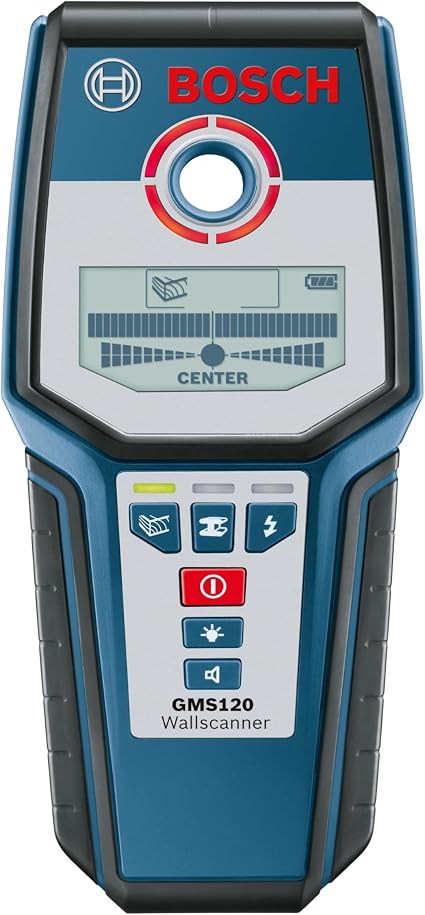
Before drilling four big lags, the GMS120's live-cable warning and metal detection audit the wall the mount will trust.
Strengths
- Three modes: drywall, universal, and concrete
- Detects ferrous metal to 4-3/4 inches, live cables to 2 inches
- Center finder with color-changing light ring
- Auto-calibration with clear multilingual display
Limitations
- Price reflects pro positioning
- Learning the signal language takes practice
- Not an imager; indications still need interpretation
| Modes | Drywall, Universal, Concrete |
|---|---|
| Depth | Studs to 1.5 in; ferrous metal to 4.75 in; live cable to 2 in |
| Display | Illuminated LCD plus LED ring |
| Power | 9V battery |
| Rating | IP54 (battery compartment excepted) |
Best for: Contractors drilling into unknown walls who need live-cable warnings they can trust.
Skip if: Simple picture hanging; a Franklin or magnetic finder is faster and cheaper.
Best value
Zircon StudSensor HD55
Center-find Zircon with DeepScan and wire warning.

Center find plus DeepScan at a TV-budget-friendly price, with wire warning as a bonus.
Strengths
- Center and edge indications in one scan
- DeepScan reaches 1.5 inches for thicker walls
- WireWarning live AC alerts
- Low-battery display and SpotLite-style targeting
Limitations
- Single-sensor scanning still needs a slow, flat pass
- Thick plaster remains a weakness
- 9V battery not always included
| Modes | StudScan, DeepScan, center find |
|---|---|
| Depth | Up to 1.5 in (DeepScan) |
| Display | LCD with center indication |
| Power | 9V battery |
| Extras | WireWarning AC detection |
Best for: Homeowners stepping up to center-find convenience within the Zircon system.
Skip if: You want wide-array instant reads; Franklin still shows more at once.
Best with wire warning
Franklin Sensors ProSensor M210
Multi-sensor center find plus live-wire display.

The M210 shows the stud's full width instantly like the 710 and adds a live-wire display, so the same scan that finds your two mounting studs also flags the AC run you must not drill.
Strengths
- Multi-sensor array shows stud width instantly
- Live wire display warns of AC presence
- Depth and center indications on an improved readout
- No calibration ritual; place and read
Limitations
- Costs more than the 710
- Still a 1.5-inch class drywall tool
- Display adds battery draw versus LED-only models
| Sensors | Multi-sensor array |
|---|---|
| Depth | Up to 1.5 in |
| Display | LED array plus wire-warning display |
| Power | 2 AA batteries |
| Extras | Built-in pencil and level features on select bundles |
Best for: Homeowners wanting Franklin speed with added wire warning and a fuller display.
Skip if: You prefer the original 710's dead-simple LED honesty and lower price.
Best multi-mode scanner
Zircon MultiScanner A200
Studs, metal, and live AC in one scanner.

Before a mount goes up, the A200's metal mode checks for pipes and its AC scan traces wiring to warn you off, while DeepScan confirms the studs through thicker drywall.
Strengths
- Four modes: stud, deep stud, metal, and AC scan
- Metal mode traces pipes and rebar to 3 inches
- Ultra-bright display with target indication
- WireWarning plus dedicated AC trace mode
Limitations
- Mode switching adds steps versus Franklin simplicity
- AC detection is proximity-based, not exact tracing
- Still an edge-finding workflow for studs
| Modes | Stud, DeepScan, Metal, AC Scan |
|---|---|
| Depth | Studs to 1.5 in; metal to 3 in |
| Display | Backlit LCD with signal bars |
| Power | 9V battery |
| Extras | SpotLite pointer |
Best for: Renovators who need stud, metal, and AC scanning before cutting or drilling.
Skip if: You want full imaging; Walabot shows a picture, this shows indications.
Best imaging
Walabot DIY 2 In-Wall Imager
See studs, pipes, and wires on your phone screen.

When the wall hides plumbing or conduit near the mount, the Walabot's RF picture shows studs, pipes, and wires in place, the most certain pre-drill check before lag bolts go in.
Strengths
- RF imaging visualizes studs, pipes, and wires through drywall
- Detects to about 4 inches deep in drywall
- Pairs with phone for large, clear visuals and snapshots
- Expert mode shows raw signal for tricky walls
Limitations
- Requires phone pairing and app setup
- Drywall-focused; concrete and lath reduce performance
- Premium price versus sensor finders
| Method | Radio-frequency imaging |
|---|---|
| Depth | Up to 4 in (drywall) |
| Display | Smartphone app (iOS/Android) |
| Detects | Studs, pipes, wires, pests (movement) |
| Power | Rechargeable, USB-C |
Best for: Renovators and cautious drillers who want to actually see inside the wall.
Skip if: You lack a compatible smartphone or want a ten-second grab-and-scan tool.
Best edge finder
Zircon StudSensor e50
Edge finder with wire warning and SpotLite pointer.

The e50's classic two-edge method still works for TV mounts: mark both edges with the SpotLite pointer, split the difference, and its WireWarning flags live AC while you scan.
Strengths
- StudScan finds edges to 3/4 inch, DeepScan to 1.5 inches
- WireWarning alerts to live AC near the wall
- SpotLite pointer projects the edge on the wall
- ACT calibration trims accuracy on varied densities
Limitations
- Edge-find workflow means marking both edges yourself
- Plaster and lath walls still challenge it
- Requires careful flat calibration every scan
| Modes | StudScan (0.75 in), DeepScan (1.5 in) |
|---|---|
| Detection | Wood and metal stud edges, live AC warning |
| Display | LCD with target bar plus SpotLite pointer |
| Power | 9V battery |
| Calibration | Automatic ACT |
Best for: Homeowners wanting a reliable electronic edge finder with live-wire alerts.
Skip if: You want center-find in one pass; multi-sensor Franklin models are faster.
Best ultra-budget electronic
Tavool Stud Finder Sensor
Budget 5-in-1 electronic scanner for home use.

On plain drywall the Tavool's center and edge indications find mounting studs for very little money; verify its marks with a second pass or a pilot hole before trusting four lag bolts to it.
Strengths
- Five scan modes covering studs, deep, metal, and AC
- LCD with signal strength and audio alerts
- Center and edge indications for the price of lunch
- Honest performance on plain drywall
Limitations
- Inconsistent on plaster, tile, and textured walls
- Build and switch feel budget-grade
- Instructions and calibration demand patience
| Modes | Stud, Deep, Metal, AC, plus center find |
|---|---|
| Depth | Studs to 1.5 in (rated) |
| Display | LCD with bars and beeper |
| Power | 9V battery |
| Calibration | Manual, per mode |
Best for: Occasional hangers who want electronic modes at the lowest price.
Skip if: Accuracy on difficult walls matters; budget sensors false-positive more often.
Questions, answered
How do I confirm a stud before drilling lag bolts?
Scan at two heights, mark edges and center, then test with a tiny pilot bit or finish nail in an inconspicuous spot behind the mount footprint.
What if studs are not 16 inches apart for my mount?
Older and steel framing vary. Trust the finder over the tape measure, and use a mount with a wide wall plate or add plywood backing across two studs.
Can I mount a TV on drywall anchors alone?
Small fixed TVs with rated toggle anchors, sometimes. Large or articulating mounts belong in studs, full stop.
Where do wires usually run near TV walls?
Horizontally at outlet height and vertically to switches and outlets. Scan the drill zone with a wire-detecting tool before every hole.