For windy conditions
The Best Backpacking Stoves for Wind (2027)
The best windproof backpacking stoves for 2027: systems and burners that keep boiling when exposed burners quit.
The short answer
For serious wind in 2027, the MSR WindBurner is unbeatable: its enclosed radiant burner simply does not blow out. For a separate stove, the Soto WindMaster is the wind pick.
Our top picks at a glance
- MSR WindBurnerA radiant-burner system that wind simply cannot blow out.Most windproof
- Soto WindMasterA concave burner head that shrugs off wind like integrated systems.Best separate stove in wind
- Jetboil FlashThe fastest integrated system: a liter boiled in about 100 seconds.Fastest in a breeze
- MSR Reactor 1.7LThe expedition system that melts snow and boils faster than anything in wind.Best for groups and snow
- Jetboil MiniMoJetboil speed with actual simmer control and a bowl-shaped pot.Best for cooking
- Fire-Maple Fixed Star X2An integrated heat-exchanger system at half the big-brand price.Best budget system
- Soto AmicusSoto engineering at an entry price, with a stealth igniter.Best budget stove
What owners report
Synthesized from recurring themes in long-term owner feedback.
Most praised
- Enclosed radiant systems boil on ridgelines where exposed burners cannot stay lit
- A concave burner head saves the separate stove cook from building rock windbreaks at every camp
Common complaints
- Windproof systems repay their calm with weight and bulk on the calm days too
- Integrated pots that lock to one burner limit the cook who wants a frying pan option
The picks, ranked
Every product in this lineup was picked for this use case, ranked with our strongest choices first. If a product from the wider category does not genuinely fit this scenario, it is not listed here.
| # | Product | Award | Weight (1.0 L system) | Boil time (1 L) | Pot capacity | Fuel | Ignition |
|---|---|---|---|---|---|---|---|
| 1 | MSR WindBurner | Most windproof | 15.3 oz (434 g) | 4.5 min (sheltered rating; excels in wind) | 1.0 L (1.8 L available) | Isobutane-propane canister | Manual |
| 2 | Soto WindMaster | Best separate stove in wind | - | About 3 min sheltered | - | Isobutane-propane canister | Built-in piezo (Micro Regulator) |
| 3 | Jetboil Flash | Fastest in a breeze | - | 1 min 40 sec | 1 L FluxRing | Isobutane-propane canister | Push-button piezo |
| 4 | MSR Reactor 1.7L | Best for groups and snow | - | 3 min (sheltered) | 1.7 L | Isobutane-propane canister | Manual |
| 5 | Jetboil MiniMo | Best for cooking | - | - | 1 L, short and wide | Isobutane-propane canister | Push-button piezo |
| 6 | Fire-Maple Fixed Star X2 | Best budget system | - | About 3.5 min | 1 L | Isobutane-propane canister | Piezo |
| 7 | Soto Amicus | Best budget stove | - | About 3.5 to 4 min | - | Isobutane-propane canister | Built-in piezo (igniter model) |
Most windproof
MSR WindBurner
A radiant-burner system that wind simply cannot blow out.

An enclosed radiant burner wind cannot reach. The WindBurner boils on ridgelines where other stoves will not stay lit.
Strengths
- Enclosed radiant burner is effectively windproof
- Pressure regulator keeps output steady in cold and as fuel drops
- Integrated pot with cozy and lid drinking ports
- Faster real-world boils in wind than any exposed burner
Limitations
- System weight and bulk exceed ultralight setups
- Limited simmer finesse
- Premium price
| Weight (1.0 L system) | 15.3 oz (434 g) |
|---|---|
| Boil time (1 L) | 4.5 min (sheltered rating; excels in wind) |
| Pot capacity | 1.0 L (1.8 L available) |
| Fuel | Isobutane-propane canister |
| Ignition | Manual |
Best for: Mountaineers and windy-climate hikers who need guaranteed boils.
Skip if: You want to simmer sauces; this system boils brilliantly and cooks modestly.
Best separate stove in wind
Soto WindMaster
A concave burner head that shrugs off wind like integrated systems.

The concave burner head shelters its own flame, delivering near-system wind performance with separate-stove versatility.
Strengths
- Concave burner and close pot placement resist wind dramatically
- Boils fast and simmers genuinely well
- Built-in igniter that actually works at altitude
- Interchangeable 3-flex and 4-flex pot supports
Limitations
- Costs more than simpler canister stoves
- 4-flex support is a separate purchase on some bundles
- Small support arms need care with big pots
| Weight (with 4-flex) | 3.0 oz (86 g) |
|---|---|
| Boil time (1 L) | About 3 min sheltered |
| Fuel | Isobutane-propane canister |
| Output | 11,000 BTU/hr |
| Ignition | Built-in piezo (Micro Regulator) |
Best for: Backpackers in windy country who want a separate stove's versatility.
Skip if: You need the absolute lightest; the BRS-3000T beats it on grams.
Fastest in a breeze
Jetboil Flash
The fastest integrated system: a liter boiled in about 100 seconds.
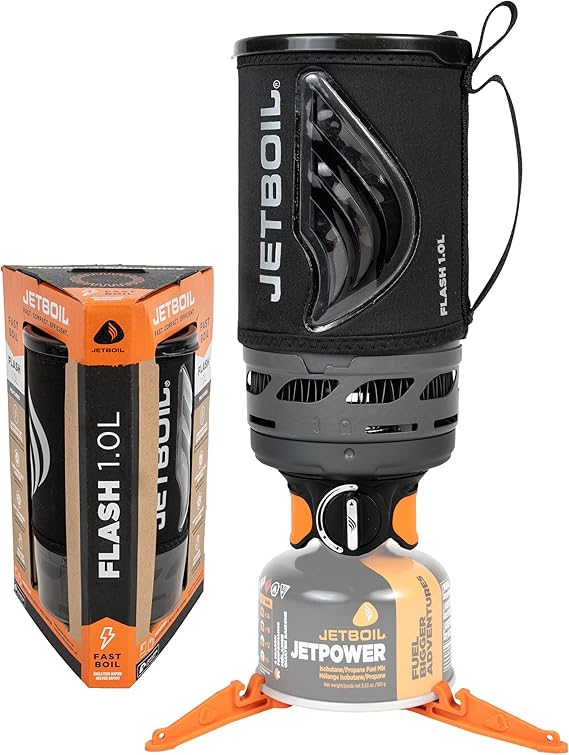
The Flash's shielded FluxRing design keeps its 100-second pace in moderate wind that halves exposed burners' efficiency.
Strengths
- FluxRing pot boils 1 L in roughly 100 seconds
- Integrated system shields the burner from wind
- Push-button igniter is reliable and glove-friendly
- Color-change heat indicator prevents wasted fuel
Limitations
- Poor simmer control for actual cooking
- System weight exceeds stove-plus-pot ultralight setups
- Proprietary pot locks you into the Jetboil ecosystem
| Weight (system) | 13.1 oz (371 g) |
|---|---|
| Boil time (1 L) | 1 min 40 sec |
| Pot capacity | 1 L FluxRing |
| Fuel | Isobutane-propane canister |
| Ignition | Push-button piezo |
Best for: Hikers who live on dehydrated meals and want boiling water fastest.
Skip if: You cook real meals; the Flash is a boiler, not a chef's stove.
Best for groups and snow
MSR Reactor 1.7L
The expedition system that melts snow and boils faster than anything in wind.
The radiant burner plus heat exchanger is the wind benchmark in this catalog, and the 1.7 L pot keeps boiling for two when exposed burners will not stay lit. Heavy, and worth it when wind is the plan, not the risk.
Strengths
- Radiant burner plus heat exchanger is the wind benchmark
- 1.7 L pot serves two and melts snow efficiently
- Pressure-regulated for consistent output in cold and altitude
- The mountaineering standard for over a decade
Limitations
- Heavy and expensive for casual backpacking
- Boil-only personality; no real simmering
- Large packed size
| Weight (system) | 1 lb 5 oz (581 g) |
|---|---|
| Boil time (1 L) | 3 min (sheltered) |
| Pot capacity | 1.7 L |
| Fuel | Isobutane-propane canister |
| Ignition | Manual |
Best for: Mountaineers and groups melting snow and boiling for two or more.
Skip if: You hike solo in summer; this is heavy artillery for a simple job.
Best for cooking
Jetboil MiniMo
Jetboil speed with actual simmer control and a bowl-shaped pot.

The same shielded FluxRing idea as the Flash in a short wide pot, with a precision valve that still simmers once the wind drops. The windy camp pick for hikers who cook rather than only rehydrate.
Strengths
- Fine valve control simmers sauces without scorching
- Short, wide 1 L pot works as a bowl and mug
- FluxRing efficiency with push-button ignition
- Metal handles you can actually hold with food in the pot
Limitations
- Heavier than the Flash system
- Still less versatile than a stove plus separate cookware
- Premium price
| Weight (system) | 14.6 oz (415 g) |
|---|---|
| Boil time (0.5 L) | 2 min 15 sec |
| Pot capacity | 1 L, short and wide |
| Fuel | Isobutane-propane canister |
| Ignition | Push-button piezo |
Best for: Solo hikers who cook real one-pot meals, not just boil-and-bag.
Skip if: You only rehydrate meals; the cheaper Flash boils just as fast.
Best budget system
Fire-Maple Fixed Star X2
An integrated heat-exchanger system at half the big-brand price.

An integrated windscreen design and heat exchanger pot at a budget price, with piezo ignition included. It gives up weight and long term support to the premium systems, not basic wind competence.
Strengths
- Heat-exchanger pot boils fast and sips fuel
- Integrated windscreen design works in real weather
- Piezo ignition included at a budget price
- Pot doubles as bowl with insulated cozy
Limitations
- Heavier than premium integrated systems
- Long-term parts support is thinner than MSR or Jetboil
- Simmer control is basic
| Weight (system) | 1 lb 2 oz (about 510 g) |
|---|---|
| Boil time (1 L) | About 3.5 min |
| Pot capacity | 1 L |
| Fuel | Isobutane-propane canister |
| Ignition | Piezo |
Best for: Budget hikers who want Jetboil-style speed without Jetboil pricing.
Skip if: You want the lightest system; budget integration costs ounces.
Best budget stove
Soto Amicus
Soto engineering at an entry price, with a stealth igniter.

The concave burner offers better wind behavior than flat rivals at this tier, though it stops short of WindMaster class. A fair weather plus pick: fine in moderate gusts behind a rock, not a ridgeline stove.
Strengths
- Concave burner offers better wind behavior than flat rivals
- Built-in stealth igniter is protected inside the burner post
- Four folding supports handle real pots stably
- Excellent simmer for the price class
Limitations
- Heavier than the PocketRocket 2
- Wind resistance is good, not WindMaster-class
- Igniter-equipped version is the one to buy; base version lacks it
| Weight (with igniter) | 2.9 oz (81 g) |
|---|---|
| Boil time (1 L) | About 3.5 to 4 min |
| Fuel | Isobutane-propane canister |
| Output | About 9,900 BTU/hr |
| Ignition | Built-in piezo (igniter model) |
Best for: Value seekers who want Japanese burner quality without WindMaster pricing.
Skip if: You cook in serious wind; the WindMaster's burner head is worth the upgrade there.
Questions, answered
Why does wind hurt stoves so much?
Wind strips the flame's heat away from the pot and can reduce efficiency by half or more, doubling boil times and fuel use. Burner shielding matters more than raw BTU output.
Can I just block wind with my body?
It helps for lighting and mild breezes, but sustained wind needs design solutions: enclosed burners, heat exchangers, or a genuinely sheltered cook spot.
Are liquid-fuel stoves better in wind?
They pair with full windscreens safely and excel in extreme cold, but for three-season wind, modern regulated canister systems match them with far less fuss.
Does a lid really matter?
Yes. A lid can cut boil time and fuel use significantly, especially in wind. Every system pick here includes one; separate-stove users should never skip it.