For ultralight hikers
The Best Ultralight Backpacking Stoves (2027)
The best ultralight backpacking stoves for 2027: gram-counting burners that still boil honestly.
The short answer
The BRS-3000T is the lightest backpacking stove worth carrying in 2027 at 25 g. Most ultralight hikers will be happier with the MSR PocketRocket 2, whose extra 48 g buy stability and speed.
Our top picks at a glance
- BRS 3000TThe 25-gram stove that ultralighters buy by the handful.Lightest
- MSR PocketRocket 2The benchmark mini canister stove: fast, tiny, dependable.Best ultralight all-rounder
- Soto AmicusSoto engineering at an entry price, with a stealth igniter.Best with igniter
- Soto WindMasterA concave burner head that shrugs off wind like integrated systems.Best in wind
- Snow Peak GigaPower 2.0Japanese-built burner with the smoothest valve in the class.Best flame control
- MSR PocketRocket DeluxeThe 2.9 oz PocketRocket with a pressure regulator and piezo igniter.Regulated power at 2.9 oz
- Jetboil Stash Cooking SystemJetboil's lightest system ever: 7.1 oz with a FluxRing pot.Lightest complete system
What owners report
Synthesized from recurring themes in long-term owner feedback.
Most praised
- The lightest options vanish into a cook pot and leave pack weight for food and layers
- A regulated ultralight stove keeps its boil on cold mornings when basic burners fade
Common complaints
- Gram counting picks punish you in wind, where shelter hunting becomes part of every meal
- Tiny pot supports and wide pans are a spill waiting for a tired hiker
The picks, ranked
Every product in this lineup was picked for this use case, ranked with our strongest choices first. If a product from the wider category does not genuinely fit this scenario, it is not listed here.
| # | Product | Award | Weight | Boil time (1 L) | Fuel | Material | Ignition |
|---|---|---|---|---|---|---|---|
| 1 | BRS 3000T | Lightest | 0.9 oz (25 g) | About 4 min sheltered | Isobutane-propane canister | Titanium alloy and aluminum | Manual |
| 2 | MSR PocketRocket 2 | Best ultralight all-rounder | 2.6 oz (73 g) | 3.5 min | Isobutane-propane canister | - | Manual (lighter/match) |
| 3 | Soto Amicus | Best with igniter | - | About 3.5 to 4 min | Isobutane-propane canister | - | Built-in piezo (igniter model) |
| 4 | Soto WindMaster | Best in wind | - | About 3 min sheltered | Isobutane-propane canister | - | Built-in piezo (Micro Regulator) |
| 5 | Snow Peak GigaPower 2.0 | Best flame control | 3.25 oz (92 g) | About 4 min | Isobutane-propane canister (GP fuel) | - | Manual (auto version available) |
| 6 | MSR PocketRocket Deluxe | Regulated power at 2.9 oz | 2.9 oz (83 g) | About 3 min 30 sec | Isobutane-propane canister | - | Piezo push-button |
| 7 | Jetboil Stash Cooking System | Lightest complete system | - | - | Isobutane-propane canister, 100 g nests inside | - | Match (manual) |
Lightest
BRS 3000T
The 25-gram stove that ultralighters buy by the handful.

25 grams is not a typo. The BRS-3000T plus a small titanium pot is the lightest real cook system you can carry.
Strengths
- At 25 g it is the lightest stove in this guide by far
- Costs less than a freeze-dried meal
- Surprisingly durable titanium and aluminum build
- A favorite backup stove for group trips
Limitations
- No wind resistance; efficiency craters in a breeze
- Tiny pot supports demand care with larger pots
- No igniter and modest simmer control
| Weight | 0.9 oz (25 g) |
|---|---|
| Boil time (1 L) | About 4 min sheltered |
| Fuel | Isobutane-propane canister |
| Material | Titanium alloy and aluminum |
| Ignition | Manual |
Best for: Gram-counters boiling water for one in fair conditions.
Skip if: You use wide pots or cook in wind; the tiny supports and bare burner struggle.
Best ultralight all-rounder
MSR PocketRocket 2
The benchmark mini canister stove: fast, tiny, dependable.
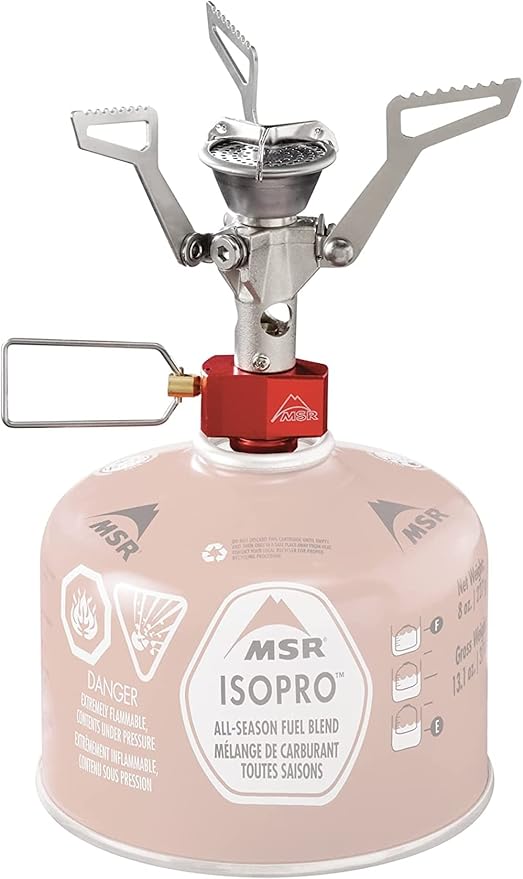
At 2.6 oz the PocketRocket 2 adds stable supports and faster boils for an ounce and a half over the BRS, a trade most hikers should take.
Strengths
- Boils a liter in about 3.5 minutes
- Folds to fit inside most cook pots
- Folding pot supports handle larger pots stably
- Decades of refinement behind the PocketRocket name
Limitations
- No built-in igniter
- Wind hurts efficiency without shelter
- Simmer control is adequate, not gourmet
| Weight | 2.6 oz (73 g) |
|---|---|
| Boil time (1 L) | 3.5 min |
| Fuel | Isobutane-propane canister |
| Packed size | 2 x 2 x 3 in |
| Ignition | Manual (lighter/match) |
Best for: Most backpackers who want a proven, packable canister stove.
Skip if: You cook in high wind without a natural windbreak; it has no windscreen solution.
Best with igniter
Soto Amicus
Soto engineering at an entry price, with a stealth igniter.

The Amicus packs an igniter and four stable supports into 2.9 oz, the lightest full-featured option here.
Strengths
- Concave burner offers better wind behavior than flat rivals
- Built-in stealth igniter is protected inside the burner post
- Four folding supports handle real pots stably
- Excellent simmer for the price class
Limitations
- Heavier than the PocketRocket 2
- Wind resistance is good, not WindMaster-class
- Igniter-equipped version is the one to buy; base version lacks it
| Weight (with igniter) | 2.9 oz (81 g) |
|---|---|
| Boil time (1 L) | About 3.5 to 4 min |
| Fuel | Isobutane-propane canister |
| Output | About 9,900 BTU/hr |
| Ignition | Built-in piezo (igniter model) |
Best for: Value seekers who want Japanese burner quality without WindMaster pricing.
Skip if: You cook in serious wind; the WindMaster's burner head is worth the upgrade there.
Best in wind
Soto WindMaster
A concave burner head that shrugs off wind like integrated systems.

At 3.0 oz with the 4-flex support it is still a gram counter's stove, and the concave burner keeps working on the exposed camps where the lightest burners lose their boil entirely.
Strengths
- Concave burner and close pot placement resist wind dramatically
- Boils fast and simmers genuinely well
- Built-in igniter that actually works at altitude
- Interchangeable 3-flex and 4-flex pot supports
Limitations
- Costs more than simpler canister stoves
- 4-flex support is a separate purchase on some bundles
- Small support arms need care with big pots
| Weight (with 4-flex) | 3.0 oz (86 g) |
|---|---|
| Boil time (1 L) | About 3 min sheltered |
| Fuel | Isobutane-propane canister |
| Output | 11,000 BTU/hr |
| Ignition | Built-in piezo (Micro Regulator) |
Best for: Backpackers in windy country who want a separate stove's versatility.
Skip if: You need the absolute lightest; the BRS-3000T beats it on grams.
Best flame control
Snow Peak GigaPower 2.0
Japanese-built burner with the smoothest valve in the class.
At 3.25 oz it gives up little to the lightest burners and gains the smoothest valve in the class, so ultralight cooks who simmer real food are not punished for counting grams.
Strengths
- Exceptionally smooth valve for real simmer control
- Compact fold with stable four-arm supports
- Snow Peak build quality is a genuine step up
- Works beautifully with Snow Peak's pot systems
Limitations
- Manual ignition on the standard model
- Wind performance is average for the class
- Costs more than the PocketRocket 2
| Weight | 3.25 oz (92 g) |
|---|---|
| Boil time (1 L) | About 4 min |
| Fuel | Isobutane-propane canister (GP fuel) |
| Output | 8,500 BTU/hr |
| Ignition | Manual (auto version available) |
Best for: Hikers who value refined flame control and compact reliability.
Skip if: You want an igniter; the manual version keeps weight and cost down deliberately.
Regulated power at 2.9 oz
MSR PocketRocket Deluxe
The 2.9 oz PocketRocket with a pressure regulator and piezo igniter.

The pressure regulator keeps boils consistent when canisters chill at altitude or run low, and the piezo igniter is built in, all at 2.9 oz. The ultralight pick for trips where the weather will not play along.
Strengths
- Built-in pressure regulator keeps output steady as canisters chill or empty
- 2.9 oz with a piezo igniter included, no lighter required
- Broad burner head spreads flame for more even heating and better wind behavior
- Boils a liter in about 3.5 minutes per MSR figures
Limitations
- Costs notably more than the PocketRocket 2 it builds on
- Still a canister-top stove; stability depends on the canister and ground
- Regulator helps in cold but cannot match a liquid-feed stove in deep winter
| Weight | 2.9 oz (83 g) |
|---|---|
| Ignition | Piezo push-button |
| Regulator | Built-in pressure regulator |
| Boil time (1 L) | About 3 min 30 sec |
| Fuel | Isobutane-propane canister |
Sources: Amazon product listing, Amazon Canada product listing
Best for: Ultralight hikers whose trips run cold or high, where unregulated stoves fade.
Skip if: Your trips are warm and low; the standard PocketRocket 2 does the same job for less.
Lightest complete system
Jetboil Stash Cooking System
Jetboil's lightest system ever: 7.1 oz with a FluxRing pot.

Burner, FluxRing pot, and stabilizer at 7.1 oz total, with the fuel canister nesting inside the pot. If you count your cook kit as one system weight, nothing integrated comes close.
Strengths
- 7.1 oz total system weight, the lightest Jetboil has made
- 0.8 L FluxRing pot is matched to the titanium burner for fast, efficient boils
- Boils 0.5 L in about 2.5 minutes at 4500 BTU/h
- Whole system nests a 100 g fuel canister inside the pot for packing
Limitations
- Match ignition; no piezo to fail, but no push-button convenience either
- 0.8 L capacity suits one person's drinks and pouch meals
- Premium price for a boil-water system
| Weight (system) | 7.1 oz (201 g) |
|---|---|
| Pot capacity | 0.8 L FluxRing |
| Boil time (0.5 L) | About 2 min 30 sec |
| Output | 4500 BTU/h |
| Ignition | Match (manual) |
| Fuel | Isobutane-propane canister, 100 g nests inside |
Sources: Amazon product listing, CamelCamelCamel
Best for: Ultralight hikers who want a matched pot-and-burner system without Jetboil's usual weight.
Skip if: You cook real meals for groups; the 0.8 L pot is a solo water boiler at heart.
Questions, answered
What pot pairs with ultralight stoves?
A 550 to 750 ml titanium mug-pot matches solo boil-only cooking and lets the stove nest inside. Wider, shorter pots boil faster and sit more stably on tiny supports.
How do ultralight stoves handle wind?
Poorly, without help. Cook in your vestibule's lee, behind rocks, or with your pack as a break, and expect longer boils and more fuel use on exposed camps.
Is the BRS-3000T durable enough for a thru-hike?
Many have finished thru-hikes, and at its price carrying a spare is painless. The threads and supports are the wear points to inspect weekly.
Should I ditch the stove entirely?
Cold-soaking and stoveless hiking save the most weight but are a menu commitment. Most hikers find a 25 g stove earns its grams in morale alone.