Best of
The Best Backpacking Stoves (2027)
The best backpacking stoves for 2027, ranked on boil time, wind performance, fuel efficiency, simmer control, and weight.
The short answer
The MSR PocketRocket 2 is the best backpacking stove for most hikers in 2027: light, fast, and proven. Boil-only campers who want maximum speed should choose the Jetboil Flash. Ultralight hikers should choose the 25-gram BRS-3000T, and windy-country cooks the Soto WindMaster.
Our top picks at a glance
- MSR PocketRocket 2The benchmark mini canister stove: fast, tiny, dependable.Best overall
- Jetboil FlashThe fastest integrated system: a liter boiled in about 100 seconds.Fastest boils
- Soto WindMasterA concave burner head that shrugs off wind like integrated systems.Best in wind
- MSR WindBurnerA radiant-burner system that wind simply cannot blow out.Best for mountaineering
- Jetboil MiniMoJetboil speed with actual simmer control and a bowl-shaped pot.Best for cooking
What owners report
Patterns from long-term owner reviews, synthesized across retailers and forums.
Most praised
- Integrated systems earn praise for fuel savings that stretch a small canister for a week
- Push-button igniters are praised until they fail; owners still carry a mini lighter as backup
- Simmer control wins devoted fans among hikers who cook fresh food on trail
- Pocketability inside the cook pot is consistently cited as a favorite small design win
Common complaints
- Wind destroying boil times and fuel budgets is the top complaint for exposed burners
- Piezo igniters failing at altitude or after seasons of use is a recurring frustration
- Tall integrated systems feeling tippy on uneven ground worries many owners
- Canister stoves sputtering in cold weather pushes winter users toward warming tricks
The picks, ranked
| # | Product | Award | Weight | Boil time (1 L) | Fuel | Packed size | Ignition |
|---|---|---|---|---|---|---|---|
| 1 | MSR PocketRocket 2 | Best overall | 2.6 oz (73 g) | 3.5 min | Isobutane-propane canister | 2 x 2 x 3 in | Manual (lighter/match) |
| 2 | Jetboil Flash | Fastest boils | - | 1 min 40 sec | Isobutane-propane canister | - | Push-button piezo |
| 3 | Soto WindMaster | Best in wind | - | About 3 min sheltered | Isobutane-propane canister | - | Built-in piezo (Micro Regulator) |
| 4 | MSR WindBurner | Best for mountaineering | - | 4.5 min (sheltered rating; excels in wind) | Isobutane-propane canister | - | Manual |
| 5 | Jetboil MiniMo | Best for cooking | - | - | Isobutane-propane canister | - | Push-button piezo |
| 6 | BRS 3000T | Best ultralight | 0.9 oz (25 g) | About 4 min sheltered | Isobutane-propane canister | - | Manual |
| 7 | Snow Peak GigaPower 2.0 | Best flame control | 3.25 oz (92 g) | About 4 min | Isobutane-propane canister (GP fuel) | - | Manual (auto version available) |
| 8 | MSR Reactor 1.7L | Best for groups and snow | - | 3 min (sheltered) | Isobutane-propane canister | - | Manual |
| 9 | Fire-Maple Fixed Star X2 | Best budget system | - | About 3.5 min | Isobutane-propane canister | - | Piezo |
| 10 | Soto Amicus | Best budget stove | - | About 3.5 to 4 min | Isobutane-propane canister | - | Built-in piezo (igniter model) |
Best overall
MSR PocketRocket 2
The benchmark mini canister stove: fast, tiny, dependable.
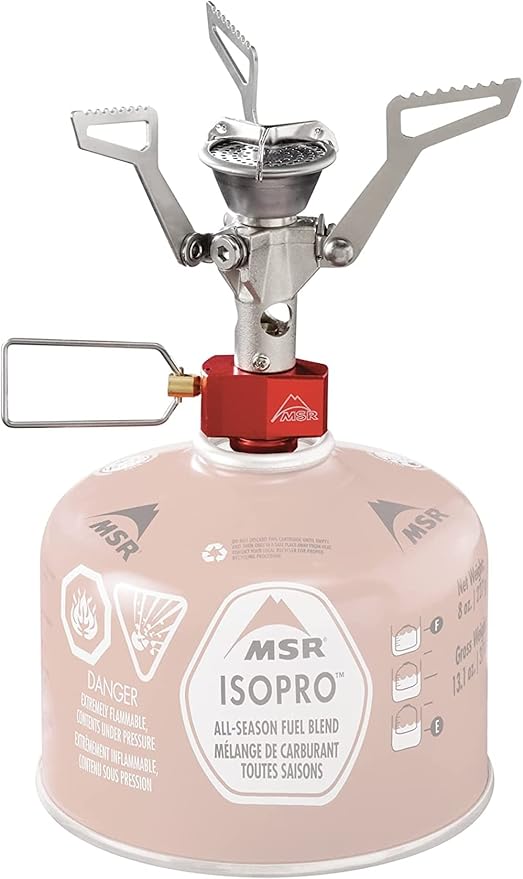
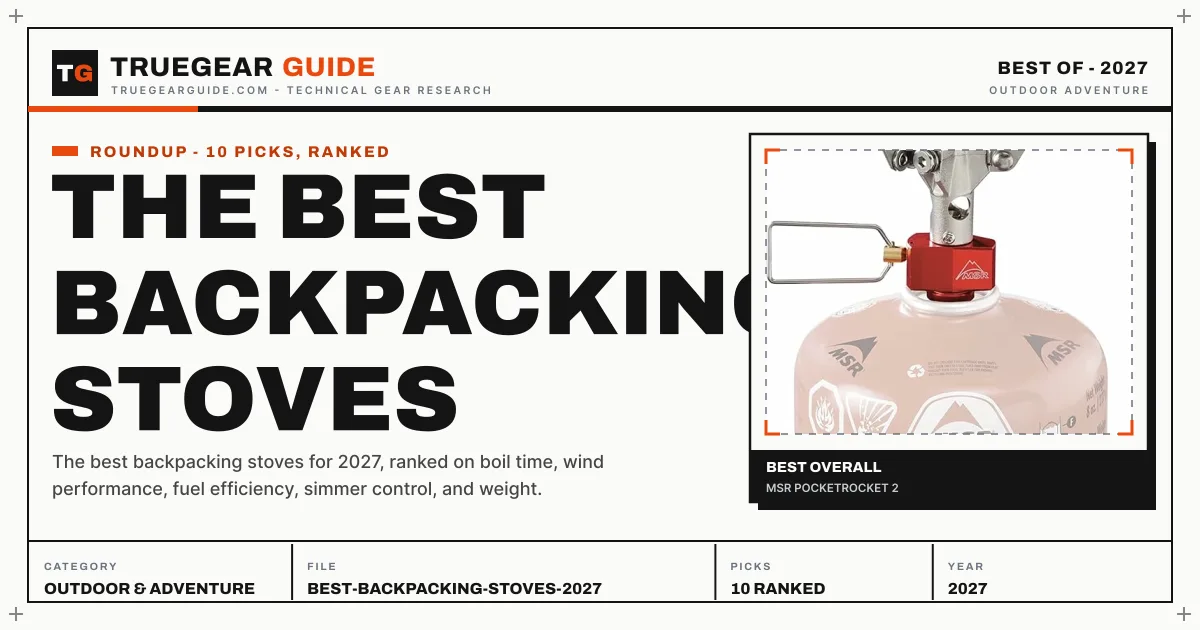
The PocketRocket 2 is the default answer for a reason: 2.6 oz, a 3.5-minute liter boil, supports that handle real pots, and a design refined over decades of trail use. It lacks an igniter and needs shelter in wind, but as a balance of weight, speed, reliability, and price, nothing here beats it for the typical backpacker.
Strengths
- Boils a liter in about 3.5 minutes
- Folds to fit inside most cook pots
- Folding pot supports handle larger pots stably
- Decades of refinement behind the PocketRocket name
Limitations
- No built-in igniter
- Wind hurts efficiency without shelter
- Simmer control is adequate, not gourmet
| Weight | 2.6 oz (73 g) |
|---|---|
| Boil time (1 L) | 3.5 min |
| Fuel | Isobutane-propane canister |
| Packed size | 2 x 2 x 3 in |
| Ignition | Manual (lighter/match) |
Best for: Most backpackers who want a proven, packable canister stove.
Skip if: You cook in high wind without a natural windbreak; it has no windscreen solution.
Fastest boils
Jetboil Flash
The fastest integrated system: a liter boiled in about 100 seconds.

One hundred seconds to a rolling liter is still astonishing, and the Flash's integrated FluxRing pot makes that speed repeatable in real weather. For hikers whose menu is coffee, oatmeal, and freeze-dried dinners, no system is faster or simpler. Just do not ask it to simmer a sauce.
Strengths
- FluxRing pot boils 1 L in roughly 100 seconds
- Integrated system shields the burner from wind
- Push-button igniter is reliable and glove-friendly
- Color-change heat indicator prevents wasted fuel
Limitations
- Poor simmer control for actual cooking
- System weight exceeds stove-plus-pot ultralight setups
- Proprietary pot locks you into the Jetboil ecosystem
| Weight (system) | 13.1 oz (371 g) |
|---|---|
| Boil time (1 L) | 1 min 40 sec |
| Pot capacity | 1 L FluxRing |
| Fuel | Isobutane-propane canister |
| Ignition | Push-button piezo |
Best for: Hikers who live on dehydrated meals and want boiling water fastest.
Skip if: You cook real meals; the Flash is a boiler, not a chef's stove.
Best in wind
Soto WindMaster
A concave burner head that shrugs off wind like integrated systems.

The WindMaster's concave burner head and rim-clearing pot distance deliver integrated-system wind performance from a 3 oz separate stove, with genuine simmer control and an igniter that works. Alpine and coastal hikers who cook real food should start here.
Strengths
- Concave burner and close pot placement resist wind dramatically
- Boils fast and simmers genuinely well
- Built-in igniter that actually works at altitude
- Interchangeable 3-flex and 4-flex pot supports
Limitations
- Costs more than simpler canister stoves
- 4-flex support is a separate purchase on some bundles
- Small support arms need care with big pots
| Weight (with 4-flex) | 3.0 oz (86 g) |
|---|---|
| Boil time (1 L) | About 3 min sheltered |
| Fuel | Isobutane-propane canister |
| Output | 11,000 BTU/hr |
| Ignition | Built-in piezo (Micro Regulator) |
Best for: Backpackers in windy country who want a separate stove's versatility.
Skip if: You need the absolute lightest; the BRS-3000T beats it on grams.
Best for mountaineering
MSR WindBurner
A radiant-burner system that wind simply cannot blow out.

The WindBurner's enclosed radiant burner cannot be blown out, and its pressure regulator holds output as canisters chill and empty. In the conditions where a failed boil means a failed summit bid, this is the dependable system, and its real-world wind boils humiliate faster-on-paper rivals.
Strengths
- Enclosed radiant burner is effectively windproof
- Pressure regulator keeps output steady in cold and as fuel drops
- Integrated pot with cozy and lid drinking ports
- Faster real-world boils in wind than any exposed burner
Limitations
- System weight and bulk exceed ultralight setups
- Limited simmer finesse
- Premium price
| Weight (1.0 L system) | 15.3 oz (434 g) |
|---|---|
| Boil time (1 L) | 4.5 min (sheltered rating; excels in wind) |
| Pot capacity | 1.0 L (1.8 L available) |
| Fuel | Isobutane-propane canister |
| Ignition | Manual |
Best for: Mountaineers and windy-climate hikers who need guaranteed boils.
Skip if: You want to simmer sauces; this system boils brilliantly and cooks modestly.
Best for cooking
Jetboil MiniMo
Jetboil speed with actual simmer control and a bowl-shaped pot.

The MiniMo fixes the Jetboil formula's one flaw: a precision valve that simmers, in a short wide pot you can eat from. Solo hikers who cook rice, sauces, and real one-pot meals get system speed without giving up being a cook.
Strengths
- Fine valve control simmers sauces without scorching
- Short, wide 1 L pot works as a bowl and mug
- FluxRing efficiency with push-button ignition
- Metal handles you can actually hold with food in the pot
Limitations
- Heavier than the Flash system
- Still less versatile than a stove plus separate cookware
- Premium price
| Weight (system) | 14.6 oz (415 g) |
|---|---|
| Boil time (0.5 L) | 2 min 15 sec |
| Pot capacity | 1 L, short and wide |
| Fuel | Isobutane-propane canister |
| Ignition | Push-button piezo |
Best for: Solo hikers who cook real one-pot meals, not just boil-and-bag.
Skip if: You only rehydrate meals; the cheaper Flash boils just as fast.
Best ultralight
BRS 3000T
The 25-gram stove that ultralighters buy by the handful.

Twenty-five grams. The BRS-3000T boils water for one at a weight and price so low that many hikers carry it as a spare. In sheltered camps with a small pot it performs honestly; ask more of it, in wind or with a family pot, and you are outside its design brief.
Strengths
- At 25 g it is the lightest stove in this guide by far
- Costs less than a freeze-dried meal
- Surprisingly durable titanium and aluminum build
- A favorite backup stove for group trips
Limitations
- No wind resistance; efficiency craters in a breeze
- Tiny pot supports demand care with larger pots
- No igniter and modest simmer control
| Weight | 0.9 oz (25 g) |
|---|---|
| Boil time (1 L) | About 4 min sheltered |
| Fuel | Isobutane-propane canister |
| Material | Titanium alloy and aluminum |
| Ignition | Manual |
Best for: Gram-counters boiling water for one in fair conditions.
Skip if: You use wide pots or cook in wind; the tiny supports and bare burner struggle.
Best flame control
Snow Peak GigaPower 2.0
Japanese-built burner with the smoothest valve in the class.
The GigaPower 2.0's valve is the smoothest in the class, metering from simmer to boil with a precision that makes actual cooking pleasant. Snow Peak's machining quality shows in every fold and thread. Refinement is the product here, and cooks will feel it nightly.
Strengths
- Exceptionally smooth valve for real simmer control
- Compact fold with stable four-arm supports
- Snow Peak build quality is a genuine step up
- Works beautifully with Snow Peak's pot systems
Limitations
- Manual ignition on the standard model
- Wind performance is average for the class
- Costs more than the PocketRocket 2
| Weight | 3.25 oz (92 g) |
|---|---|
| Boil time (1 L) | About 4 min |
| Fuel | Isobutane-propane canister (GP fuel) |
| Output | 8,500 BTU/hr |
| Ignition | Manual (auto version available) |
Best for: Hikers who value refined flame control and compact reliability.
Skip if: You want an igniter; the manual version keeps weight and cost down deliberately.
Best for groups and snow
MSR Reactor 1.7L
The expedition system that melts snow and boils faster than anything in wind.
The Reactor 1.7L is the expedition benchmark: the fastest wind-proof boils and snow-melting in the business, with a pot sized for two or more. It is overkill for a summer solo trip and exactly right for a winter team, which is the definition of a specialist's tool.
Strengths
- Radiant burner plus heat exchanger is the wind benchmark
- 1.7 L pot serves two and melts snow efficiently
- Pressure-regulated for consistent output in cold and altitude
- The mountaineering standard for over a decade
Limitations
- Heavy and expensive for casual backpacking
- Boil-only personality; no real simmering
- Large packed size
| Weight (system) | 1 lb 5 oz (581 g) |
|---|---|
| Boil time (1 L) | 3 min (sheltered) |
| Pot capacity | 1.7 L |
| Fuel | Isobutane-propane canister |
| Ignition | Manual |
Best for: Mountaineers and groups melting snow and boiling for two or more.
Skip if: You hike solo in summer; this is heavy artillery for a simple job.
Best budget system
Fire-Maple Fixed Star X2
An integrated heat-exchanger system at half the big-brand price.

The Fixed Star X2 delivers the integrated-system experience, heat-exchanger pot, windscreening, piezo ignition, at roughly half the premium systems' price. It weighs more and support is thinner, but for budget hikers who boil, it is the smartest money in this guide.
Strengths
- Heat-exchanger pot boils fast and sips fuel
- Integrated windscreen design works in real weather
- Piezo ignition included at a budget price
- Pot doubles as bowl with insulated cozy
Limitations
- Heavier than premium integrated systems
- Long-term parts support is thinner than MSR or Jetboil
- Simmer control is basic
| Weight (system) | 1 lb 2 oz (about 510 g) |
|---|---|
| Boil time (1 L) | About 3.5 min |
| Pot capacity | 1 L |
| Fuel | Isobutane-propane canister |
| Ignition | Piezo |
Best for: Budget hikers who want Jetboil-style speed without Jetboil pricing.
Skip if: You want the lightest system; budget integration costs ounces.
Best budget stove
Soto Amicus
Soto engineering at an entry price, with a stealth igniter.

The Amicus brings Soto's burner engineering and a protected built-in igniter to an entry price, with four stable supports and simmer control that embarrasses pricier rivals. For a first stove or a value upgrade, it is the separate-stove bargain to beat.
Strengths
- Concave burner offers better wind behavior than flat rivals
- Built-in stealth igniter is protected inside the burner post
- Four folding supports handle real pots stably
- Excellent simmer for the price class
Limitations
- Heavier than the PocketRocket 2
- Wind resistance is good, not WindMaster-class
- Igniter-equipped version is the one to buy; base version lacks it
| Weight (with igniter) | 2.9 oz (81 g) |
|---|---|
| Boil time (1 L) | About 3.5 to 4 min |
| Fuel | Isobutane-propane canister |
| Output | About 9,900 BTU/hr |
| Ignition | Built-in piezo (igniter model) |
Best for: Value seekers who want Japanese burner quality without WindMaster pricing.
Skip if: You cook in serious wind; the WindMaster's burner head is worth the upgrade there.
How we chose
Real-world boil performance
Sheltered lab boil times were discounted in favor of burner designs that keep their speed in wind, because trail cooking rarely happens in still air.
Fuel efficiency counts
Heat exchangers, regulators, and wind design decide how many boils a canister delivers; efficiency was scored alongside raw speed so nobody carries extra fuel needlessly.
Cooking honesty
Every pick is labeled boil-only or simmer-capable based on its valve and burner design, so meal-preppers are not sold a water boiler.
System weight, not stove weight
Integrated systems were compared at full system weight against stove-plus-pot combinations, keeping the weight math honest across formats.
Questions, answered
How much fuel do I need per day?
For boil-only cooking, roughly 15 to 25 grams of canister fuel per person per day in three-season conditions, more in wind and cold. A 100 g canister typically gives a solo hiker 4 to 6 days of two-boil days; efficient systems like the Flash stretch it further.
Can I use a windscreen with a canister stove?
Never fully enclose a canister-top stove with a windscreen; trapped heat can overheat the canister dangerously. Use natural shelter, your body, or a partial screen that leaves the canister ventilated. Integrated systems and the WindMaster exist precisely to solve this safely.
Why does my stove struggle in the cold?
Canister pressure drops as the fuel chills, and evaporative cooling makes it worse during use. Sleep with the canister in your bag, set it in lukewarm water while cooking, and choose pressure-regulated stoves like the WindBurner for winter.
Stove system or separate stove and pot?
Systems win on speed, wind, and fuel efficiency for boiling. Separate stoves win on versatility: any pot, real cooking, group sizes. Your menu decides: rehydrated meals point to systems, fresh cooking to separate stoves.