Buying guide
Backpacking Stoves Buying Guide (2027)
How to choose a backpacking stove in 2027: stove formats, boil times, wind design, fuel math, and simmer versus boil-only explained.
Format first: separate stove or integrated system
Separate canister stoves (PocketRocket 2, WindMaster) pair with any pot, cook real food, and weigh least. Integrated systems (Flash, WindBurner, Reactor) lock burner and heat-exchanger pot together for speed, wind resistance, and fuel efficiency, at the cost of versatility. Decide by menu: rehydrated meals reward systems; fresh cooking rewards separate stoves.
Boil time and the wind asterisk
Manufacturer boil times are measured sheltered, and wind can double them for exposed burners. Judge stoves by burner design: concave heads, enclosed radiant burners, and heat-exchanger pots protect real-world performance. A stove that boils in 3 minutes in the lab and 9 on a ridge is a 9-minute stove. Match the design to where you actually camp.
Fuel math
Canister fuel is isobutane-propane in 100 g and 230 g sizes. Budget 15 to 25 g per person per day for boil-only three-season cooking, doubling the estimate for winter snow-melting. Efficient systems stretch canisters meaningfully further. Weigh canisters before trips (a full 100 g canister weighs about 200 g total) so you never guess your fuel state at the trailhead.
Simmer, ignition, and regulation
Simmer control lives in the valve and burner spread; Soto and the MiniMo prove small stoves can cook gently. Piezo igniters are convenient and mortal, so carry a mini lighter regardless. Pressure regulators, found on the WindMaster and WindBurner, keep output steady as canisters chill and empty, a genuine performance feature for cold and altitude rather than a spec-sheet extra.
Start with our top 3
The three highest-ranked products in our full backpacking stoves ranking. Read the in-depth review where one exists, or jump to the product in the ranked list.
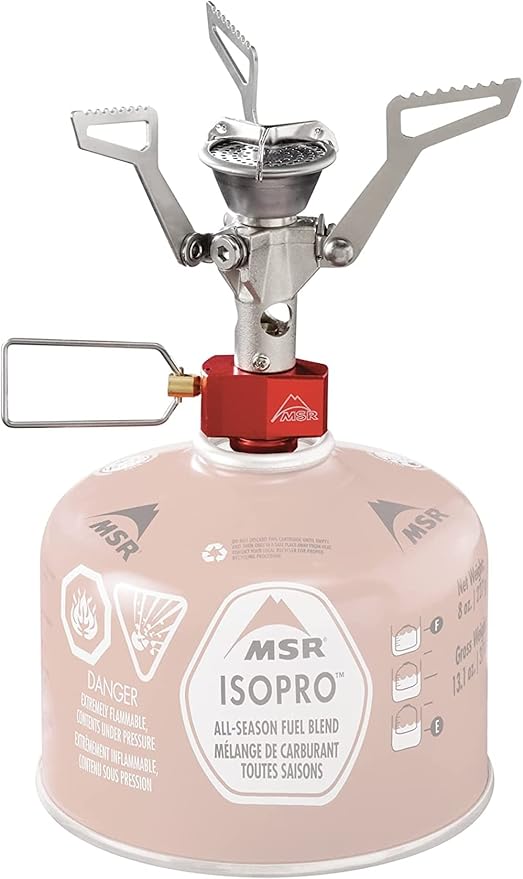
MSR PocketRocket 2
The benchmark mini canister stove: fast, tiny, dependable.
- Weight: 2.6 oz (73 g)
- Boil time (1 L): 3.5 min

Jetboil Flash
The fastest integrated system: a liter boiled in about 100 seconds.
- Weight (system): 13.1 oz (371 g)
- Boil time (1 L): 1 min 40 sec

Soto WindMaster
A concave burner head that shrugs off wind like integrated systems.
- Weight (with 4-flex): 3.0 oz (86 g)
- Boil time (1 L): About 3 min sheltered
Questions, answered
Can I fly with a backpacking stove?
The stove itself, yes, in checked baggage, cleaned and aired. Fuel canisters, never; buy them at your destination. This logistics point matters for international treks.
What about alcohol and liquid-fuel stoves?
Alcohol stoves are ultralight and simple but slow and often restricted during fire bans. Liquid-fuel stoves excel for international fuel availability and extreme cold. Canister stoves remain the best default for most backpackers in 2027.
How many people can one stove serve?
A 1 L system serves two boil-only eaters comfortably. Groups of three or more should carry two stoves for redundancy and speed; a single failure should never end a group's cooking.
Are canister stoves allowed during fire bans?
Usually yes, because they have a shutoff valve, while alcohol stoves and twig stoves are typically banned. Always check the local order; rules vary by agency and season.