Head to head
Nikon Z6 III vs Sony A7 IV (2027)
Nikon Z6 III vs Sony A7 IV compared for 2027: partially stacked speed and 6K video against 33MP versatility and the E-mount ecosystem.
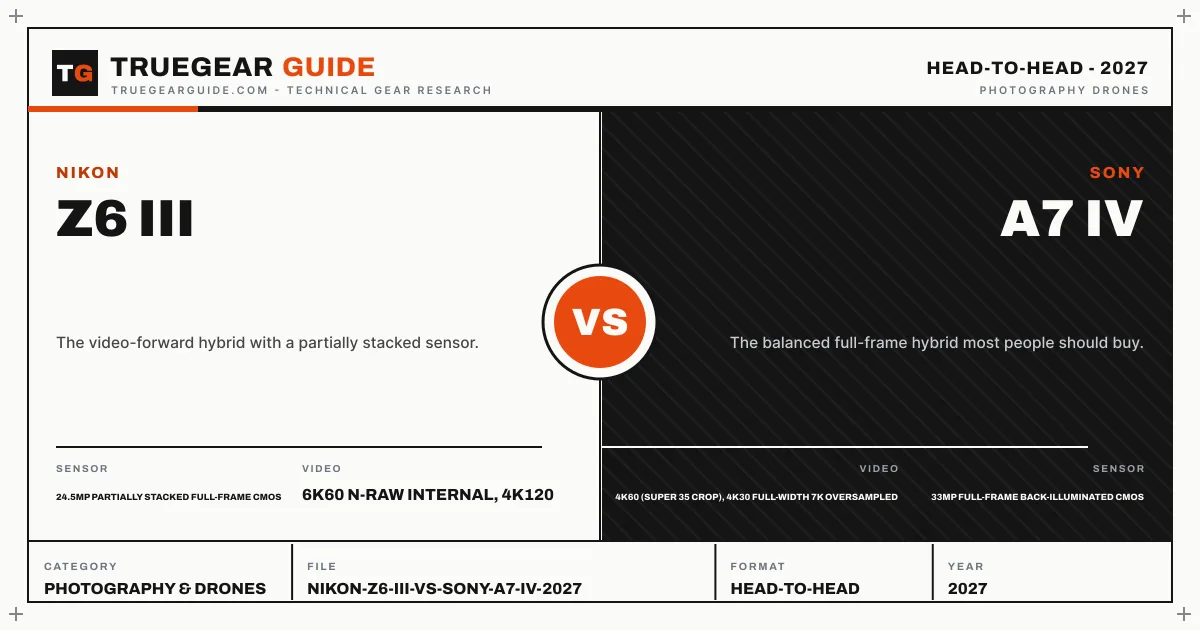

Nikon Z6 III
The video-forward hybrid with a partially stacked sensor.
- Sensor: 24.5MP partially stacked full-frame CMOS
- Video: 6K60 N-RAW internal, 4K120

Sony A7 IV
The balanced full-frame hybrid most people should buy.
- Sensor: 33MP full-frame back-illuminated CMOS
- Video: 4K60 (Super 35 crop), 4K30 full-width 7K oversampled
Our recommendation
Buy the Nikon Z6 III if video is half your work or more: 6K60 N-RAW and 4K120 are in a different league. Buy the Sony A7 IV if stills lead and you want more resolution plus the deepest lens catalog. This is a video-first versus stills-first decision.
Sensor philosophy
Nikon chose speed: a partially stacked 24.5MP sensor with fast readout that enables 6K video and 20 fps stills. Sony chose resolution: 33MP with conventional readout, trading burst and video ceiling for cropping latitude. Neither is objectively better; they optimize opposite ends.
Video capabilities
The Z6 III records 6K60 N-RAW internally and 4K120, specs the A7 IV cannot approach. The A7 IV counters with 10-bit 4:2:2 4K that satisfies most YouTube and client workflows at far smaller file sizes. Serious video producers should go Nikon; everyone else should weigh whether they will ever grade RAW.
Viewfinder and ecosystem
Nikon's 5.76M-dot EVF is visibly sharper than Sony's 3.69M-dot panel, a real advantage for manual focus. Sony's E-mount catalog is far deeper, especially in affordable third-party autofocus lenses, which lowers the total cost of building a system.
Choose Nikon Z6 III if…
- Video is half or more of your shooting
- You want 4K120 slow motion or 6K reframing latitude
- You value the sharpest EVF for manual focus work
Choose Sony A7 IV if…
- Stills lead and you want 33MP cropping headroom
- You want the widest, most affordable lens selection
- You prefer smaller video files over RAW workflows
Questions, answered
Is N-RAW practical for a solo creator?
Rarely. N-RAW files demand fast CFexpress cards, terabytes of storage, and serious grading time. Solo creators are usually better served by the Z6 III's 10-bit H.265 modes, which grade well at manageable sizes.
Which system costs less to build out?
Sony, typically by a wide margin. Third-party E-mount lenses from Tamron and Sigma deliver 90 percent of first-party performance at half the cost, an option Nikon Z largely lacks for autofocus glass.
Does the Z6 III overheat in video?
Far less than older Nikon hybrids, thanks to the stacked sensor's efficiency. For continuous 6K recording in heat, still plan shade and airflow like any mirrorless body; no camera is immune to physics.