Best of
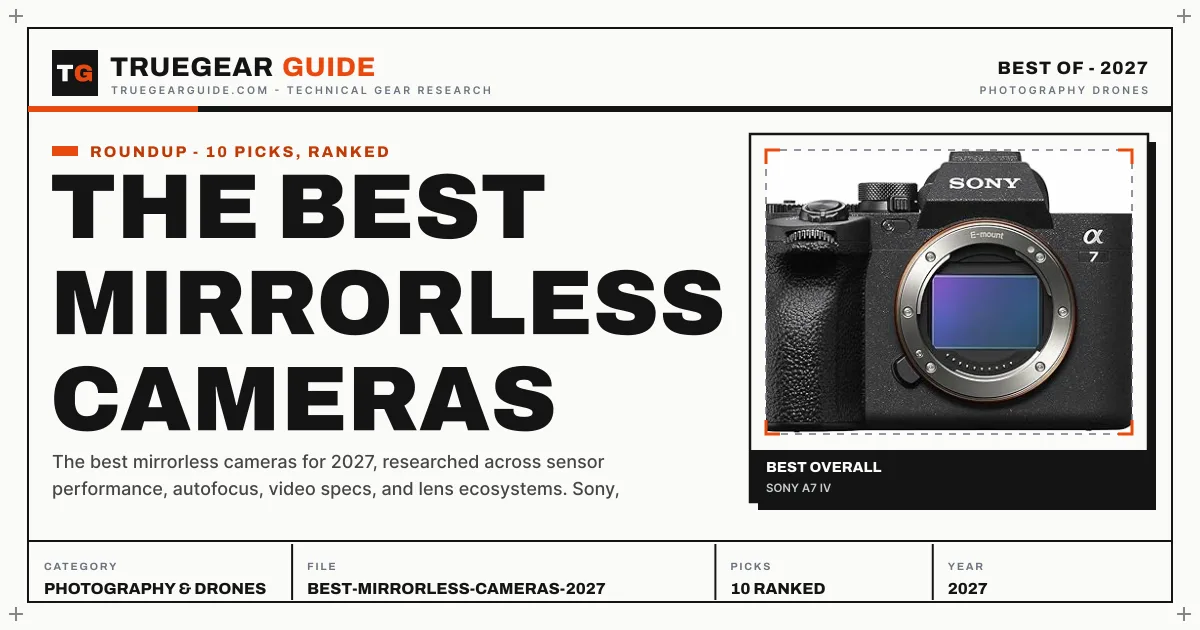
The Best Mirrorless Cameras (2027)
The best mirrorless cameras for 2027, researched across sensor performance, autofocus, video specs, and lens ecosystems. Sony, Canon, Nikon, and Fujifilm picks.
The short answer
The Sony A7 IV is the best mirrorless camera for most people in 2027: a 33MP full-frame sensor, 4K60 video, and the deepest lens ecosystem. Action shooters should get the Canon EOS R6 Mark II for its 40 fps bursts, video-first hybrids the Nikon Z6 III for 6K60 N-RAW, and travelers the Fujifilm X-T5 for 40MP resolution in a compact APS-C kit.
Our top picks at a glance
- Sony A7 IVThe balanced full-frame hybrid most people should buy.Best overall
- Canon EOS R6 Mark IISpeed-first full-frame body with superb autofocus.Best for sports and wildlife
- Nikon Z6 IIIThe video-forward hybrid with a partially stacked sensor.Best for video
- Fujifilm X-T5High-resolution APS-C body with classic dials.Best APS-C option
- Canon EOS R8Full-frame image quality in the lightest body Canon makes.Best budget full-frame
What owners report
Synthesized from recurring themes in long-term owner feedback.
Most praised
- Subject detection autofocus that locks onto eyes, animals and vehicles has changed hit rates for moving subjects across this whole class
- In body stabilization on most of these bodies makes older and adapted lenses newly usable handheld
- Hybrid video specs such as oversampled 4K and log profiles let one body cover stills work and serious filming
- Smaller APS-C and Micro Four Thirds systems in this lineup prove a capable kit can still travel light
- Mature lens mounts give owners native, third party and adapted options at nearly every focal length
Common complaints
- Full frame lenses, not bodies, end up deciding the real size and cost of a mirrorless kit
- Rolling shutter still shows up on electronic shutter bursts with fast pans and flickering venue lights
- Several bodies here trade a second card slot, IBIS or battery size away to hit their price or weight
- Menu systems across brands remain dense enough that customizing buttons becomes homework for new owners
- Video headline modes often carry crops, record limits or card demands that only appear in the fine print
The picks, ranked
| # | Product | Award | Sensor | Video | Continuous shooting | Stabilization | Card slots |
|---|---|---|---|---|---|---|---|
| 1 | Sony A7 IV | Best overall | 33MP full-frame back-illuminated CMOS | 4K60 (Super 35 crop), 4K30 full-width 7K oversampled | 10 fps with AF/AE tracking | 5.5-stop in-body image stabilization | 1x CFexpress Type A / SD, 1x SD UHS-II |
| 2 | Canon EOS R6 Mark II | Best for sports and wildlife | 24.2MP full-frame CMOS | 4K60 uncropped, oversampled from 6K | 40 fps electronic, 12 fps mechanical | 8-stop in-body image stabilization | - |
| 3 | Nikon Z6 III | Best for video | 24.5MP partially stacked full-frame CMOS | 6K60 N-RAW internal, 4K120 | 20 fps with full AF/AE | 8-stop in-body image stabilization | - |
| 4 | Fujifilm X-T5 | Best APS-C option | 40.2MP APS-C X-Trans 5 HR CMOS | 6.2K30, 4K60 | 15 fps mechanical shutter | 7-stop in-body image stabilization | - |
| 5 | Canon EOS R8 | Best budget full-frame | 24.2MP full-frame CMOS | 4K60 with crop, Full HD 180p | 40 fps electronic shutter | Lens-based only, no IBIS | - |
| 6 | Nikon Z50 II | Best for beginners | 20.9MP APS-C CMOS | 4K30, 1080p120 | 11 fps mechanical shutter | - | - |
| 7 | Sony A6700 | Best compact hybrid | 26MP APS-C back-illuminated CMOS | 4K120, 4K60 from 6K oversampling | 11 fps mechanical shutter | 5-axis IBIS, 5 stops | - |
| 8 | Panasonic Lumix S5 II | Best video value | 24.2MP full-frame CMOS | 6K30 open gate, 4K120 | - | 5-axis IBIS with Dual I.S. 2 | - |
| 9 | Fujifilm X100VI | Best fixed-lens camera | 40.2MP APS-C X-Trans 5 HR CMOS | 6.2K30, 4K60 | - | 6-stop in-body image stabilization | - |
| 10 | OM System OM-1 Mark II | Best for wildlife reach | 20.4MP Micro Four Thirds stacked BSI | 4K60, 1080p240 | 120 fps electronic, 50 fps with AF | 8.5-stop in-body image stabilization | - |
Best overall
Sony A7 IV
The balanced full-frame hybrid most people should buy.

The A7 IV remains the safest full-frame recommendation because it has no serious weakness: a 33MP sensor with real cropping latitude, 4K60 video, 10 fps bursts, and access to the deepest lens catalog in mirrorless. Rivals beat it in individual disciplines, but none match the total package at this level.
Strengths
- 33MP sensor gives useful cropping headroom over 24MP rivals
- Strong hybrid spec sheet: 4K60 video plus 10 fps stills
- Sony E-mount has the deepest native and third-party lens catalog
- Fully articulating touchscreen suits both vlogging and low-angle stills
Limitations
- 4K60 carries a Super 35 crop, unlike some rivals
- 10 fps burst lags behind 20 to 40 fps competitors
- Menu system is deep and takes time to learn
| Sensor | 33MP full-frame back-illuminated CMOS |
|---|---|
| Video | 4K60 (Super 35 crop), 4K30 full-width 7K oversampled |
| Continuous shooting | 10 fps with AF/AE tracking |
| Stabilization | 5.5-stop in-body image stabilization |
| Card slots | 1x CFexpress Type A / SD, 1x SD UHS-II |
Best for: Photographers who split time evenly between stills and video and want one body that does both well.
Skip if: You need the fastest burst rates for sports, or you want the smallest possible kit.
Best for sports and wildlife
Canon EOS R6 Mark II
Speed-first full-frame body with superb autofocus.

When the subject moves fast, burst rate and autofocus decide the shot. The R6 II offers 40 fps electronic shooting with subject detection that locks onto people, animals, and vehicles, plus 8-stop stabilization for long lenses. The 24.2MP sensor is the trade-off, and it is worth it for action.
Strengths
- 40 fps electronic shutter freezes fast action
- Deep-learning subject detection covers people, animals, and vehicles
- 8-stop IBIS is among the best in class
- Uncropped 4K60 oversampled from 6K looks clean
Limitations
- 24.2MP resolution limits cropping compared to 33MP rivals
- Electronic shutter can show rolling shutter with very fast subjects
- RF lens lineup is strong but third-party autofocus options are limited
| Sensor | 24.2MP full-frame CMOS |
|---|---|
| Video | 4K60 uncropped, oversampled from 6K |
| Continuous shooting | 40 fps electronic, 12 fps mechanical |
| Stabilization | 8-stop in-body image stabilization |
| Viewfinder | 3.69M-dot OLED electronic viewfinder |
Best for: Sports, wildlife, and event shooters who need fast bursts and reliable subject tracking.
Skip if: You want maximum resolution for large prints or heavy cropping.
Best for video
Nikon Z6 III
The video-forward hybrid with a partially stacked sensor.

The partially stacked sensor is the differentiator: fast readout for 6K60 N-RAW internal recording and 4K120 slow motion without the rolling-shutter penalties of older sensors. If video is half your work or more, this is the hybrid to buy.
Strengths
- Partially stacked sensor enables fast readout with less rolling shutter
- 6K60 N-RAW internal recording suits serious video workflows
- 4K120 gives real slow-motion options
- 5.76M-dot EVF is the sharpest in this class
Limitations
- 24.5MP stills resolution trails higher-resolution rivals
- N-RAW workflow demands fast cards and storage
- Z-mount third-party lens support is narrower than E-mount
| Sensor | 24.5MP partially stacked full-frame CMOS |
|---|---|
| Video | 6K60 N-RAW internal, 4K120 |
| Continuous shooting | 20 fps with full AF/AE |
| Stabilization | 8-stop in-body image stabilization |
| Viewfinder | 5.76M-dot OLED electronic viewfinder |
Best for: Hybrid shooters who prioritize video codecs and high-frame-rate 4K.
Skip if: You want the largest native lens catalog, or you shoot mostly stills.
Best APS-C option
Fujifilm X-T5
High-resolution APS-C body with classic dials.

The X-T5 proves you do not need full-frame for detail: its 40.2MP APS-C sensor out-resolves every full-frame camera here, and X-mount lenses keep kits genuinely portable. It is the pick for travel and street photography where size matters as much as pixels.
Strengths
- 40.2MP APS-C sensor out-resolves every full-frame rival here
- Smaller X-mount lenses make genuinely compact kits
- Dedicated exposure dials suit photographers who hate menus
- Film Simulation modes produce finished JPEGs in camera
Limitations
- APS-C sensor gives up about a stop of low-light performance to full-frame
- 15 fps mechanical burst is modest next to stacked-sensor rivals
- Video autofocus tracking lags Sony and Canon slightly
| Sensor | 40.2MP APS-C X-Trans 5 HR CMOS |
|---|---|
| Video | 6.2K30, 4K60 |
| Continuous shooting | 15 fps mechanical shutter |
| Stabilization | 7-stop in-body image stabilization |
| Viewfinder | 3.69M-dot OLED electronic viewfinder |
Best for: Travel and street photographers who want resolution and small lenses.
Skip if: You need full-frame low-light performance or the deepest video codec options.
Best budget full-frame
Canon EOS R8
Full-frame image quality in the lightest body Canon makes.

The R8 puts a 24.2MP full-frame sensor and 4K60 video in a 461-gram body for the lowest full-frame entry cost here. You give up in-body stabilization and a second card slot, but for stills-first buyers the image quality per dollar is unmatched.
Strengths
- 24.2MP full-frame sensor shared with the far costlier R6 II
- 4K60 video with 10-bit Canon Log 3 for flexible grading
- 461-gram body is the lightest full-frame Canon mirrorless
- Subject detection covers people, animals, and vehicles
Limitations
- No in-body image stabilization, so unstabilized lenses show shake
- Single UHS-II card slot limits backup options
- Small LP-E17 battery drains fast during 4K recording
| Sensor | 24.2MP full-frame CMOS |
|---|---|
| Video | 4K60 with crop, Full HD 180p |
| Continuous shooting | 40 fps electronic shutter |
| Stabilization | Lens-based only, no IBIS |
| Weight | 461 g with battery and card |
Best for: Buyers who want full-frame image quality at the lowest entry cost.
Skip if: You shoot long video takes; the small battery and no in-body stabilization limit it.
Best for beginners
Nikon Z50 II
The friendliest on-ramp to the Z system.

The Z50 II pairs guided shooting modes with subject-detection autofocus borrowed from Nikon's flagship bodies, so beginners get keepers while they learn. The 20.9MP sensor is modest, but the Z-mount leaves real room to grow.
Strengths
- 20.9MP APS-C sensor with EXPEED 7 processing
- Subject detection autofocus inherited from pricier Z bodies
- Bright, detailed electronic viewfinder for the class
- Access to the full Z-mount lens lineup as skills grow
Limitations
- No in-body image stabilization
- Single card slot
- 20.9MP resolution trails newer APS-C rivals
| Sensor | 20.9MP APS-C CMOS |
|---|---|
| Video | 4K30, 1080p120 |
| Continuous shooting | 11 fps mechanical shutter |
| Viewfinder | 2.36M-dot OLED electronic viewfinder |
| Mount | Nikon Z |
Best for: First-time interchangeable-lens buyers who want guided controls and room to grow.
Skip if: You need in-body stabilization or plan heavy video work.
Best compact hybrid
Sony A6700
Flagship autofocus and video in a travel-size body.

With AI subject recognition, 4K120 slow motion, and 5-stop stabilization in a 493-gram body, the A6700 is the travel-friendly alternative to full-frame hybrids. Wildlife and video shooters gain reach and portability; they lose about a stop of low-light performance.
Strengths
- AI-based subject recognition tracks people, animals, birds, and insects
- 26MP back-illuminated APS-C sensor with wide dynamic range
- 4K120 slow motion from 6K oversampling
- 5-axis in-body stabilization rated to 5 stops
Limitations
- APS-C sensor cannot match full-frame low-light performance
- Single UHS-II slot, no CFexpress option
- Menu system remains dense for newcomers
| Sensor | 26MP APS-C back-illuminated CMOS |
|---|---|
| Video | 4K120, 4K60 from 6K oversampling |
| Continuous shooting | 11 fps mechanical shutter |
| Stabilization | 5-axis IBIS, 5 stops |
| Weight | 493 g with battery and card |
Best for: Hybrid shooters who want A7-series autofocus intelligence in a compact APS-C kit.
Skip if: You need the shallow depth of field and high-ISO headroom of full-frame.
Best video value
Panasonic Lumix S5 II
The video-value king finally gets phase-detect autofocus.

6K30 open-gate recording, 779-point phase-detect autofocus, and unlimited record times make the S5 II the strongest video tool per dollar in this lineup. Stills shooters who need burst speed should look at the Sony and Canon options instead.
Strengths
- 6K30 open-gate recording gives reframing freedom in post
- Phase-detect autofocus fixes the S-series historic weakness
- Dual native ISO keeps low-light footage clean
- Unlimited recording time with active cooling
Limitations
- 14 fps mechanical burst is modest for sports
- L-mount lens catalog is smaller than E-mount or RF
- Body is bulkier than the Sony A7C line
| Sensor | 24.2MP full-frame CMOS |
|---|---|
| Video | 6K30 open gate, 4K120 |
| Autofocus | 779-point phase detection |
| Stabilization | 5-axis IBIS with Dual I.S. 2 |
| Mount | Leica L |
Best for: Video-first creators who want 6K open-gate recording without cinema-camera prices.
Skip if: You shoot fast action stills; burst rates trail Sony and Canon.
Best fixed-lens camera
Fujifilm X100VI
The fixed-lens phenomenon that sells out everywhere.

A 40.2MP sensor, 6-stop stabilization, and a sharp 23mm f/2 lens in a jacket-pocket body: the X100VI is the one-camera travel kit. The fixed lens is the entire philosophy, so zoom-dependent shooters should skip it.
Strengths
- 40.2MP X-Trans 5 sensor shared with the X-T5
- Fixed 23mm f/2 lens is sharp and discreet
- In-body stabilization, a first for the X100 line
- Film Simulation modes need no editing for social sharing
Limitations
- Fixed 23mm lens means no zoom and no lens changes
- Premium pricing for a compact camera
- Autofocus is good, not class-leading for action
| Sensor | 40.2MP APS-C X-Trans 5 HR CMOS |
|---|---|
| Lens | 23mm f/2 fixed (35mm equivalent) |
| Stabilization | 6-stop in-body image stabilization |
| Video | 6.2K30, 4K60 |
| Viewfinder | Hybrid optical and electronic |
Best for: Street and travel photographers who want a pocketable camera with film-like JPEGs.
Skip if: You need interchangeable lenses or fast telephoto reach.
Best for wildlife reach
OM System OM-1 Mark II
Computational speed and reach that full-frame cannot match for the size.

The 2x crop factor and 120 fps bursts give bird photographers 600mm-equivalent reach and blackout-free tracking in a kit half the size of full-frame. The 20.4MP Micro Four Thirds sensor is the price, paid in low light and cropping latitude.
Strengths
- Stacked sensor enables 120 fps blackout-free bursts
- 2x crop factor turns a 300mm lens into 600mm equivalent reach
- 8.5-stop stabilization, the best rating in mirrorless
- IP53 weather sealing for harsh field conditions
Limitations
- Micro Four Thirds sensor trails full-frame in low light
- 20MP resolution limits heavy cropping
- Smaller lens ecosystem than the big three mounts
| Sensor | 20.4MP Micro Four Thirds stacked BSI |
|---|---|
| Continuous shooting | 120 fps electronic, 50 fps with AF |
| Stabilization | 8.5-stop in-body image stabilization |
| Weather sealing | IP53 dust and splash proof |
| Video | 4K60, 1080p240 |
Best for: Wildlife and bird photographers who want maximum reach in the smallest kit.
Skip if: You need shallow depth of field or the best high-ISO files.
How we chose
We compared current-generation bodies from the four major mounts on sensor resolution and readout speed, continuous shooting rates, in-body stabilization ratings, video resolution and codec options, viewfinder resolution, and the breadth of each native lens catalog. Bodies were ranked by how well their strengths map to specific shooting disciplines rather than by a single score.
Questions, answered
Is full-frame still worth it over APS-C in 2027?
For low-light work and shallow depth of field, yes: a full-frame sensor collects roughly twice the light of APS-C at the same aperture. But the Fujifilm X-T5 shows the gap narrowing for daylight detail, where its 40.2MP sensor out-resolves 24MP full-frame bodies. Choose by shooting conditions, not by prestige.
How many megapixels do I actually need?
24MP is enough for prints up to about 16 by 20 inches and generous social-media crops. 33 to 45MP matters if you crop heavily, as wildlife shooters do, or print large. More megapixels also mean larger files and slower processing, so do not buy resolution you will never use.
Which mount has the best lens selection?
Sony E-mount, by a clear margin: a decade of native lenses plus full third-party autofocus support from Sigma, Tamron, and others. Canon RF and Nikon Z have excellent first-party glass but narrower third-party autofocus catalogs. Fujifilm X-mount is the best-served APS-C system.
Should I care about 8K video in a stills camera?
For most buyers, no. 4K60 with good codecs covers client work and YouTube; 6K options like the Z6 III matter mainly for reframing in post. 8K files are enormous and few delivery platforms use them. Prioritize 4K quality, codecs, and overheating behavior over headline 8K numbers.