In-depth review
Canon EOS R6 Mark II Review (2027)
In-depth research review of the Canon EOS R6 Mark II: 40 fps shooting, subject-detection autofocus, 8-stop IBIS, and 4K60 video.
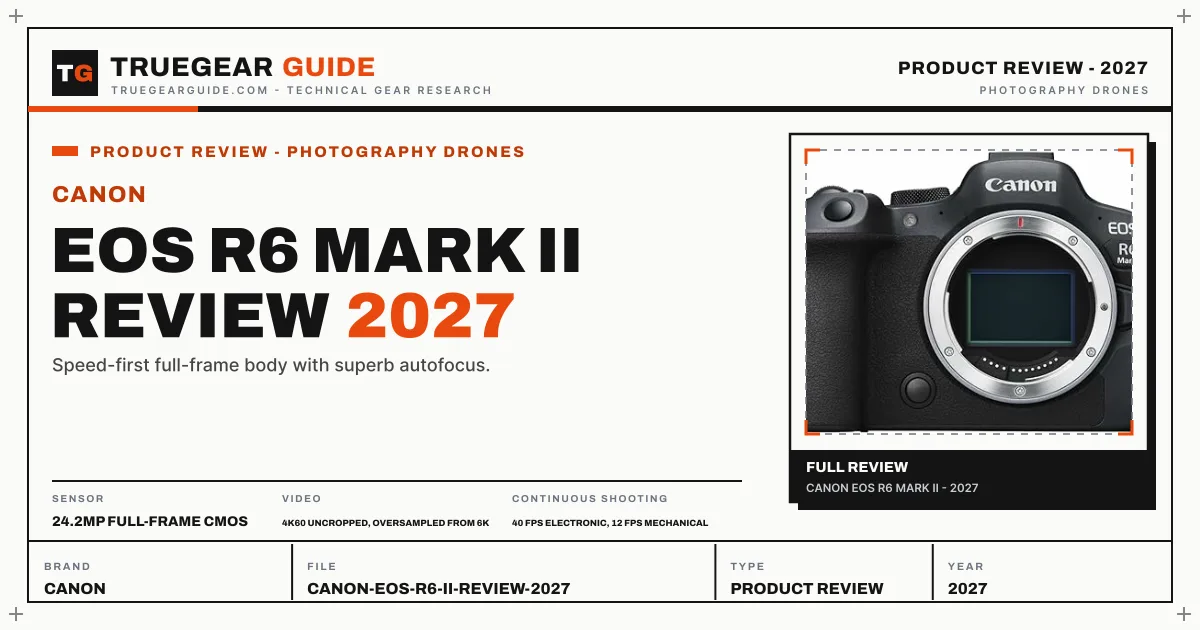

Our verdict
The R6 II is the action specialist done right: 40 fps bursts, autofocus that finds subjects before you do, and stabilization that makes long lenses handholdable. The 24.2MP sensor asks you to frame tightly rather than crop later. For sports and wildlife, that is a trade worth making.
What we like
- 40 fps electronic shutter freezes fast action
- Deep-learning subject detection covers people, animals, and vehicles
- 8-stop IBIS is among the best in class
- Uncropped 4K60 oversampled from 6K looks clean
What to watch out for
- 24.2MP resolution limits cropping compared to 33MP rivals
- Electronic shutter can show rolling shutter with very fast subjects
- RF lens lineup is strong but third-party autofocus options are limited
What owners report: Canon EOS R6 Mark II
Synthesized from recurring themes in long-term owner feedback.
Most praised
- Event shooters praise deep learning subject detection for holding faces through confetti, veils and low light
- The coordinated stabilization keeps handheld shutter speeds usable that would be motion blurred elsewhere
- Uncropped oversampled 4K60 makes it a genuine second camera for video crews
Common complaints
- Wildlife shooters cropping hard feel the resolution ceiling sooner than high megapixel rivals
- Fast electronic bursts can bend very fast subjects under rolling shutter
- Canon's tight control of third party autofocus lenses keeps some bargains off the RF mount
Who it is for
Sports, wildlife, and event photographers who measure a camera by keeper rate on moving subjects rather than by spec-sheet resolution.
Speed and autofocus
40 fps with the electronic shutter and 12 fps mechanical put this in genuine sports-camera territory. Deep-learning subject detection recognizes people, animals, horses, trains, and aircraft, and tracking sticks through erratic motion. Pre-shooting buffer modes capture frames before you fully press the shutter, saving decisive moments.
Stabilization and low light
8-stop IBIS is class-leading and transforms handholding: 200mm lenses stay sharp at shutter speeds that would demand a tripod elsewhere. The 24.2MP sensor's larger photosites deliver clean high-ISO files, which matters for indoor sports and dawn wildlife work.
Video and limitations
Uncropped 4K60 oversampled from 6K looks excellent, and Canon color needs little grading. The limits are resolution for cropping, rolling shutter in electronic-shutter bursts with very fast lateral motion, and a narrower third-party autofocus lens catalog than Sony E-mount.
Key specifications
- Sensor
- 24.2MP full-frame CMOS
- Video
- 4K60 uncropped, oversampled from 6K
- Continuous shooting
- 40 fps electronic, 12 fps mechanical
- Stabilization
- 8-stop in-body image stabilization
- Viewfinder
- 3.69M-dot OLED electronic viewfinder
Also consider

Sony A7 IV
The balanced full-frame hybrid most people should buy.
Why consider it: Choose the A7 IV for a better all-rounder: 33MP resolution and a deeper lens catalog suit mixed stills and video work.
- Sensor: 33MP full-frame back-illuminated CMOS
- Video: 4K60 (Super 35 crop), 4K30 full-width 7K oversampled

Nikon Z6 III
The video-forward hybrid with a partially stacked sensor.
Why consider it: Choose the Z6 III if video matters equally: its 6K60 and 4K120 options go beyond the R6 II's video specs.
- Sensor: 24.5MP partially stacked full-frame CMOS
- Video: 6K60 N-RAW internal, 4K120
Research-based assessment. TrueGear has not hands-on tested this product; this evaluation synthesizes manufacturer specifications, retailer documentation, and published expert reviews.
Questions, answered
Is 24.2MP enough for wildlife photography?
Yes if you frame tightly with long glass, which wildlife technique demands anyway. It becomes limiting for small distant birds where heavy cropping is unavoidable; in that niche, higher-resolution bodies earn their keep.
How bad is rolling shutter at 40 fps?
Noticeable with very fast lateral subjects like golf swings or racing cars crossing the frame. For most field sports and wildlife, subject motion is slow enough relative to readout that distortion stays minimal.
Can I use EF lenses on the R6 II?
Yes, via Canon's EF-to-RF adapters, with full autofocus performance. This makes the R6 II an economical upgrade path for photographers with existing Canon EF telephoto glass.