In-depth review
Fujifilm Instax Wide 400 Review (2027)
In-depth review of the Fujifilm Instax Wide 400: Wide film impact, self-timer dial, handling and who the big format suits.
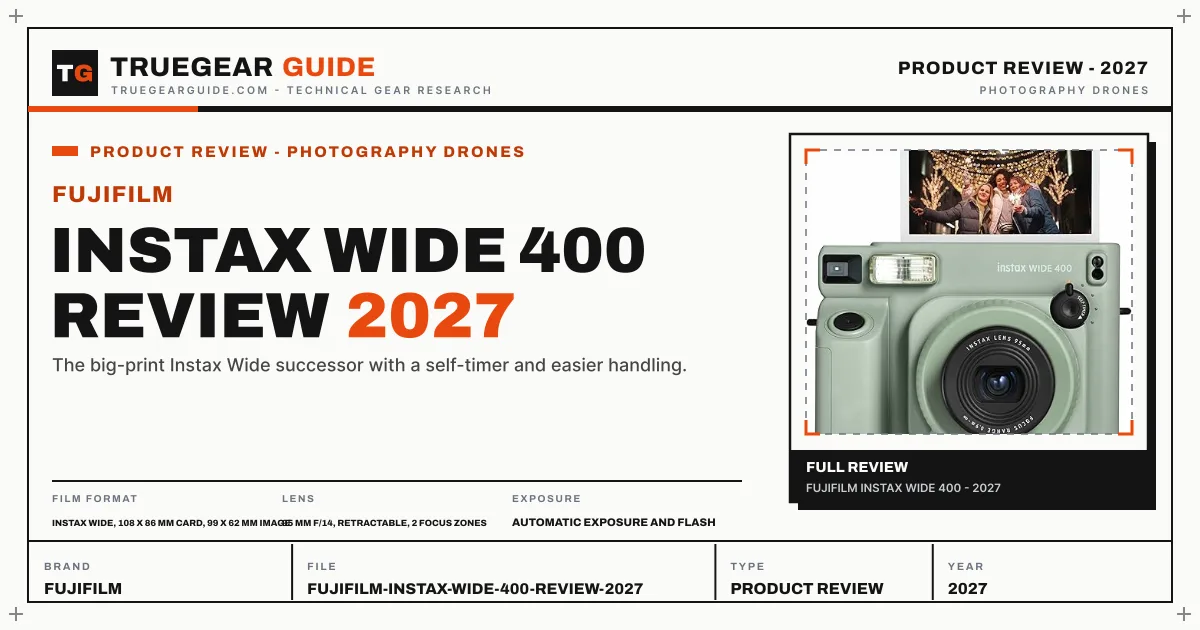

Fujifilm Instax Wide 400
The big-print Instax Wide successor with a self-timer and easier handling.
Our verdict
The Wide 400 fixes the old Wide 300's two annoyances - the fiddly timer and the tripod ritual - and keeps everything that made Wide film beloved: prints big enough to read faces across a table. It is bulky and the film is not cheap, but for events, guest books and group travel it produces the most satisfying prints of any sub-premium instant camera here.
What we like
- Instax Wide prints are double the Mini width, ideal for groups
- Self-timer dial with LED countdown is made for group self-portraits
- Two focus zones and automatic exposure keep operation simple
- Camera strap and close-up lens attachment included in the box
What to watch out for
- Bulky body needs a bag, not a jacket pocket
- Wide film costs more per shot than Mini film
- No hybrid preview, so composition errors cost a large frame
What owners report: Fujifilm Instax Wide 400
Synthesized from recurring themes in long-term owner feedback.
Most praised
- Guest book hosts praise wide prints that give a whole table of guests room on one frame
- The timer dial with its countdown lights lets the photographer actually join the group shot
- Included strap and close up attachment make the big body easier to live with at events
Common complaints
- Its bulk demands a real bag, ending any pocket carry plans
- Wide film raises the cost of every guest mistake at an event
- Composition errors sting more when the wasted frame is the big expensive format
Who it is for
Event hosts, guest-book planners and group travellers who prioritise print size and simple operation over portability.
The Wide advantage
At 99 x 62 mm the image area is roughly double a Mini print. Group portraits keep individual expressions, landscapes gain real sweep, and there is border space for captions. Once you have watched a table pass around a Wide print, Mini prints feel like postage stamps by comparison - the format, not the camera, is the headline.
Handling updates
The self-timer is now a clear rotating dial with LED indicators for 4, 6, 8 and 10 second options, and the body adds a camera angle adjustment for tabletop self-timing. Two focus zones - normal and landscape - plus automatic exposure keep guest operation simple. The included close-up lens extends the kit for detail shots.
Size and running cost
At 616 g before batteries and film, this is a bag camera, full stop. Wide film costs noticeably more per shot than Mini, so the Wide 400 rewards intention: compose groups properly rather than spraying. Four AA batteries keep event logistics simple, since spares are available anywhere.
Key specifications
- Film format
- Instax Wide, 108 x 86 mm card, 99 x 62 mm image
- Lens
- 95 mm f/14, retractable, 2 focus zones
- Exposure
- Automatic exposure and flash
- Power
- 4 x AA alkaline
- Weight
- 616 g without batteries, strap and film
Also consider

Polaroid Now+ Generation 2
The connected Polaroid with app manual controls and lens filters.
Why consider it: Slightly larger, square-ish prints with creative manual control, at higher film cost.
- Film format: Polaroid i-Type and 600, 107 x 88 mm, 79 x 79 mm image
- Lens: Autofocus 2-lens system, approx. 35 mm and 40 mm equiv.

Fujifilm Instax Square SQ1
Square-format Instax with one-touch selfie mode and auto exposure.
Why consider it: A middle path: bigger than Mini, much smaller body than the Wide 400.
- Film format: Instax Square, 86 x 72 mm card, 62 x 62 mm image
- Lens: 65.75 mm f/12.6, selfie mode 0.3 to 0.5 m
Research-based assessment. TrueGear has not hands-on tested this product; this evaluation synthesizes manufacturer specifications, retailer documentation, and published expert reviews.
Questions, answered
Is Instax Wide film being discontinued?
No. Wide remains a current Fujifilm format and the Wide 400 is its current camera. Film is stocked by major photo retailers and Amazon, though less universally than Mini.
Can the Wide 400 take selfies?
Yes. The self-timer dial plus the tabletop angle adjustment is designed exactly for group self-portraits. Frame generously, since there is no selfie mirror.
Wide 400 or Square SQ1?
Wide for groups and landscapes, Square for single subjects and social-style square composition in a far smaller body. Film cost per shot is comparable.