Best of
The Best Instant Cameras (2027)
The best instant cameras for 2027 ranked on film format, print size, exposure control and cost per shot. The best instant film cameras here span Instax, Polaroid and hybrid picks for every budget, including a good Polaroid camera pick for creative shooters.
The short answer
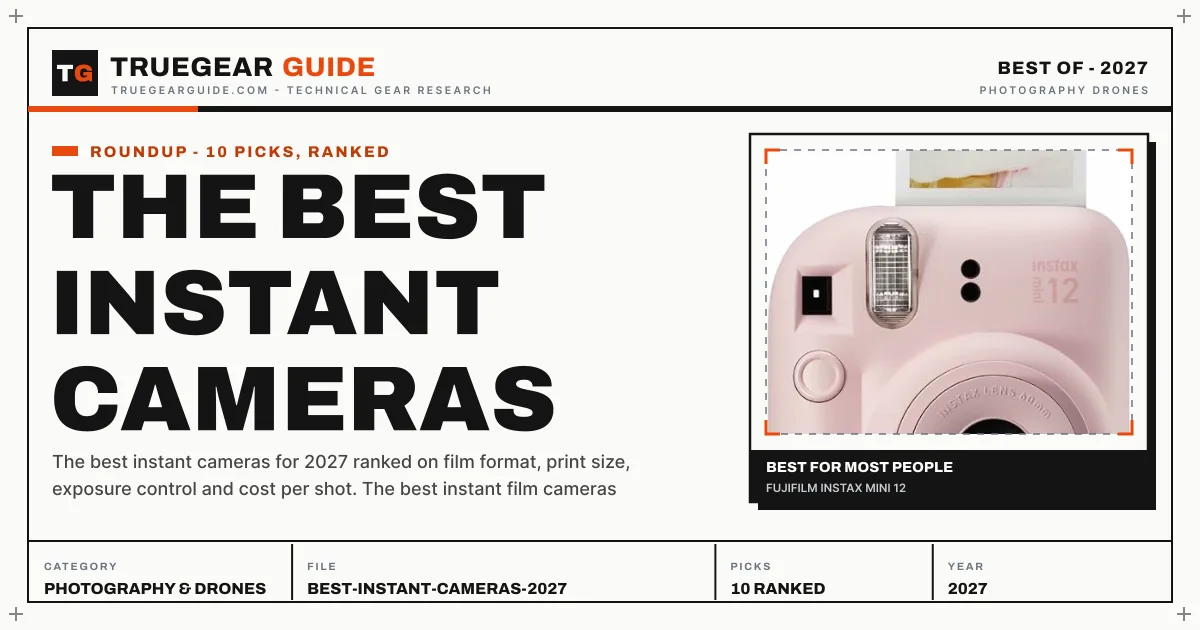
For most people in 2027, the Fujifilm Instax Mini 12 is the best instant camera: foolproof auto exposure and the cheapest film. Want bigger prints? Choose the Instax Wide 400. Want to stop wasting film? Choose the hybrid Instax Mini Evo. Want true creative control on big film? Choose the Polaroid Now+ Generation 2.
Our top picks at a glance
- Fujifilm Instax Mini 12The point-and-shoot Instax Mini that gets exposure right automatically.Best for most people
- Fujifilm Instax Wide 400The big-print Instax Wide successor with a self-timer and easier handling.Best for groups
- Fujifilm Instax Square SQ1Square-format Instax with one-touch selfie mode and auto exposure.Best square format
- Polaroid Now+ Generation 2The connected Polaroid with app manual controls and lens filters.Best for creatives
- Polaroid Go Generation 2The smallest Polaroid ever made, for pockets and everyday carry.Best pocket camera
What owners report
Synthesized from recurring themes in long-term owner feedback.
Most praised
- Prints as physical gifts and guest-book entries create a moment no phone photo matches
- Auto-exposure models visibly reduce wasted frames for beginners compared with older manual Instax bodies
- Hybrid owners value printing phone photos and reprinting a favourite frame for a second person
- Instax film consistency and wide retail availability are praised versus Polaroid film variability
- Compact models like the Go and Pal get carried daily, which owners say matters more than specs
Common complaints
- Cost per shot adds up fast at events, especially with Polaroid and Wide film
- Indoor flash photos can wash out faces while backgrounds fall to black
- Polaroid prints need careful shielding and warm conditions to develop predictably
- Hybrid screens are hard to judge in bright sunlight, leading to surprise prints
- Proprietary cartridges and ZINK paper can be harder to find locally than Instax film
The picks, ranked
| # | Product | Award | Film format | Lens | Exposure | Power | Weight |
|---|---|---|---|---|---|---|---|
| 1 | Fujifilm Instax Mini 12 | Best for most people | Instax Mini, 54 x 86 mm card, 46 x 62 mm image | 60 mm f/12.7, 2 components, close-up mode 0.3 to 0.5 m | Automatic, program AE, constant flash | 2 x AA alkaline, approx. 100 shots per set | 306 g without batteries and film |
| 2 | Fujifilm Instax Wide 400 | Best for groups | Instax Wide, 108 x 86 mm card, 99 x 62 mm image | 95 mm f/14, retractable, 2 focus zones | Automatic exposure and flash | 4 x AA alkaline | 616 g without batteries, strap and film |
| 3 | Fujifilm Instax Square SQ1 | Best square format | Instax Square, 86 x 72 mm card, 62 x 62 mm image | 65.75 mm f/12.6, selfie mode 0.3 to 0.5 m | Automatic, constant firing flash | 2 x CR2 lithium, approx. 300 shots | 390 g without batteries and film |
| 4 | Polaroid Now+ Generation 2 | Best for creatives | Polaroid i-Type and 600, 107 x 88 mm, 79 x 79 mm image | Autofocus 2-lens system, approx. 35 mm and 40 mm equiv. | Auto plus app manual, aperture and double exposure modes | USB-C rechargeable lithium-ion | 457 g without film pack |
| 5 | Polaroid Go Generation 2 | Best pocket camera | Polaroid Go, 67 x 53 mm card, 47 x 46 mm image | Polycarbonate resin, approx. 34 mm equiv., f/9 and f/42 apertures | Automatic with flash, double exposure mode | USB-C rechargeable, approx. 15 packs per charge | 211 g without film pack |
| 6 | Fujifilm Instax Mini Evo | Best hybrid | Instax Mini prints from digital capture | - | - | - | 306 g |
| 7 | Kodak Mini Shot 3 Retro | Best low-cost prints | - | - | - | USB rechargeable, approx. 20 prints per cartridge | Approx. 470 g with cartridge |
| 8 | Leica Sofort 2 | Best design | Instax Mini prints from digital capture | - | - | - | 306 g |
| 9 | Canon IVY CLIQ+2 | Best for scrapbooks | - | - | - | USB rechargeable, approx. 25 prints per charge | Approx. 188 g |
| 10 | Fujifilm Instax Pal | Best for kids and parties | - | - | - | USB-C rechargeable, approx. 240 shots per charge | 91 g |
Best for most people
Fujifilm Instax Mini 12
The point-and-shoot Instax Mini that gets exposure right automatically.

The Mini 12 is the camera to hand to anyone. Automatic exposure, a selfie mirror and the cheapest film format in instant photography mean guests at a party will get usable prints without instruction. If you do not yet know which format you love, start here and let the low cost per shot teach you.
Strengths
- Automatic exposure meters the scene so beginners waste fewer frames
- Twist lens for power and close-up mode is intuitive for first-timers
- Selfie mirror next to the lens makes framing self-portraits reliable
- Uses widely available Instax Mini film, the cheapest instant format per shot
Limitations
- No self-timer delay options beyond the basics and no tripod sophistication
- No digital preview, so every mistake costs a frame
- Close-up mode parallax can crop subjects tighter than the viewfinder suggests
| Film format | Instax Mini, 54 x 86 mm card, 46 x 62 mm image |
|---|---|
| Lens | 60 mm f/12.7, 2 components, close-up mode 0.3 to 0.5 m |
| Exposure | Automatic, program AE, constant flash |
| Power | 2 x AA alkaline, approx. 100 shots per set |
| Weight | 306 g without batteries and film |
Best for: Beginners, parties and weddings who want foolproof Mini prints with zero learning curve.
Skip if: You want to choose which shots to print; every shutter press exposes a sheet of film.
Best for groups
Fujifilm Instax Wide 400
The big-print Instax Wide successor with a self-timer and easier handling.

Wide prints at 99 x 62 mm show faces properly in group shots where Mini prints turn people into dots. The Wide 400 adds a proper self-timer dial and two focus zones to the format, making it the guest-book and event camera of this guide. Bring a bag for the body and spare Wide packs.
Strengths
- Instax Wide prints are double the Mini width, ideal for groups
- Self-timer dial with LED countdown is made for group self-portraits
- Two focus zones and automatic exposure keep operation simple
- Camera strap and close-up lens attachment included in the box
Limitations
- Bulky body needs a bag, not a jacket pocket
- Wide film costs more per shot than Mini film
- No hybrid preview, so composition errors cost a large frame
| Film format | Instax Wide, 108 x 86 mm card, 99 x 62 mm image |
|---|---|
| Lens | 95 mm f/14, retractable, 2 focus zones |
| Exposure | Automatic exposure and flash |
| Power | 4 x AA alkaline |
| Weight | 616 g without batteries, strap and film |
Best for: Group photos, guest books and events where small Mini prints feel too cramped.
Skip if: You need a pocketable camera; the Wide body is the largest Instax here.
Best square format
Fujifilm Instax Square SQ1
Square-format Instax with one-touch selfie mode and auto exposure.

The SQ1 delivers the 1:1 square look with larger prints than Mini and dead-simple controls: twist, point, shoot, with a dedicated selfie mode. It is the pick for shooters who compose in squares and want more presence than a Mini print on a fridge or wall.
Strengths
- Square prints are 1.5 times the Mini image area with a classic 1:1 look
- One-touch selfie mode sets focus and flash for arm-length portraits
- Automatic exposure handles mixed party lighting well
- Simple two-button operation suits guests and beginners
Limitations
- Square film costs more per shot than Mini film
- No double-exposure or manual creative modes
- No rechargeable battery; runs on CR2 disposables
| Film format | Instax Square, 86 x 72 mm card, 62 x 62 mm image |
|---|---|
| Lens | 65.75 mm f/12.6, selfie mode 0.3 to 0.5 m |
| Exposure | Automatic, constant firing flash |
| Power | 2 x CR2 lithium, approx. 300 shots |
| Weight | 390 g without batteries and film |
Best for: Shooters who love the square crop for social-style composition and larger-than-Mini prints.
Skip if: You shoot mostly groups; Wide film fits more people per frame.
Best for creatives
Polaroid Now+ Generation 2
The connected Polaroid with app manual controls and lens filters.

No other camera here opens up like the Now+ Gen 2: app-driven manual exposure, aperture control, double exposure and light painting on the largest film in the guide. The film is expensive and demanding, but for intentional, arty instant work nothing else gives you this much control.
Strengths
- Bluetooth app unlocks manual mode, aperture priority and light painting
- Two-lens autofocus switches between portrait and landscape ranges
- Double exposure mode built in without any hack
- Works with i-Type and 600 film, USB-C rechargeable
Limitations
- Polaroid film is temperature-sensitive and needs shielding from light as it develops
- Most expensive film per shot in this guide
- App features depend on keeping a phone nearby and charged
| Film format | Polaroid i-Type and 600, 107 x 88 mm, 79 x 79 mm image |
|---|---|
| Lens | Autofocus 2-lens system, approx. 35 mm and 40 mm equiv. |
| Exposure | Auto plus app manual, aperture and double exposure modes |
| Power | USB-C rechargeable lithium-ion |
| Weight | 457 g without film pack |
Best for: Creative shooters who want double exposure, light painting and manual control on real Polaroid film.
Skip if: You want cheap running costs; i-Type and 600 film are the priciest here.
Best pocket camera
Polaroid Go Generation 2
The smallest Polaroid ever made, for pockets and everyday carry.
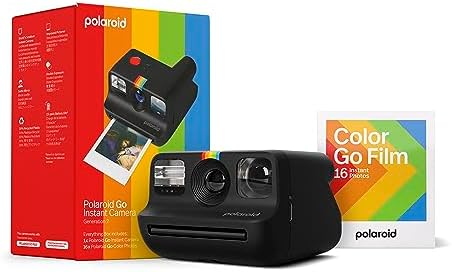
The Go Gen 2 is the instant camera you actually carry: 211 g, pocket-sized, USB-C charged, with double exposure intact. The prints are tiny, and that is the honest trade. For daily snapshots and travel journals, the camera that is with you beats the bigger one at home.
Strengths
- Pocket-sized body is genuinely wearable at 211 g
- Double exposure and selfie mirror packed into a tiny camera
- Wider aperture than the first generation improves indoor shots
- USB-C rechargeable, no disposable batteries to buy
Limitations
- Tiny 67 x 53 mm prints lose detail at arm length
- Go film costs almost as much per pack as full-size Polaroid film
- Small viewfinder takes practice to frame accurately
| Film format | Polaroid Go, 67 x 53 mm card, 47 x 46 mm image |
|---|---|
| Lens | Polycarbonate resin, approx. 34 mm equiv., f/9 and f/42 apertures |
| Exposure | Automatic with flash, double exposure mode |
| Power | USB-C rechargeable, approx. 15 packs per charge |
| Weight | 211 g without film pack |
Best for: Everyday carry and travel where a full-size Polaroid is too much to bring.
Skip if: You want large prints; Go film is the smallest Polaroid format.
Best hybrid
Fujifilm Instax Mini Evo
The hybrid Mini that lets you preview, edit and print only the keepers.

The Mini Evo ends wasted film. Shoot digitally, review on the LCD, dial in one of 100 lens and film effect combinations, and print only the frames worth a sheet of Mini film. It also prints phone photos, so one device covers camera and printer duties for Mini shooters.
Strengths
- Digital capture with LCD preview means you print only good frames
- 10 lens effects and 10 film effects combine for 100 looks
- microSD storage doubles as a Mini printer for phone photos via the Evo app
- Premium dials and print lever make shooting tactile and fun
Limitations
- 3-inch LCD and small sensor cannot match a dedicated camera for detail
- Costs two to three times a Mini 12 before film savings repay it
- Battery is internal, so a dead battery ends the shoot until recharged
| Film format | Instax Mini prints from digital capture |
|---|---|
| Sensor / lens | 1/5-inch CMOS, 28 mm equiv. f/2.0 |
| Display | 3.0-inch LCD, approx. 460k dots |
| Storage / power | microSD/microSDHC, USB-C rechargeable, approx. 100 prints per charge |
| Weight | 306 g |
Best for: Selective shooters who hate wasting film and want lens and film effects.
Skip if: You want a pure analogue workflow with no screen in the loop.
Best low-cost prints
Kodak Mini Shot 3 Retro
A hybrid camera-printer using low-cost 4PASS cartridges and square prints.

The Mini Shot 3 Retro undercuts chemical film on running cost: its 4PASS cartridges bundle paper and colour, produce laminated, water-resistant 3 x 3 inch prints, and double as a phone printer over Bluetooth. If you print in volume, the savings over Instax or Polaroid film compound fast.
Strengths
- 4PASS laminated prints resist water, fingerprints and fading
- Prints from its own camera or by Bluetooth from a phone
- Cartridges bundle paper and ink, keeping cost per print predictable and low
- Square 3 x 3 inch print size is larger than Instax Mini
Limitations
- Print speed is slower than Instax ejection and development
- Image quality is printer-like, without instant-film borders and quirks
- Cartridge system is proprietary to Kodak instant printers
| Print format | 3 x 3 in square, 4PASS dye sublimation |
|---|---|
| Camera | 10 MP, autofocus, 1.77-inch LCD viewfinder display |
| Connectivity | Bluetooth via Kodak Photo Printer app |
| Power | USB rechargeable, approx. 20 prints per cartridge |
| Weight | Approx. 470 g with cartridge |
Best for: Budget-conscious creators who want a screen, Bluetooth printing and cheap refills.
Skip if: You want true chemical instant film character; 4PASS prints look like lab prints.
Best design
Leica Sofort 2
Leica design and Instax Mini printing in a refined hybrid body.

The Sofort 2 is the Mini Evo concept in a cleaner suit: minimalist Leica industrial design, a dedicated selfie shutter button, Fotos app integration and the same ubiquitous Instax Mini film. You pay for the design and interface, and for owners who value objects as much as output, that is a rational trade.
Strengths
- Prints on standard Instax Mini film, so refills are everywhere
- Second shutter button for selfies and clean minimal controls
- Leica Fotos app transfers images and prints phone photos
- Internal memory holds about 45 images plus microSD expansion
Limitations
- Premium price buys design and interface, not a larger sensor
- Small rear screen for reviewing shots in bright light
- No viewfinder, framing is screen-only
| Film format | Instax Mini prints from digital capture |
|---|---|
| Sensor / lens | 1/5-inch CMOS, 2.4 mm f/2.0, 28 mm equiv. |
| Display | 3.0-inch LCD, approx. 460k dots |
| Storage / power | Internal approx. 45 images, microSD, USB-C rechargeable |
| Weight | 306 g |
Best for: Design-led shooters who want a hybrid workflow and Leica Fotos app integration.
Skip if: You are value-driven; the Mini Evo offers the same film for far less.
Best for scrapbooks
Canon IVY CLIQ+2
A slim camera-printer that sticks ZINK prints anywhere, no ink needed.
ZINK peel-and-stick prints are the feature: every 2 x 3 inch shot becomes a sticker for journals, planners and locker doors without glue or sleeves. The CLIQ+2 adds a generous selfie mirror and app borders, making it the journalling camera rather than the gallery camera.
Strengths
- ZINK Zero Ink paper has a peel-and-stick back for journals and walls
- Large selfie mirror with ring-style framing guide
- Canon Mini Print app adds borders, filters and collages before printing
- Slim pocketable body with microSD saving of every shot
Limitations
- 2 x 3 inch ZINK colour is less accurate than Instax or 4PASS
- Small battery gives roughly 25 prints per charge
- No optical viewfinder; framing relies on the mirror and app habits
| Print format | 2 x 3 in ZINK, peel-and-stick back |
|---|---|
| Camera | 8 MP, wide-angle lens, selfie mirror |
| Connectivity | Bluetooth via Canon Mini Print app |
| Power | USB rechargeable, approx. 25 prints per charge |
| Weight | Approx. 188 g |
Best for: Journalling, lockers and scrapbooks where peel-and-stick prints beat framed film.
Skip if: You want saturated instant-film colour; ZINK prints are softer and cooler.
Best for kids and parties
Fujifilm Instax Pal
A palm-sized digital shooter that pairs with any Instax Link printer.

The Pal separates shooting from printing in the smartest way: a 91 g wide-angle pod anyone can use, wirelessly feeding Mini, Square or Wide Link printers. As a party or family camera feeding a shared printer, it is cheaper and more forgiving than handing guests a film camera.
Strengths
- Tiny 91 g body with wide-angle lens encourages candid shooting
- Remote shutter and interval shooting via the Pal app
- Pairs with Mini, Square and Wide Link printers, so one camera covers all formats
- microSD storage and fun shutter sounds suit younger shooters
Limitations
- Requires a separate Instax Link printer or phone app to make any print
- No screen on the camera, so framing is point-and-hope without the app
- Image quality is snapshot-grade, not a step up from a phone
| Output | Digital capture, prints via Instax Link Mini, Square or Wide printers |
|---|---|
| Sensor / lens | 1/5-inch CMOS, 16.25 mm equiv. wide-angle f/2.2 |
| Storage | microSD/microSDHC, internal approx. 50 images |
| Power | USB-C rechargeable, approx. 240 shots per charge |
| Weight | 91 g |
Best for: Kids, parties and casual shooters who already own or plan an Instax Link printer.
Skip if: You want prints from the camera itself; the Pal has no built-in printer.
How we chose
Film format first
We ranked image area and cost per shot before camera features, because the format is a multi-year consumable commitment. Mini is cheapest, Wide is largest from Fujifilm, Square is the balanced crop, and Polaroid i-Type is the character pick at the highest running cost.
Exposure forgiveness
Instant film has narrow latitude. We favoured cameras whose automatic exposure, flash metering and selfie modes protect beginners from the two classic failures: blown-out faces at close range and murky indoor backgrounds.
Workflow honesty
Pure film cameras, hybrids and camera-printers behave differently. We scored each on what it actually is: hybrids for print-only-the-keepers savings, camera-printers for cheap laminated output, and analogue bodies for immediacy.
Carry and power
An instant camera only works if it is present. We weighed size, weight and battery system, AA and CR2 convenience versus USB-C recharging, against the shooting each camera is meant for.
Questions, answered
Which instant film is cheapest per shot?
Instax Mini is the cheapest true instant film per shot, followed by Instax Square and Wide. Kodak 4PASS cartridges for the Mini Shot 3 Retro can undercut all of them per print, but the output is a laminated digital print rather than chemical instant film.
Are hybrid instant cameras worth it?
If you shoot often, yes. A hybrid like the Mini Evo or Sofort 2 lets you discard bad frames before printing, so the higher camera price is repaid in saved film. If you love the one-shot gamble of film, a pure analogue body is cheaper and simpler.
Why do my Polaroid photos look washed out?
Polaroid film is light- and temperature-sensitive. Shield the print face-down or in a pocket immediately after ejection, shoot between roughly 55 and 82 degrees Fahrenheit when possible, and store film cool and flat. Instax film is far more forgiving of the same mistakes.
Can I take instant cameras through airport security?
Carry film in hand luggage and ask for a hand inspection where possible, since CT scanners can fog instant film, Polaroid especially. Loaded cameras should also travel in the cabin. Check current guidance for your airports before a big trip.
What is the best instant film camera right now?
For most people, the Fujifilm Instax Mini 12: it is the best instant film camera for beginners and parties because auto exposure protects the cheapest film format. Enthusiasts who print selectively should choose the hybrid Instax Mini Evo, and shooters who want the largest instant prints should choose the Instax Wide 400.
Instax or Polaroid: which instant film camera should I buy?
Instax for reliability and cost: consistent film, cheaper packs and forgiving development, led here by the Mini 12 and Wide 400. Polaroid for character and control: the Polaroid Now+ Generation 2 is a good Polaroid camera and the best instant Polaroid camera in this guide for creative work, with app manual controls and double exposure, on larger, pricier and more temperature-sensitive film.