Head to head
DJI RS 4 vs DJI RS 3 Mini (2027)
Head-to-head: DJI RS 4 versus RS 3 Mini on payload, weight, vertical shooting and which mirrorless kits each gimbal truly suits.
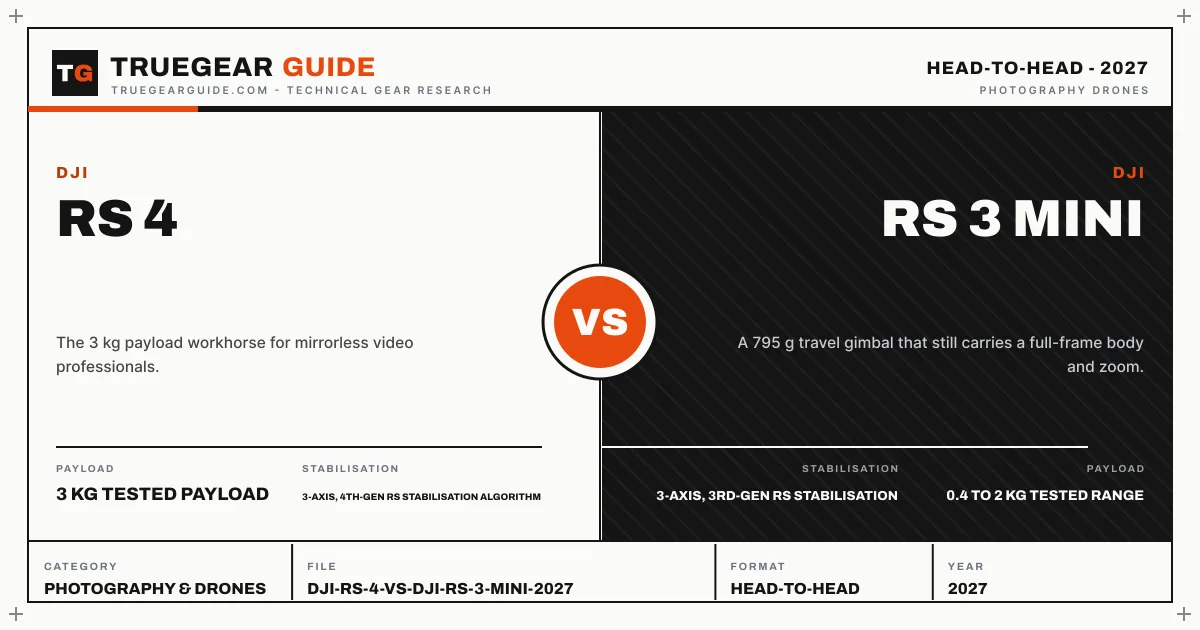

DJI RS 4
The 3 kg payload workhorse for mirrorless video professionals.
- Payload: 3 kg tested payload
- Stabilisation: 3-axis, 4th-gen RS stabilisation algorithm

DJI RS 3 Mini
A 795 g travel gimbal that still carries a full-frame body and zoom.
- Payload: 0.4 to 2 kg tested range
- Stabilisation: 3-axis, 3rd-gen RS stabilisation
Our recommendation
Buy the RS 4 for full-frame zooms, paid work and a decade-deep accessory path. Buy the RS 3 Mini for travel and compact kits where every gram is audited. The wrong choice is buying the Mini for a heavy rig and fighting its motors, or the RS 4 for a sling-bag kit and leaving it home.
Payload and rig size
RS 4: 3 kg tested payload for full-frame bodies with f/2.8 zooms, cages and monitors. RS 3 Mini: 0.4 to 2 kg tested range, happiest with APS-C bodies or full-frame bodies wearing compact primes and standard zooms. Headroom is stabilisation quality - plan your heaviest realistic rig, not your lightest.
Weight and travel
At about 795 g, the Mini is roughly 270 g lighter than the RS 4 before grips, and packs dramatically smaller. For destination weddings and hiking creators, that gap decides what else fits in the bag. For local professional work, the RS 4's weight is irrelevant next to its capability.
Features and ecosystem
Both offer native vertical shooting and Bluetooth shutter control. The RS 4 adds the larger touchscreen, RSA port ecosystem, swappable BG21 grip options and Focus Pro support that growing professional kits eventually want. The Mini deliberately stops short of that expansion path.
Choose DJI RS 4 if…
- You shoot full-frame with f/2.8 zoom lenses
- You do paid client work where reliability is the product
- You plan to add focus motors, transmission or briefcase handles
Choose DJI RS 3 Mini if…
- You travel with your camera kit in a sling or small backpack
- Your heaviest rig stays under about 1.6 kg
- You shoot social-first vertical content on compact bodies
Questions, answered
Can the RS 3 Mini handle a full-frame camera?
Yes, within its 2 kg tested payload: a full-frame body with a 24-70mm f/2.8 is its canonical maximum demo load. Balance must be precise and accessory weight minimal.
Which balances faster?
The RS 4, thanks to Teflon-coated arms and its tilt-axis fine-tuning knob. The Mini is close once plate positions are marked for a regular kit.
Which holds value for professionals?
The RS 4, because its accessory ecosystem and payload keep it relevant as kits grow. The Mini is the better second gimbal for travel even for RS 4 owners.