In-depth review
DJI RS 4 Review (2027)
In-depth review of the DJI RS 4: 3 kg payload, native vertical shooting, balancing speed and battery for professional mirrorless video.
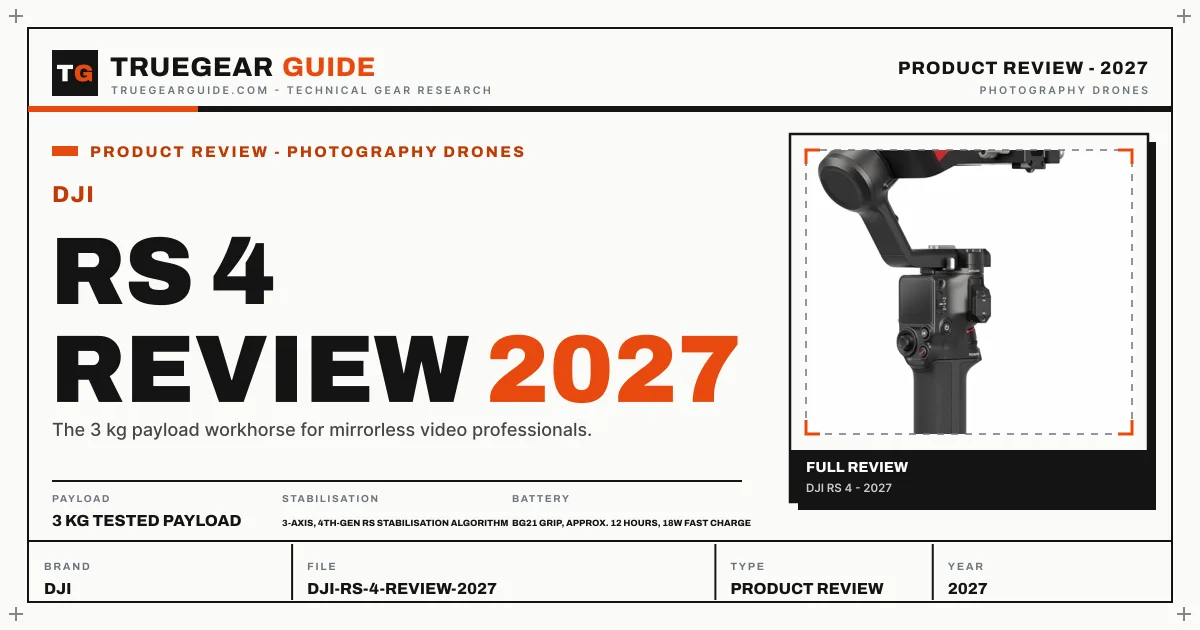

Our verdict
The RS 4 refines the professional standard rather than reinventing it: faster balancing on Teflon-coated axes, true second-generation native vertical shooting, a responsive auto-locking touchscreen and a 3 kg payload that swallows full-frame zooms. For working videographers the gains are measured in minutes saved per setup, every setup, all year.
What we like
- 3 kg payload covers full-frame bodies with 24-70mm f/2.8 zooms
- Second-generation native vertical shooting with no extra brackets
- Teflon-coated axes balance faster and move more smoothly
- RSA communication and Bluetooth shutter control across major camera brands
What to watch out for
- Overkill and overweight for APS-C travel kits
- Best accessories cost extra
- Requires proper balancing skill to deliver its stabilisation quality
What owners report: DJI RS 4
Synthesized from recurring themes in long-term owner feedback.
Most praised
- A 3 kg payload swallows a full-frame body with a fast zoom without motor strain
- Native vertical mounting needs no brackets, so switching formats between takes is quick
- Teflon-coated axes make balancing feel smoother, and repeat visits to a known setup faster
Common complaints
- For small APS-C travel kits it is simply more gimbal than the job calls for
- The accessories that complete the system are sold separately and add up
- Poorly balanced rigs give back mediocre footage; it rewards skill rather than forgiving beginners
Who it is for
Professional and serious enthusiast videographers running full-frame mirrorless kits for weddings, commercial and event work.
Payload and stabilisation
The 3 kg tested payload covers the canonical full-frame plus 24-70mm f/2.8 combination with mic and still leaves headroom for smooth motors. DJI's fourth-generation stabilisation is noticeably calmer on walking shots than the RS 2 generation, particularly on the pan axis during slow reveals.
Balancing and vertical shooting
Teflon-coated axis arms glide during balancing instead of stuttering, fine-tuning knobs on the tilt axis reward precise work, and the new horizontal plate makes native vertical a slide-and-lock move with no bracket purchase. On social-heavy shoot days this feature alone justifies the upgrade from older Ronins.
Battery and ecosystem
The BG21 grip delivers about 12 hours and fast charging, and the RSA port plus Bluetooth shutter control cover Sony, Canon, Nikon, Fujifilm and Panasonic bodies broadly. The accessory ecosystem - briefcase handles, Focus Pro, transmission - is the deepest in the class, which matters when a kit must grow with your work.
Key specifications
- Payload
- 3 kg tested payload
- Stabilisation
- 3-axis, 4th-gen RS stabilisation algorithm
- Battery
- BG21 grip, approx. 12 hours, 18W fast charge
- Weight
- Approx. 1,066 g gimbal only
- Screen
- 1.8-inch OLED touchscreen, auto-lock
Also consider

DJI RS 3 Mini
A 795 g travel gimbal that still carries a full-frame body and zoom.
Why consider it: Half the weight for travel and APS-C kits if you do not need 3 kg of payload.
- Payload: 0.4 to 2 kg tested range
- Stabilisation: 3-axis, 3rd-gen RS stabilisation

DJI RS 4 Mini Combo
The compact RS gimbal with a tracking module in the box.
Why consider it: The compact RS option with auto axis locks and a tracking module for solo creators.
- Payload: 2 kg (4.4 lb) tested
- Stabilisation: 3-axis, third-generation RS stabilisation
Research-based assessment. TrueGear has not hands-on tested this product; this evaluation synthesizes manufacturer specifications, retailer documentation, and published expert reviews.
Questions, answered
RS 4 or RS 4 Pro?
The Pro adds LiDAR autofocus support, stronger motors and car-mount capability for cinema workflows. Most mirrorless videographers are fully served by the standard RS 4.
Does the RS 4 work with my camera's record button?
For most current Sony, Canon, Nikon, Fujifilm and Panasonic bodies, yes via Bluetooth or USB-C control cable. Check DJI's compatibility list for your exact body and firmware.
How long does balancing take with practice?
About two to three minutes for a familiar kit, less when plate positions are marked. First-time setup with axis calibration takes 15 to 20 minutes and is worth doing carefully.