In-depth review
DJI Mavic 3 Pro Review (2027)
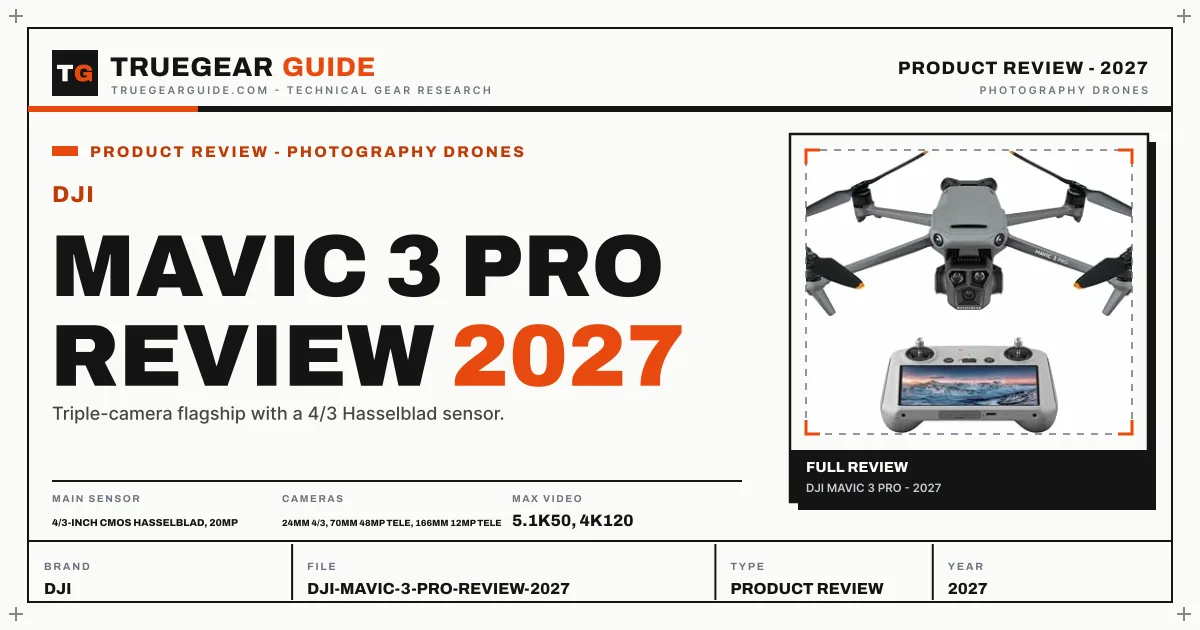
In-depth research review of the DJI Mavic 3 Pro: 4/3 Hasselblad sensor, triple cameras, 5.1K50 video, and 46-minute flight time.

Our verdict
The Mavic 3 Pro is the professional's drone because its 4/3 sensor sees light the others cannot, and three focal lengths in one flight replace lens changes that do not exist in the air. It is heavy, regulated, and expensive, and for paid aerial work it is worth every gram.
What we like
- 4/3-inch Hasselblad sensor delivers the best drone image quality here
- Triple camera covers 24mm, 70mm, and 166mm without landing
- 5.1K50 video suits professional deliverables
- Omnidirectional obstacle sensing protects during complex shots
What to watch out for
- Largest and heaviest in this group, least travel-friendly
- Requires FAA registration for recreational use in the US
- Premium tier pricing for body plus essential batteries
What owners report: DJI Mavic 3 Pro
Synthesized from recurring themes in long-term owner feedback.
Most praised
- Changing focal length mid-flight instead of landing rewrites how owners plan an aerial shoot
- The large Hasselblad sensor produces files that survive heavy grading and large prints
- Professionals trust the full sensing suite when flying a valuable airframe near structures
Common complaints
- Size and weight mean it travels in a dedicated case, not slipped into a jacket
- Registration paperwork follows it for recreational flying in the US
- The body price is only the start once the batteries a pro day requires are added
Who it is for
Professional aerial photographers and videographers billing clients for image quality that smaller sensors cannot deliver.
The 4/3 sensor advantage
The Hasselblad 4/3 sensor's light-gathering advantage shows exactly where professionals need it: dawn, dusk, and high-dynamic-range scenes. 12.8 stops of claimed dynamic range hold skies and shadows together in ways 1/1.3-inch sensors cannot match, and 20MP is ample for professional deliverables.
Triple camera system
Three perspectives, 24mm wide, 70mm medium telephoto, and 166mm telephoto, without landing to change anything, transform flight efficiency. The 70mm compresses landscapes and architecture beautifully; the 166mm enables detail shots and safer distances from subjects. This is the system's defining feature.
Flight and limitations
46-minute rated flight time and O3+ transmission deliver long, confident missions, and omnidirectional sensing protects during lateral tracking shots. The costs are weight and regulation: registration, Remote ID, and no-fly-zone diligence are mandatory, and travel packing is a real consideration.
Key specifications
- Main sensor
- 4/3-inch CMOS Hasselblad, 20MP
- Cameras
- 24mm 4/3, 70mm 48MP tele, 166mm 12MP tele
- Max video
- 5.1K50, 4K120
- Flight time
- Up to 46 minutes
- Transmission
- O3+, up to 15km
Also consider

DJI Air 3
Dual-camera versatility at a mid-tier price.
Why consider it: Choose the Air 3 for dual-camera versatility at a mid-tier price when the 4/3 sensor is overkill.
- Sensors: Dual 1/1.3-inch CMOS, 48MP each
- Cameras: 24mm wide, 70mm medium telephoto

DJI Mini 4 Pro
Sub-249g drone with flagship features.
Why consider it: Choose the Mini 4 Pro for travel and casual use where portability beats ultimate image quality.
- Sensor: 1/1.3-inch CMOS, 48MP
- Weight: Under 249g
Research-based assessment. TrueGear has not hands-on tested this product; this evaluation synthesizes manufacturer specifications, retailer documentation, and published expert reviews.
Questions, answered
Is the telephoto camera actually useful?
Enormously. The 70mm lens produces compressed perspectives impossible with wide-only drones, and the 166mm enables wildlife and inspection work at safe distances. It is the reason to buy this over dual-camera drones.
What does Hasselblad branding add?
Primarily the Natural Colour Solution color science, which produces pleasing, accurate colors with minimal grading. The hardware is DJI's; the color pipeline carries the Hasselblad contribution.
Can it fly in rain?
It is not rated waterproof; light drizzle is survivable but not sanctioned. Professionals carry on through mist, but sustained rain risks the gimbal and electronics. No DJI camera drone is a rain drone.