Best of
The Best Camera Drones (2027)
The best camera drones for 2027, researched across sensor size, flight time, transmission range, and obstacle sensing. DJI and Autel picks.
The short answer
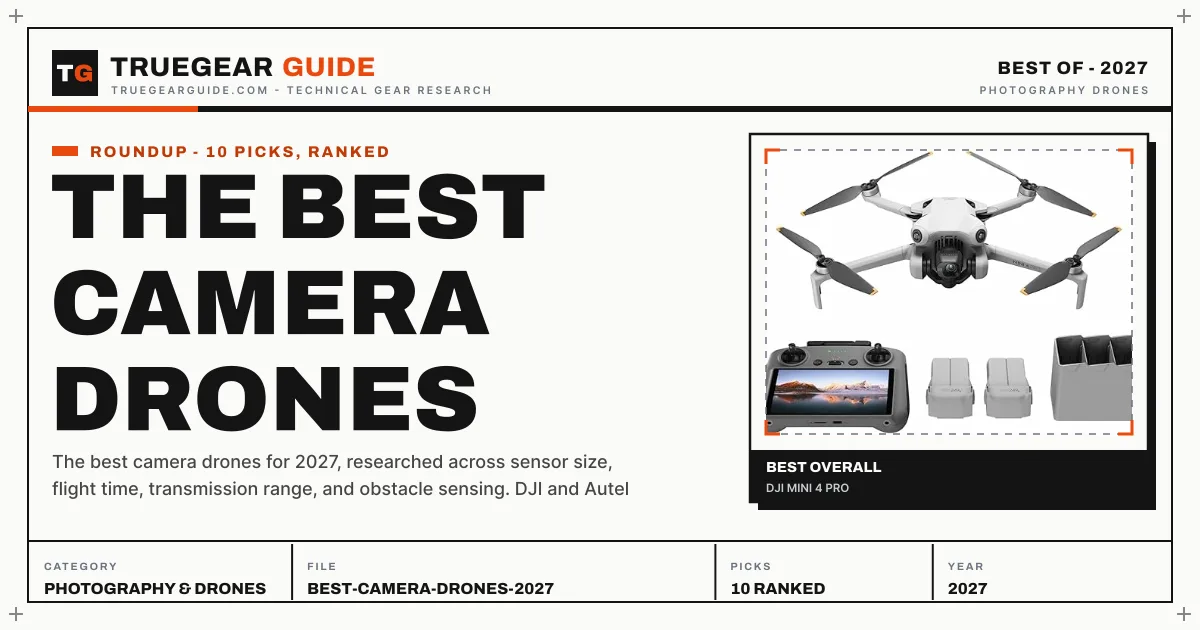
The DJI Mini 4 Pro is the best camera drone for most people in 2027: sub-249g freedom from registration, a 1/1.3-inch sensor, and omnidirectional sensing. Professionals should get the DJI Mavic 3 Pro for its 4/3 sensor and triple cameras, value seekers the DJI Air 3, and DJI skeptics the Autel Evo Lite+.
Our top picks at a glance
- DJI Mini 4 ProSub-249g drone with flagship features.Best overall
- DJI Mavic 3 ProTriple-camera flagship with a 4/3 Hasselblad sensor.Best image quality
- DJI Air 3Dual-camera versatility at a mid-tier price.Best value
- Autel Evo Lite+1-inch sensor with adjustable aperture, outside the DJI ecosystem.Best non-DJI option
- DJI Mini 3The cheapest way into DJI's sub-249g lineup.Best budget drone
What owners report
Synthesized from recurring themes in long-term owner feedback.
Most praised
- Modern obstacle sensing lets new pilots attempt shots they would never have risked a generation ago
- Folding airframes disappear into a camera bag, so the drone actually travels instead of staying home
- Having two or three focal lengths in one flight saves the landing and relaunching that used to eat batteries
- Transmission links now hold a clean feed at distances that make framing from the ground genuinely practical
- Return-to-home reliability gives beginners the confidence to explore range instead of hovering nearby
Common complaints
- Real flight time in wind and cold falls well short of the headline figure on every model here
- Spare batteries, cases, and filters turn an attractive headline price into a much larger kit spend
- Registration, airspace rules, and local restrictions ground new owners more often than they expected
- Propellers and gimbals are fragile, and a single hard landing can mean a repair bill and weeks grounded
- Firmware and app updates occasionally change behaviour owners liked, with little warning before a shoot
The picks, ranked
| # | Product | Award | Sensor | Weight | Max video | Flight time | Transmission |
|---|---|---|---|---|---|---|---|
| 1 | DJI Mini 4 Pro | Best overall | 1/1.3-inch CMOS, 48MP | Under 249g | 4K100, 4K60 HDR | Up to 34 minutes | O4, up to 20km |
| 2 | DJI Mavic 3 Pro | Best image quality | - | - | 5.1K50, 4K120 | Up to 46 minutes | O3+, up to 15km |
| 3 | DJI Air 3 | Best value | - | - | 4K100, 4K60 HDR | Up to 46 minutes | O4, up to 20km |
| 4 | Autel Evo Lite+ | Best non-DJI option | 1-inch CMOS, 20MP | - | 6K30 | Up to 40 minutes | Up to 12km |
| 5 | DJI Mini 3 | Best budget drone | - | Under 249 g | - | 38 min max | DJI O2, 10 km max range |
| 6 | DJI Avata 2 | Best FPV drone | - | 377 g | - | 23 min max | DJI O4, 13 km max range |
| 7 | Autel EVO Nano+ | Best non-DJI sub-249g | - | 249 g | - | 28 min max | - |
| 8 | DJI Flip | Best for selfies | - | Under 249 g | - | 31 min max | DJI O4, 13 km max range |
| 9 | DJI Neo | Best for absolute beginners | - | 135 g | - | 18 min max | - |
| 10 | DJI Air 3S | Best 1-inch value | - | 724 g | - | 45 min max | DJI O4, 20 km max range |
Best overall
DJI Mini 4 Pro
Sub-249g drone with flagship features.

The Mini 4 Pro is the rare product that removes the biggest drone hassle, regulation, while keeping flagship features: omnidirectional sensing, a 1/1.3-inch 48MP sensor, and 4K100 video in a sub-249g body. For most buyers, the freedom to fly anywhere legal outweighs the sensor advantage of heavier drones.
Strengths
- Under 249g: no FAA registration needed for recreational US flight
- 1/1.3-inch 48MP sensor punches above its weight class
- Omnidirectional sensing, rare in sub-249g drones
- 4K100 and 4K60 HDR cover serious video needs
Limitations
- Light weight means more wind drift than heavier drones
- Single camera: no telephoto option
- 34-minute flight time trails larger siblings
| Sensor | 1/1.3-inch CMOS, 48MP |
|---|---|
| Weight | Under 249g |
| Max video | 4K100, 4K60 HDR |
| Flight time | Up to 34 minutes |
| Transmission | O4, up to 20km |
Best for: Travelers who want capable aerials without registration hassle.
Skip if: You need the best wind handling or the largest sensor.
Best image quality
DJI Mavic 3 Pro
Triple-camera flagship with a 4/3 Hasselblad sensor.

The 4/3-inch Hasselblad sensor and triple-camera array deliver aerial image quality nothing else here touches, with 24mm, 70mm, and 166mm perspectives in one flight. Professionals billing for aerial work should buy the best sensor available.
Strengths
- 4/3-inch Hasselblad sensor delivers the best drone image quality here
- Triple camera covers 24mm, 70mm, and 166mm without landing
- 5.1K50 video suits professional deliverables
- Omnidirectional obstacle sensing protects during complex shots
Limitations
- Largest and heaviest in this group, least travel-friendly
- Requires FAA registration for recreational use in the US
- Premium tier pricing for body plus essential batteries
| Main sensor | 4/3-inch CMOS Hasselblad, 20MP |
|---|---|
| Cameras | 24mm 4/3, 70mm 48MP tele, 166mm 12MP tele |
| Max video | 5.1K50, 4K120 |
| Flight time | Up to 46 minutes |
| Transmission | O3+, up to 15km |
Best for: Professional aerial photographers who need multiple focal lengths without landing.
Skip if: You want a travel-friendly drone, or your work is all wide-angle landscapes.
Best value
DJI Air 3
Dual-camera versatility at a mid-tier price.

Dual 48MP cameras including a 70mm telephoto, 46-minute flight time, and omnidirectional sensing at a mid-tier price make the Air 3 the value sweet spot. You give up the 4/3 sensor; you keep nearly everything else that matters.
Strengths
- Dual 48MP cameras: 24mm wide plus 70mm medium tele
- O4 transmission reaches 20km with strong signal
- 46-minute flight time matches the flagship
- Omnidirectional sensing at a mid-tier price
Limitations
- 1/1.3-inch sensors trail the 4/3 sensor in low light
- Over 249g, so FAA registration required recreationally
- No 5.1K option of the Mavic 3 Pro
| Sensors | Dual 1/1.3-inch CMOS, 48MP each |
|---|---|
| Cameras | 24mm wide, 70mm medium telephoto |
| Max video | 4K100, 4K60 HDR |
| Flight time | Up to 46 minutes |
| Transmission | O4, up to 20km |
Best for: Serious creators who want telephoto compression without flagship cost.
Skip if: You need the absolute best low-light sensor, or sub-249g portability.
Best non-DJI option
Autel Evo Lite+
1-inch sensor with adjustable aperture, outside the DJI ecosystem.
The 1-inch sensor with real adjustable aperture gives photographers exposure control DJI's fixed-aperture drones cannot match, and the absence of geofencing suits pilots who fly in areas DJI restricts. A genuine alternative, not a compromise.
Strengths
- 1-inch 20MP sensor with adjustable f/2.8 to f/11 aperture
- Aperture control enables real depth-of-field and exposure choices
- 6K30 video suits high-resolution deliverables
- No geofencing system restricting takeoff locations
Limitations
- Smaller accessory and community ecosystem than DJI
- Obstacle sensing is less comprehensive than DJI rivals
- App and firmware update cadence trails DJI
| Sensor | 1-inch CMOS, 20MP |
|---|---|
| Aperture | Adjustable f/2.8 to f/11 |
| Max video | 6K30 |
| Flight time | Up to 40 minutes |
| Transmission | Up to 12km |
Best for: Photographers who want aperture control and a non-DJI option.
Skip if: You want the longest transmission range or the deepest accessory ecosystem.
Best budget drone
DJI Mini 3
The cheapest way into DJI's sub-249g lineup.

Under 249 grams, 4K HDR from a 1/1.3-inch sensor, and a 38-minute flight time for the lowest DJI entry price. No obstacle sensing and no tracking, but as a first drone the value is unmatched.
Strengths
- Under 249 grams, so no FAA registration needed for recreation
- 4K HDR video from a 1/1.3-inch sensor
- 38-minute max flight time is excellent for the price
- Beginner-friendly flight modes and return-to-home
Limitations
- No obstacle sensing in any direction
- No ActiveTrack subject tracking
- O2 transmission has shorter range than O4 models
| Weight | Under 249 g |
|---|---|
| Camera | 1/1.3-inch CMOS, 4K30 HDR |
| Flight time | 38 min max |
| Transmission | DJI O2, 10 km max range |
| Photo | 48MP stills |
Best for: Beginners who want DJI flight stability at the lowest price.
Skip if: You need obstacle avoidance or advanced tracking modes.
Best FPV drone
DJI Avata 2
Cinewhoop thrills without the build-it-yourself pain.

4K60 HDR with 10-bit D-Log M and O4 low-latency transmission make the Avata 2 the accessible FPV pick. The 23-minute flight time is short, but nothing else here flies like this.
Strengths
- 1/1.3-inch sensor shoots 4K60 HDR with 10-bit D-Log M
- O4 transmission delivers low-latency goggle feed
- Binocular fisheye sensing for safer indoor flight
- Easy ACRO mode with one-tap flips and rolls
Limitations
- 23-minute flight time is short
- Goggles and motion controller add to the real cost
- Prop guards add drag and noise versus open FPV builds
| Camera | 1/1.3-inch CMOS, 4K60 HDR |
|---|---|
| Flight time | 23 min max |
| Transmission | DJI O4, 13 km max range |
| Sensing | Binocular fisheye, downward ToF |
| Weight | 377 g |
Best for: FPV-curious pilots who want immersive flight with training wheels.
Skip if: You want slow cinematic orbits; this drone begs to be flown fast.
Best non-DJI sub-249g
Autel EVO Nano+
The sub-249g Autel for DJI skeptics.
A 1/1.28-inch RYYB sensor and three-way obstacle avoidance under 249 grams is a combination DJI does not offer at this size. Autel's software support trails DJI, which is the real cost of switching.
Strengths
- Under 249 grams with a 1/1.28-inch sensor, rare in this class
- 4K30 HDR video with RYYB color filter for low light
- 28-minute flight time
- Three-way obstacle avoidance, unusual under 249g
Limitations
- Autel app and firmware support trail DJI
- No 4K60 option
- Smaller accessory and community ecosystem
| Weight | 249 g |
|---|---|
| Camera | 1/1.28-inch CMOS, 4K30 HDR |
| Flight time | 28 min max |
| Obstacle sensing | Three-way binocular vision |
| Photo | 50MP stills |
Best for: Pilots who want a non-DJI sub-249g drone with a big sensor.
Skip if: You rely on DJI's app ecosystem and third-party support.
Best for selfies
DJI Flip
The palm-launch selfie drone with real camera specs.

Palm takeoff, AI subject tracking, and 4K100 slow motion from a 48MP sensor: the Flip is built for solo creators. Serious pilots will miss obstacle avoidance and manual control.
Strengths
- Under 249 grams with folding full-coverage prop guards
- 1/1.3-inch 48MP sensor shoots 4K100 slow motion
- Palm takeoff and AI subject tracking for hands-free shots
- 31-minute flight time is strong for its size
Limitations
- No obstacle avoidance
- Auto-heavy shooting limits creative control
- Wind resistance is modest for its weight class
| Weight | Under 249 g |
|---|---|
| Camera | 1/1.3-inch CMOS, 48MP, 4K100 |
| Flight time | 31 min max |
| Transmission | DJI O4, 13 km max range |
| Takeoff | Palm launch, no controller needed |
Best for: Solo creators who want aerial selfies without piloting skills.
Skip if: You need manual camera control or long-range missions.
Best for absolute beginners
DJI Neo
The 135-gram palm drone for absolute beginners.

At 135 grams with palm launch and AI tracking, the Neo is the least intimidating drone ever made. The 18-minute flight time and 1/2-inch sensor are modest, but so is everything else about the learning curve.
Strengths
- 135 grams, the lightest DJI camera drone by far
- Palm takeoff and landing with AI tracking modes
- 4K30 stabilized video is genuinely usable
- Prop guards included for safe indoor flight
Limitations
- 18-minute flight time is the shortest here
- 1/2-inch sensor shows noise in low light
- No obstacle sensing and modest wind handling
| Weight | 135 g |
|---|---|
| Camera | 1/2-inch CMOS, 4K30 |
| Flight time | 18 min max |
| Takeoff | Palm launch, controller optional |
| Photo | 12MP stills |
Best for: First-time drone owners who want zero learning curve.
Skip if: You need 4K60, obstacle avoidance, or wind resistance.
Best 1-inch value
DJI Air 3S
Dual cameras and a 1-inch main sensor: the Air line grown up.

The Air 3S pairs a 1-inch 50MP wide camera with a 70mm medium tele, shoots 4K/60fps HDR with 10-bit D-Log M, and flies 45 minutes on O4 transmission: flagship imaging habits at a mid-range price. At 724 grams it needs registration, unlike the sub-249g minis.
Strengths
- 1-inch 50MP wide camera plus a 70mm medium tele in one airframe
- 4K/60fps HDR and 4K/120fps with 10-bit D-Log M for grading
- 45-minute flight time and O4 transmission up to 20 km
- Omnidirectional sensing with forward LiDAR for night flights
Limitations
- 724 grams means FAA registration for recreational use
- Battery charger is sold separately by DJI
- The dual cameras still trail the Mavic 3 Pro's 4/3 main sensor
| Camera | Dual: 1-inch CMOS 50MP wide (24mm), 1/1.3-inch CMOS 48MP tele (70mm) |
|---|---|
| Flight time | 45 min max |
| Obstacle sensing | Omnidirectional with forward LiDAR |
| Weight | 724 g |
| Transmission | DJI O4, 20 km max range |
Best for: Travel creators who want two focal lengths and a 1-inch sensor in one folding drone.
Skip if: You want sub-249g registration-free flying; at 724 grams this drone registers.
How we chose
We compared current camera drones on sensor size, photo resolution, maximum video resolution and frame rates, rated flight time, transmission system and range, obstacle sensing coverage, weight class and its regulatory implications, and camera versatility (single, dual, or triple lens arrays).
Questions, answered
Do I need to register a drone in the US?
Recreational drones under 249g, like the Mini 4 Pro, do not require FAA registration. Everything heavier needs registration, which costs a small fee and covers three years. Commercial use always requires a Part 107 license regardless of weight.
What is Remote ID and does it affect me?
Remote ID broadcasts your drone's identity and location; most drones over 249g must comply, and current DJI and Autel models have it built in. Sub-249g recreational drones are exempt. It does not restrict where you fly, it identifies you while flying.
How much does sensor size matter in a drone?
A lot for stills at dawn and dusk, which is when the best aerial light happens. The 4/3 sensor gathers roughly four times the light of a 1/1.3-inch sensor. For midday video, the gap narrows considerably.
Can I fly in national parks?
No. Drone takeoff and landing is prohibited in US National Parks, with very limited exceptions. State parks vary by state; always check local rules before flying, and use the FAA's B4UFLY app for airspace awareness.