Head to head
SanDisk Extreme Pro UHS-I vs Lexar 2000x UHS-II (2027)
Head-to-head: SanDisk Extreme Pro UHS-I versus Lexar Professional 2000x UHS-II on in-camera speed, offload time and when the upgrade pays.
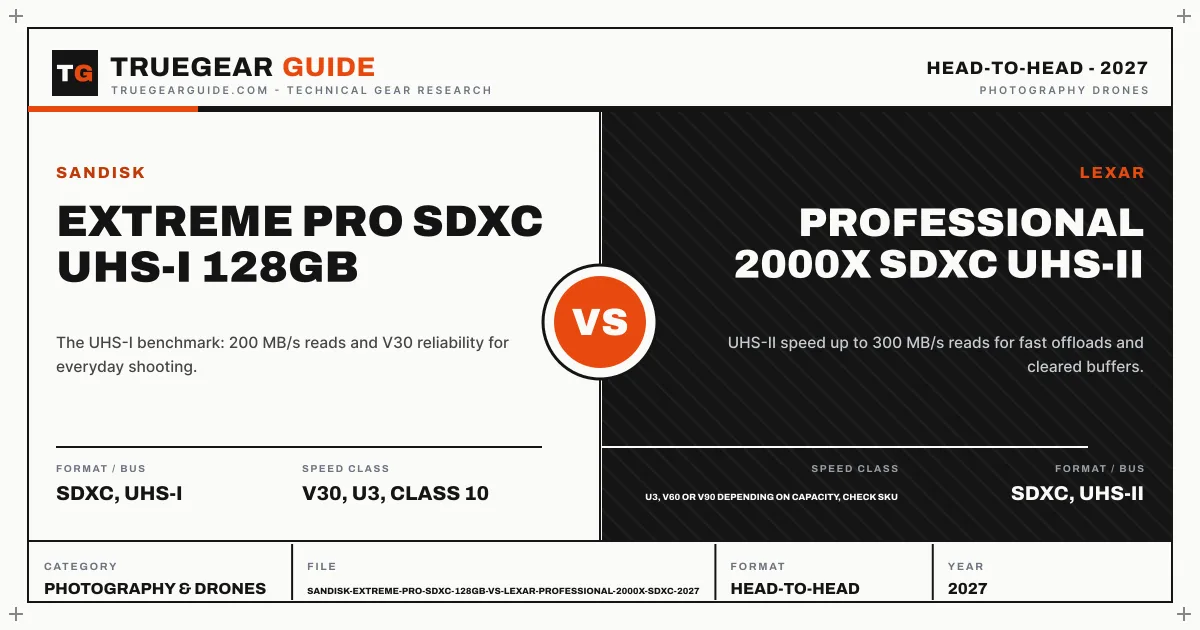

SanDisk Extreme Pro SDXC UHS-I 128GB
The UHS-I benchmark: 200 MB/s reads and V30 reliability for everyday shooting.
- Format / bus: SDXC, UHS-I
- Speed class: V30, U3, Class 10

Lexar Professional 2000x SDXC UHS-II
UHS-II speed up to 300 MB/s reads for fast offloads and cleared buffers.
- Format / bus: SDXC, UHS-II
- Speed class: U3, V60 or V90 depending on capacity, check SKU
Our recommendation
Buy the Extreme Pro UHS-I if your camera is UHS-I or your video is V30 class - it is the value benchmark. Buy the Lexar 2000x if your body has UHS-II slots, you shoot bursts or big video files, and offload time is costing you evenings.
In-camera behaviour
In a UHS-I body they are effectively tied, both capped by the slot. In a UHS-II body the Lexar clears buffers several times faster and sustains higher video classes depending on capacity, while the SanDisk remains a V30 stills and standard 4K card.
Offload speed
With matched readers, the Lexar's 300 MB/s-class reads roughly halve card-to-drive time versus the SanDisk's already quick 200 MB/s proprietary best. Across a wedding season, that difference is measured in evenings returned.
Price per gigabyte
The SanDisk wins outright, often by half. The Lexar premium buys a bus upgrade, so it should be purchased only when both camera slot and reader exist to exploit it end to end.
Choose SanDisk Extreme Pro SDXC UHS-I 128GB if…
- Your camera has UHS-I slots only
- You shoot stills and standard 4K V30 video
- You want several cards for the price of one UHS-II card
Choose Lexar Professional 2000x SDXC UHS-II if…
- Your camera has UHS-II slots and you shoot bursts
- You offload hundreds of gigabytes weekly
- Your video modes ask for V60-class sustained writes
Questions, answered
Will the Lexar make my UHS-I camera faster?
No for recording; the slot governs. It will offload faster in a UHS-II reader, which is a real but narrower benefit.
Which is safer for a paid job?
Both are reputable. For paid video at high bitrates the Lexar's higher classes help; for paid stills, two SanDisks mirrored beat one of anything.
Do I need a new reader for the Lexar?
To see 300 MB/s-class reads, yes: a UHS-II reader is required. The card still works in UHS-I readers at reduced speed.