In-depth review
Ryobi 18V ONE+ PCL235B Review (2027)
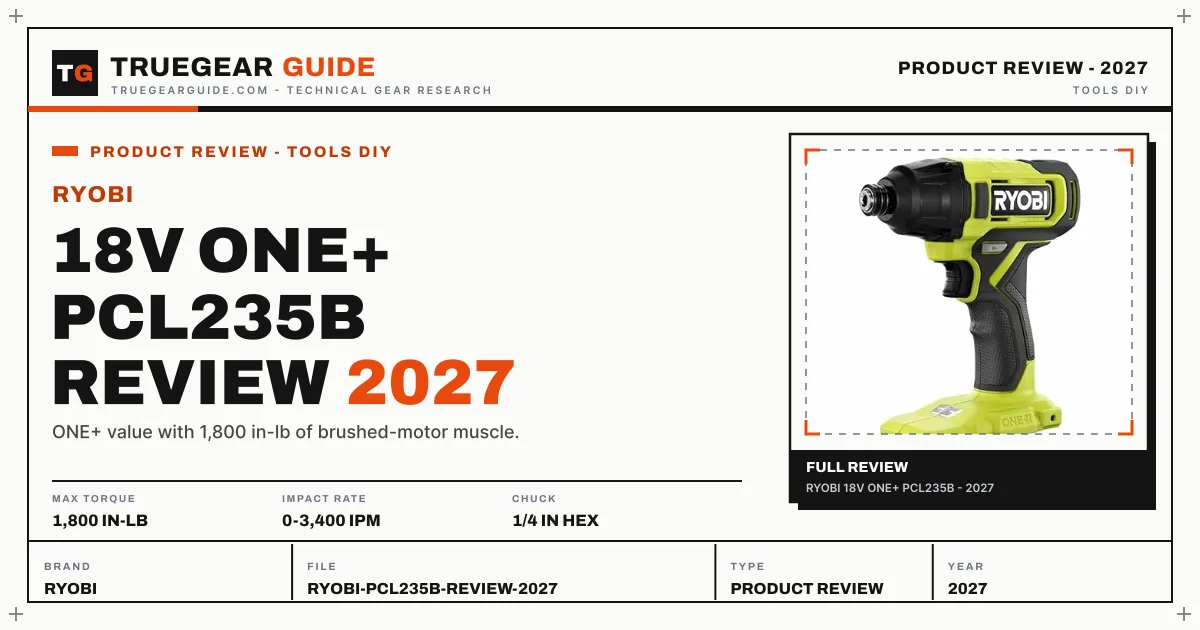
In-depth review of the Ryobi PCL235B: 1,800 in-lb brushed power, ONE+ value, and the compromises behind the price.

Our verdict
The PCL235B is proof that torque got cheap. Its brushed motor delivers 1,800 in-lb that embarrasses mid-priced rivals, and ONE+ batteries are the most affordable in the industry. You trade refinement, size, and efficiency for that price, and for most homeowners it is the right trade.
What we like
- 1,800 in-lb torque rivals pricier brushed rivals
- ONE+ batteries are cheap and shared across 260-plus tools
- Built-in LED work light for dark work areas
- 0-3,400 IPM impact rate keeps long screws moving
What to watch out for
- Brushed motor is less efficient and wears faster
- Bulkier and heavier than brushless competitors
- Sold tool-only on Amazon; battery and charger cost extra
What owners report: Ryobi 18V ONE+ PCL235B
Synthesized from recurring themes in long-term owner feedback.
Most praised
- Torque on par with pricier brands from a budget brushed driver
- ONE Plus batteries are inexpensive and shared across a huge tool family
- The built in LED helps inside cabinets and dark joist bays
Common complaints
- The brushed motor is less efficient and will wear sooner than brushless rivals
- It feels bulkier and heavier than brushless competitors in the hand
- Tool only listings leave battery and charger as extra purchases
Who it is for
Homeowners and ONE+ owners who want maximum driving power per dollar for projects, not production work.
Power versus polish
On paper the PCL235B out-torques the Makita XDT16. In hand, the difference is delivery: a single speed range and a less progressive trigger mean you supply the finesse the Makita automates. For deck screws and flat-pack bolts, that hardly matters. For brass hardware, it does.
Runtime and the brushed penalty
Brushed motors convert more battery into heat, so expect fewer screws per charge than brushless rivals on the same amp-hours. The saving grace is economics: a second ONE+ 4.0Ah battery costs less than the brushless upgrade on rival platforms.
Size and daily use
This is a full-size, slightly bulky driver with a genuinely good LED work light and a quick-release collet that works with gloves. It will not sneak into cabinet corners like the Bosch PS42, but it was never meant to.
Who should skip it, and who should not
Skip the PCL235B if your work is overhead all day, inside finished cabinetry, or on a crew where one tool must survive daily production driving; the size, single speed range, and brushed appetite for batteries will wear on you. Buy it without hesitation if your driving is weekend-shaped: furniture assembly, fence repairs, a deck every few years, and the long tail of household jobs. In that role the compromises barely surface, the torque is real, and the money saved buys the bits, batteries, and materials that finish the project.
Key specifications
- Max torque
- 1,800 in-lb
- Impact rate
- 0-3,400 IPM
- Chuck
- 1/4 in hex
- Motor
- Brushed
- Weight
- 2.7 lb (tool only)
Also consider

CRAFTSMAN V20 CMCF800
Straightforward V20 power for everyday home projects.
Why consider it: A similarly priced V20 alternative if your other tools are CRAFTSMAN.
- Max torque: 1,500 in-lb
- No-load speed: 0-2,800 RPM
DEWALT ATOMIC 20V MAX DCF809
ATOMIC compactness with 1,700 in-lb on tap.
Why consider it: Brushless compact efficiency if your budget stretches to mid-tier.
- Max torque: 1,700 in-lb
- No-load speed: 0-2,800 RPM
Research-based assessment. TrueGear has not hands-on tested this product; this evaluation synthesizes manufacturer specifications, retailer documentation, and published expert reviews.
Questions, answered
How long do brushed motors last?
Years of weekend use. Brushes are wear items but inexpensive, and most homeowners will upgrade the platform before wearing this motor out.
Which ONE+ battery should I pair with it?
A 4.0Ah HP pack for deck and framing work; the compact 1.5Ah kit battery is fine for furniture and hanging jobs.
Can it drive lag bolts?
Moderate lags in pre-drilled holes, yes. Continuous large-lag work deserves a flagship brushless driver or an impact wrench.