In-depth review
Festool ETS 125 REQ-Plus Review (2027)
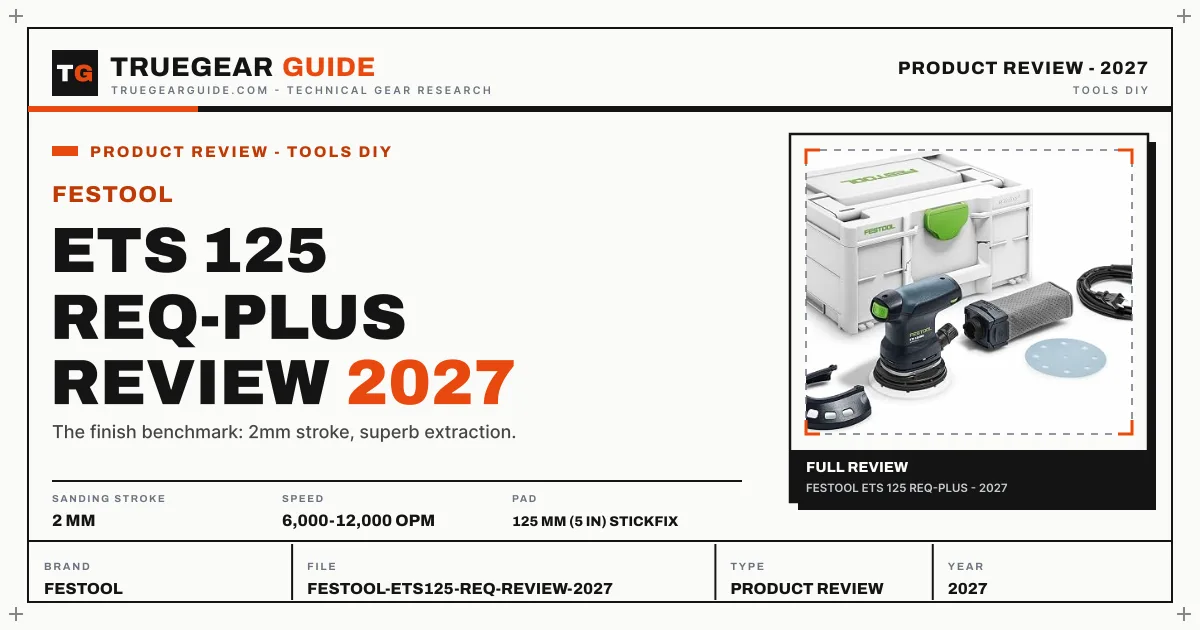
In-depth review of the Festool ETS 125 REQ-Plus: 2mm stroke finish quality, extraction, and who should pay the premium.

Our verdict
The ETS 125 REQ is a finishing instrument disguised as a sander. Its 2mm stroke, jewel-like balance, and extraction performance produce surfaces that take clear finishes beautifully. It is slow at removal by design, and worth every cent to the right woodworker.
What we like
- 2mm sanding stroke produces the finest finish here
- Near-total dust capture with a Festool extractor
- Exceptionally low vibration for marathon sessions
- Pad brake and MMC electronics hold speed under load
What to watch out for
- Premium price plus Festool abrasive ecosystem costs
- Gentle stroke removes stock slowly
- Best value only when paired with extraction
What owners report: Festool ETS 125 REQ-Plus
Synthesized from recurring themes in long-term owner feedback.
Most praised
- The fine stroke leaves surfaces owners describe as ready for finish with minimal hand work
- Paired with an extractor, dust capture is close to total, keeping shops and lungs happier
- Very low vibration makes marathon furniture sessions genuinely comfortable
Common complaints
- The gentle stroke removes stock slowly, so it is the wrong tool for heavy leveling
- Premium pricing extends into the abrasive ecosystem owners buy into
- Its full value only shows when paired with proper extraction, another purchase
Who it is for
Furniture makers, cabinet finishers, and anyone whose final surface is the product.
The 2mm difference
Stroke size is destiny in finish sanding. At 2mm the ETS 125 removes scratches from the previous grit without writing new ones, which is why owners report going straight to finish with confidence. Pair it with Festool Granat abrasives and the system logic clicks.
Dust as a design priority
With a CT extractor the ETS captures dust at a level bag sanders cannot approach, keeping abrasives cutting and the shop air clean. This is not a luxury for professionals sanding MDF and hardwoods daily; it is occupational hygiene.
Limits and value
Do not ask it to strip paint or flatten cupped boards; that is belt and Rotex territory. The ETS earns its premium only in a workflow that values finish above speed, ideally within the Festool extraction ecosystem.
Abrasives as part of the system
The ETS rewards owners who stay inside its abrasive logic. Granat discs match the pad hole pattern exactly, so extraction stays at full strength and discs run cooler and longer. Mixing in bargain discs with mismatched holes quietly taxes the very dust performance you paid for. Budget the system, not just the sander, and the finish quality stays repeatable from the first panel to the fiftieth.
Key specifications
- Sanding stroke
- 2 mm
- Speed
- 6,000-12,000 OPM
- Pad
- 125 mm (5 in) StickFix
- Power
- 250 W corded
- Weight
- 2.6 lb
Also consider

DEWALT 20V MAX XR Random Orbital DCW210
Brushless cordless orbit with dialed-in control.
Why consider it: Cordless versatility and faster removal for general project work.
- Orbit diameter: 3/32 in (2.4 mm)
- Speed: 8,000-12,000 OPM

Makita 9403 Belt Sander
4x24 belt muscle, famously quiet for its class.
Why consider it: The opposite tool: maximum removal when finish sanders stall.
- Belt size: 4 x 24 in
- Belt speed: 1,640 ft/min
Research-based assessment. TrueGear has not hands-on tested this product; this evaluation synthesizes manufacturer specifications, retailer documentation, and published expert reviews.
Questions, answered
ETS 125 or ETS 150: which size?
The 125 for smaller workpieces, edges, and one-handed control; the 150 covers large tabletops faster. Both share the fine-finish character.
Do I need a Festool extractor?
Any good vacuum works with adapters, but auto-start and matched suction make the Festool pairing seamless. The sander alone still outperforms rivals on bag capture.
Is it good for drywall?
It can smooth small patches superbly, but drywall dust volume overwhelms fine pads quickly. Dedicated drywall sanders suit whole rooms.
Can it sand curved and profiled work?
With a soft interface pad it follows gentle curves kindly, which is why luthiers and boat finishers keep one nearby. Sharp profiles still belong to hand blocks and detail sanders; the ETS is a flat-work instrument first.