Beginner friendly
Best Circular Saws for Beginners (2027)
The best circular saws for beginners in 2027: forgiving handling, clear sight lines, and safety features that matter while you learn.
The short answer
Beginners should start with the Skil 5280-01: full 7-1/4 in capacity at the lowest cost, so learning mistakes are cheap. If safety features matter most while you learn, the DeWalt DWE575SB adds an electric brake worth paying for.
Our top picks at a glance
- Skil 5280-01The budget 7-1/4 in that just works.Best for beginners
- Makita XSS02ZThe compact cutter for one-handed control.Easiest to control
- DeWalt DWE575SBThe corded benchmark that cordless chases.Best to grow into
- Worx WX429LOne-handed 4-1/2 in cutting for trim and plywood.Best one-hand saw
- Bosch CS10Corded value: 15 amps and 5,600 RPM for less.Best corded value
- Ryobi P507Brushless 18V cutting: 4,700 RPM on the ONE+ platform.Best 18V value
- DeWalt ATOMIC 4-1/2 in. Circular Saw (DCS571B)A true compact cordless saw: 4-1/2 inch brushless, and it still cuts 2x stock.Best compact for learning
What owners report
Synthesized from recurring themes in long-term owner feedback.
Most praised
- Beginners value compact and lower-cost saws that feel controllable while learning to track a line
- A positive bevel stop and clear guard movement make early angled cuts less intimidating
Common complaints
- Entry saws without a blade brake teach patience, since the blade coasts before set-down
- New users quickly discover depth limits when a project moves from plywood to framing lumber
The picks, ranked
Every product in this lineup was picked for this use case, ranked with our strongest choices first. If a product from the wider category does not genuinely fit this scenario, it is not listed here.
| # | Product | Award | Motor | Blade | No-load speed | Bevel capacity | Brake |
|---|---|---|---|---|---|---|---|
| 1 | Skil 5280-01 | Best for beginners | 15 amp corded | 7-1/4 in | 5,300 RPM | 51 degrees | None |
| 2 | Makita XSS02Z | Easiest to control | Brushed | 6-1/2 in | 5,000 RPM | 50 degrees | - |
| 3 | DeWalt DWE575SB | Best to grow into | 15 amp corded | 7-1/4 in | 5,200 RPM | 57 degrees | Electric |
| 4 | Worx WX429L | Best one-hand saw | - | - | 4,600 RPM | - | - |
| 5 | Bosch CS10 | Best corded value | - | 7-1/4 in | 5,600 RPM | 56 degrees | - |
| 6 | Ryobi P507 | Best 18V value | Brushless | 7-1/4 in | 4,700 RPM | 50 degrees | - |
| 7 | DeWalt ATOMIC 4-1/2 in. Circular Saw (DCS571B) | Best compact for learning | - | 4-1/2 in | 4,500 RPM | - | Electronic blade brake |
Best for beginners
Skil 5280-01
The budget 7-1/4 in that just works.

The 5280-01 is cheap enough that mistakes do not hurt, full-size enough to learn real technique, and simple: 15 amps, 5,300 RPM, a 51-degree bevel with a positive 45-degree stop. Beginners should learn on a saw they are not afraid of.
Strengths
- 15-amp motor and 5,300 RPM match pricier corded saws
- 51-degree bevel with positive 45-degree stop for common angles
- 7-1/4 in blade handles full 2x depth cuts
- Lowest entry cost in the full-size class
Limitations
- No electric brake; blade coasts after trigger release
- Basic shoe and guard feel less refined than premium saws
- Corded only, no battery path
| Motor | 15 amp corded |
|---|---|
| Blade | 7-1/4 in |
| No-load speed | 5,300 RPM |
| Bevel capacity | 51 degrees |
| Brake | None |
Best for: Occasional users who want full-size capacity at the lowest cost.
Skip if: You cut daily or need premium dust control and brakes.
Easiest to control
Makita XSS02Z
The compact cutter for one-handed control.

The compact 6-1/2 in frame is the least intimidating saw here, and lighter weight means steadier cuts while your technique develops. A great second saw even after you outgrow it as a primary.
Strengths
- 6-1/2 in blade and compact frame excel in tight spaces
- 5,000 RPM is plenty for sheet goods and trim
- 50-degree bevel covers nearly all finish angles
- Light body reduces arm fatigue on long cut sessions
Limitations
- 6-1/2 in blade cannot cut 2x stock at 90 degrees in one pass
- Smaller blade means slower deep rips
- Bare tool; battery and charger add to the real cost
| Platform | 18V LXT |
|---|---|
| Blade | 6-1/2 in |
| No-load speed | 5,000 RPM |
| Bevel capacity | 50 degrees |
| Motor | Brushed |
Best for: Users who prioritize maneuverability for trim, plywood, and overhead cuts.
Skip if: You regularly rip 2x lumber at full depth.
Best to grow into
DeWalt DWE575SB
The corded benchmark that cordless chases.

If you would rather buy once, the DWE575SB's electric brake is a genuine safety upgrade for beginners, and its 57-degree bevel and 5,200 RPM mean you will never outgrow it.
Strengths
- 15-amp motor holds 5,200 RPM under load in 2x stock
- 57-degree bevel capacity is the deepest in this group
- Electric brake stops the blade in seconds for safer set-downs
- Lightweight 8.8 lb body reduces fatigue on long rip cuts
Limitations
- Cord tethers you to outlets and snags on workpieces
- No battery platform to grow into
- Dust collection needs an adapter for shop vacs
| Motor | 15 amp corded |
|---|---|
| Blade | 7-1/4 in |
| No-load speed | 5,200 RPM |
| Bevel capacity | 57 degrees |
| Brake | Electric |
Best for: Buyers who want unlimited runtime and the deepest bevel in the class.
Skip if: You need cordless freedom or already own into a battery platform.
Best one-hand saw
Worx WX429L
One-handed 4-1/2 in cutting for trim and plywood.

Its own positioning says it plainly: the WX429L is the least intimidating saw here, a compact one-hand 20V saw that teaches control on trim and plywood before a beginner ever meets a full-size blade.
Strengths
- Compact one-hand form factor
- 4,600 RPM is plenty for thin stock
- Runs on 20V PowerShare batteries
- Least intimidating saw here for beginners
Limitations
- 4-1/2 in blade limits cut depth
- Not for framing or thick hardwoods
- Small base can feel tippy on wide boards
| Platform | 20V PowerShare |
|---|---|
| Blade diameter | 4-1/2 in |
| No-load speed | 4,600 RPM |
| Form factor | Compact one-hand |
| Best for | Trim, plywood, PVC |
Best for: Trim work, plywood breakdown, and users who fear full-size saws.
Skip if: You rip 2x lumber regularly; the 4-1/2 in blade cannot.
Best corded value
Bosch CS10
Corded value: 15 amps and 5,600 RPM for less.

The CS10 is the gentle full-size route: a 15-amp corded saw with 5,600 RPM and a 56-degree bevel at the lowest full-size price here, and a cord means a beginner never fights a dying battery mid-cut.
Strengths
- 15-amp motor for sustained cutting
- 5,600 RPM keeps cuts clean
- 56-degree bevel capacity
- Lowest price among full-size corded saws here
Limitations
- Cord tethers you to an outlet
- Basic feature set, no frills
- Heavier than magnesium rivals
| Power | 15A corded |
|---|---|
| No-load speed | 5,600 RPM |
| Blade | 7-1/4 in |
| Bevel capacity | 56 degrees |
| Weight | 10.3 lbs |
Best for: Budget buyers who want full-size cutting capacity on a cord.
Skip if: You want the lightest saw; 10.3 lbs is middle of the pack.
Best 18V value
Ryobi P507
Brushless 18V cutting: 4,700 RPM on the ONE+ platform.

For a beginner already holding ONE+ batteries, the brushless P507 adds cordless freedom and a full-size blade at a budget tier, with a 50-degree bevel that covers the angles a first year of projects actually uses.
Strengths
- Brushless motor stretches battery runtime
- 4,700 RPM with a full 7-1/4 in blade
- 50-degree bevel capacity
- Uses batteries you may already own
Limitations
- Less sustained power than 60V saws
- Bare tool; battery cost if you are new to ONE+
- Heavier than compact-class saws
| Platform | 18V ONE+ |
|---|---|
| Motor | Brushless |
| Blade | 7-1/4 in |
| No-load speed | 4,700 RPM |
| Bevel capacity | 50 degrees |
Best for: ONE+ owners who want a capable cordless saw without a new battery system.
Skip if: You cut thick hardwoods all day; 18V has less stamina than 60V.
Best compact for learning
DeWalt ATOMIC 4-1/2 in. Circular Saw (DCS571B)
A true compact cordless saw: 4-1/2 inch brushless, and it still cuts 2x stock.
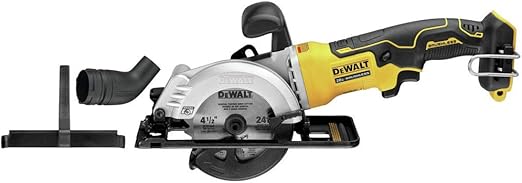
Learning on a 5.5 lb saw with an electronic brake is simply safer: the DCS571B stops fast, starts cuts one-handed with its auxiliary handle, and still graduates to real 2x work as skills grow.
Strengths
- Brushless 20V MAX motor spins the 4-1/2 inch blade at 4,500 RPM
- Bevel-gear design cuts 2x material at 90 degrees and 1x at 45 degrees
- Electronic blade brake stops the blade fast between cuts
- Removable auxiliary handle and on-board dust port for controlled trim work
Limitations
- 1-9/16 inch depth ceiling rules out doubled-up lumber and thick beams
- Tool-only listing; battery and charger are separate if you are new to 20V MAX
- Small blade selection is narrower than the 7-1/4 inch ecosystem
| Platform | 20V MAX, brushless (tool only) |
|---|---|
| Blade | 4-1/2 in |
| No-load speed | 4,500 RPM |
| Depth of cut | 1-9/16 in at 90 degrees |
| Brake | Electronic blade brake |
| Weight | About 5.5 lb (tool only) |
Sources: Desertcart, Starshop, CamelCamelCamel
Best for: Trim carpenters and DIYers who want one-hand control without giving up 2x depth.
Skip if: You rip long framing lumber all day; a full-size 7-1/4 inch saw is the right tool.
Questions, answered
What is the safest circular saw for a beginner?
One with an electric brake, like the DeWalt DWE575SB. The brake stops the blade quickly after the trigger releases, which is the feature that prevents the most common beginner accidents.
Should beginners get corded or cordless?
Corded. It is cheaper, lighter without a battery, and never dies mid-cut, which removes variables while you are learning technique.
What blade should a beginner use?
A 24-tooth framing blade for rough cuts and a 40-tooth general purpose blade for plywood. Dull blades cause more accidents than any saw feature, so replace them early.
How do I make straight cuts as a beginner?
Clamp a straight board as a guide fence. Freehand straight cuts take practice; a guide gives you perfect cuts on day one and teaches you what straight feels like.