Cordless picks
Best Cordless Circular Saws (2027)
The best cordless circular saws of 2027: full-size cutting power without the cord, ranked on RPM and battery efficiency.
The short answer
The Milwaukee M18 2732-20 is the best cordless circular saw of 2027: 5,800 RPM brushless power with a full 7-1/4 in blade. For lighter work, the compact Makita XSS02Z stretches batteries further and handles better.
Our top picks at a glance
- Milwaukee M18 2732-20Cordless 7-1/4 in power without compromise.Best cordless overall
- Makita XSS02ZThe compact cutter for one-handed control.Best compact cordless
- DeWalt DWE575SBThe corded benchmark that cordless chases.Corded alternative
- DeWalt DCS570BFlexVolt muscle: corded-class 5,800 RPM without the cord.Most powerful cordless
- Ryobi P507Brushless 18V cutting: 4,700 RPM on the ONE+ platform.Best 18V value
- Worx WX429LOne-handed 4-1/2 in cutting for trim and plywood.Best one-hand saw
- DeWalt ATOMIC 4-1/2 in. Circular Saw (DCS571B)A true compact cordless saw: 4-1/2 inch brushless, and it still cuts 2x stock.Best true compact cordless
What owners report
Synthesized from recurring themes in long-term owner feedback.
Most praised
- Cordless owners praise cutting anywhere on a site without hunting for power or dragging a cord over fresh work
- Full-size blade models in this list handle framing lumber in one pass, not just sheet goods
Common complaints
- Battery size decides the working day, and owners of small packs feel it first
- Premium brushless models plus batteries cost far more than a proven corded saw
The picks, ranked
Every product in this lineup was picked for this use case, ranked with our strongest choices first. If a product from the wider category does not genuinely fit this scenario, it is not listed here.
| # | Product | Award | Platform | Motor | Blade | No-load speed | Bevel capacity |
|---|---|---|---|---|---|---|---|
| 1 | Milwaukee M18 2732-20 | Best cordless overall | M18 18V | Brushless FUEL | 7-1/4 in | 5,800 RPM | 50 degrees |
| 2 | Makita XSS02Z | Best compact cordless | 18V LXT | Brushed | 6-1/2 in | 5,000 RPM | 50 degrees |
| 3 | DeWalt DWE575SB | Corded alternative | - | 15 amp corded | 7-1/4 in | 5,200 RPM | 57 degrees |
| 4 | DeWalt DCS570B | Most powerful cordless | 60V MAX | Brushless | 7-1/4 in | 5,800 RPM | 57 degrees |
| 5 | Ryobi P507 | Best 18V value | 18V ONE+ | Brushless | 7-1/4 in | 4,700 RPM | 50 degrees |
| 6 | Worx WX429L | Best one-hand saw | 20V PowerShare | - | - | 4,600 RPM | - |
| 7 | DeWalt ATOMIC 4-1/2 in. Circular Saw (DCS571B) | Best true compact cordless | 20V MAX, brushless (tool only) | - | 4-1/2 in | 4,500 RPM | - |
Best cordless overall
Milwaukee M18 2732-20
Cordless 7-1/4 in power without compromise.

5,800 RPM from a brushless FUEL motor with a full 7-1/4 in blade: the 2732-20 cuts like a corded saw with none of the cord. The magnesium shoe and rafter hook are proper jobsite details.
Strengths
- Brushless FUEL motor spins 5,800 RPM, fastest here
- Full 7-1/4 in blade cuts 2x lumber at 90 degrees in one pass
- Magnesium shoe stays flat and resists jobsite bending
- Rafter hook hangs the saw safely between cuts
Limitations
- Bare tool price is premium before batteries
- Heavier than corded equivalents with a 5.0Ah pack
- Runtime depends entirely on battery size you own
| Platform | M18 18V |
|---|---|
| Motor | Brushless FUEL |
| Blade | 7-1/4 in |
| No-load speed | 5,800 RPM |
| Bevel capacity | 50 degrees |
Best for: M18 owners who want full-size cordless cutting for framing and decks.
Skip if: You want the lowest cost or rarely cut away from outlets.
Best compact cordless
Makita XSS02Z
The compact cutter for one-handed control.

The 6-1/2 in XSS02Z sips battery compared to full-size saws, stretching smaller LXT packs through a day of trim and plywood. The light frame is the real win for overhead and one-handed cuts.
Strengths
- 6-1/2 in blade and compact frame excel in tight spaces
- 5,000 RPM is plenty for sheet goods and trim
- 50-degree bevel covers nearly all finish angles
- Light body reduces arm fatigue on long cut sessions
Limitations
- 6-1/2 in blade cannot cut 2x stock at 90 degrees in one pass
- Smaller blade means slower deep rips
- Bare tool; battery and charger add to the real cost
| Platform | 18V LXT |
|---|---|
| Blade | 6-1/2 in |
| No-load speed | 5,000 RPM |
| Bevel capacity | 50 degrees |
| Motor | Brushed |
Best for: Users who prioritize maneuverability for trim, plywood, and overhead cuts.
Skip if: You regularly rip 2x lumber at full depth.
Corded alternative
DeWalt DWE575SB
The corded benchmark that cordless chases.

Not cordless, but worth naming: if your 'cordless' shortlist exists because you hate cords, not because you lack outlets, the DWE575SB's 5,200 RPM and 57-degree bevel outperform every cordless saw here except the Milwaukee.
Strengths
- 15-amp motor holds 5,200 RPM under load in 2x stock
- 57-degree bevel capacity is the deepest in this group
- Electric brake stops the blade in seconds for safer set-downs
- Lightweight 8.8 lb body reduces fatigue on long rip cuts
Limitations
- Cord tethers you to outlets and snags on workpieces
- No battery platform to grow into
- Dust collection needs an adapter for shop vacs
| Motor | 15 amp corded |
|---|---|
| Blade | 7-1/4 in |
| No-load speed | 5,200 RPM |
| Bevel capacity | 57 degrees |
| Brake | Electric |
Best for: Buyers who want unlimited runtime and the deepest bevel in the class.
Skip if: You need cordless freedom or already own into a battery platform.
Most powerful cordless
DeWalt DCS570B
FlexVolt muscle: corded-class 5,800 RPM without the cord.

The DCS570B is the cordless ceiling here: 60V MAX brushless power at 5,800 RPM with a 57-degree bevel, the saw for crews who cut framing all day and refuse to drag a cord.
Strengths
- 60V MAX power rivals corded saws
- Brushless motor for efficiency
- 5,800 RPM with a 7-1/4 in blade
- 57-degree bevel capacity for steep cuts
Limitations
- Bare tool; 60V batteries are expensive
- Heavier than 18V-class saws
- Overkill for occasional plywood cuts
| Platform | 60V MAX |
|---|---|
| Motor | Brushless |
| No-load speed | 5,800 RPM |
| Blade | 7-1/4 in |
| Bevel capacity | 57 degrees |
Best for: Pros who want to cut the cord without cutting power.
Skip if: You are not on the 60V platform; the battery cost is real.
Best 18V value
Ryobi P507
Brushless 18V cutting: 4,700 RPM on the ONE+ platform.

The P507 brings a brushless motor and a full 7-1/4 inch blade to the ONE+ platform, so millions of existing Ryobi batteries suddenly own a capable cordless saw at a budget tier.
Strengths
- Brushless motor stretches battery runtime
- 4,700 RPM with a full 7-1/4 in blade
- 50-degree bevel capacity
- Uses batteries you may already own
Limitations
- Less sustained power than 60V saws
- Bare tool; battery cost if you are new to ONE+
- Heavier than compact-class saws
| Platform | 18V ONE+ |
|---|---|
| Motor | Brushless |
| Blade | 7-1/4 in |
| No-load speed | 4,700 RPM |
| Bevel capacity | 50 degrees |
Best for: ONE+ owners who want a capable cordless saw without a new battery system.
Skip if: You cut thick hardwoods all day; 18V has less stamina than 60V.
Best one-hand saw
Worx WX429L
One-handed 4-1/2 in cutting for trim and plywood.

Worx's 4-1/2 inch PowerShare saw is the cordless pick for trim and plywood: one-hand control, 4,600 RPM, and a size that makes overhead and in-place cuts calm instead of risky.
Strengths
- Compact one-hand form factor
- 4,600 RPM is plenty for thin stock
- Runs on 20V PowerShare batteries
- Least intimidating saw here for beginners
Limitations
- 4-1/2 in blade limits cut depth
- Not for framing or thick hardwoods
- Small base can feel tippy on wide boards
| Platform | 20V PowerShare |
|---|---|
| Blade diameter | 4-1/2 in |
| No-load speed | 4,600 RPM |
| Form factor | Compact one-hand |
| Best for | Trim, plywood, PVC |
Best for: Trim work, plywood breakdown, and users who fear full-size saws.
Skip if: You rip 2x lumber regularly; the 4-1/2 in blade cannot.
Best true compact cordless
DeWalt ATOMIC 4-1/2 in. Circular Saw (DCS571B)
A true compact cordless saw: 4-1/2 inch brushless, and it still cuts 2x stock.
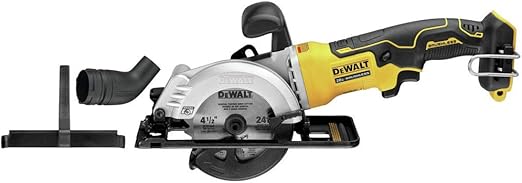
The ATOMIC DCS571B is the compact the cordless list was missing: a 4-1/2 inch brushless saw at about 5.5 lb that still cuts 2x stock at 90 degrees and brakes electronically between cuts.
Strengths
- Brushless 20V MAX motor spins the 4-1/2 inch blade at 4,500 RPM
- Bevel-gear design cuts 2x material at 90 degrees and 1x at 45 degrees
- Electronic blade brake stops the blade fast between cuts
- Removable auxiliary handle and on-board dust port for controlled trim work
Limitations
- 1-9/16 inch depth ceiling rules out doubled-up lumber and thick beams
- Tool-only listing; battery and charger are separate if you are new to 20V MAX
- Small blade selection is narrower than the 7-1/4 inch ecosystem
| Platform | 20V MAX, brushless (tool only) |
|---|---|
| Blade | 4-1/2 in |
| No-load speed | 4,500 RPM |
| Depth of cut | 1-9/16 in at 90 degrees |
| Brake | Electronic blade brake |
| Weight | About 5.5 lb (tool only) |
Sources: Desertcart, Starshop, CamelCamelCamel
Best for: Trim carpenters and DIYers who want one-hand control without giving up 2x depth.
Skip if: You rip long framing lumber all day; a full-size 7-1/4 inch saw is the right tool.
Questions, answered
Can cordless saws match corded power?
The best ones can. The Milwaukee 2732-20's 5,800 RPM exceeds most 15-amp corded saws, though sustained all-day ripping still favors corded for unlimited runtime.
What battery size do I need for a cordless saw?
5.0Ah minimum for real work. Saws are the hungriest cordless tools; small packs drain in minutes under rip-cut loads.
Are compact 6-1/2 in saws enough?
For plywood, trim, and 1x lumber, yes, and they are far easier to control. For 2x framing at full depth, you need 7-1/4 in.
Do I need the same brand as my drill?
It helps a lot. Sharing batteries between your saw and drill halves your battery investment, which is the strongest argument for platform loyalty.