Buying guide
Universal Travel Adapter Buying Guide (2027)
How to choose a travel adapter: adapter vs converter explained, plug types by region, USB charging realities, and claims to ignore.
Adapter vs converter: the critical distinction
An adapter changes plug shape so your device fits the outlet; it does nothing to electricity. A converter changes voltage (e.g., 220V to 110V) and is a separate, heavier device. Most modern electronics (phones, laptops, tablets, camera chargers) accept 100-240V, check the label, and need only an adapter. Single-voltage appliances like most hair dryers and straighteners need a converter or, better, a dual-voltage travel version. Plugging a 120V-only dryer into 220V through a mere adapter will destroy it, possibly dramatically.
Plug types by region
Learn the four families: Type A/B (North America, Japan), Type C/E/F (Europe), Type G (UK, Ireland, much of Africa and Asia), Type I (Australia, China, Argentina). A true universal adapter covers all four, which handles 150+ countries. If you only ever visit one region, a simple single-type plug is smaller and cheaper than a universal.
USB ports and charging realities
Count your devices, then buy ports accordingly: a phone, watch, and earbuds need three. USB-C is now essential; USB-A remains useful for older accessories. But understand the limits: budget adapter USB ports share modest total power, so they will not fast-charge laptops. For speed, plug a GaN multi-port charger into the adapter's AC outlet instead of relying on built-in USB.
What to ignore
Country counts: 150+ versus 200+ is marketing rounding; what matters is covering the four plug families. "Surge protection" claims: most adapters have fuses, not true surge protection; do not rely on them for expensive gear in storm-prone grids. Voltage conversion claims on cheap adapters: if it is light and cheap, it is not a converter. Built-in cables: they fray and cannot be replaced; bring your own quality cables.
Start with our top 3
The three highest-ranked products in our full universal travel adapters (2027) ranking. Read the in-depth review where one exists, or jump to the product in the ranked list.
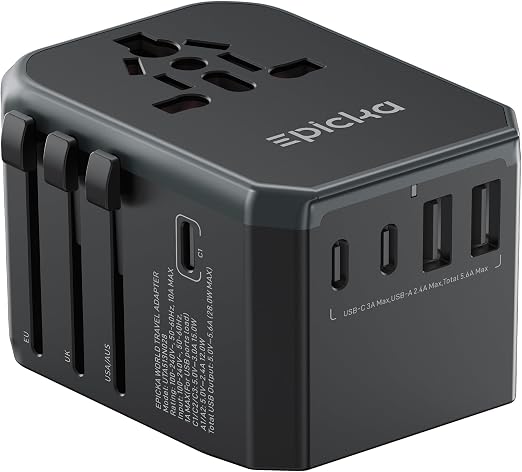
Epicka Universal Travel Adapter
The bestseller: five-device charging for 150+ countries.
- USB: 4x USB-A + 1x USB-C
- Coverage: 150+ countries

Tessan Universal Travel Adapter
Five-device charging with dual-fuse safety.
- USB: Multi-port USB-A and USB-C
- Coverage: 200+ countries advertised

Ceptics World Travel Adapter Kit
The compact kit for country-hoppers.
- USB: 2x USB-A
- Coverage: Worldwide plug types
Questions, answered
Do I need a universal adapter or a country-specific one?
Multi-country trips: universal. Single country, repeatedly: a small country-specific plug is cheaper and more compact. Most travelers are better served by one good universal.
How many adapters should I pack?
One universal with multi-USB covers most trips. Add a second cheap one as backup for important trips, or a travel power strip if your hotel room has one outlet.
Are airport adapters overpriced?
Wildly. Buy before you travel: airport shops charge multiples for worse adapters. This is a buy-ahead item, not a buy-there item.
What certifications should an adapter have?
Look for CE, FCC, or equivalent marks and documented fuse protection. Avoid unbranded adapters with no certifications; they are the ones that melt in foreign outlets.