Buying guide
Tire Inflators Buying Guide (2027)
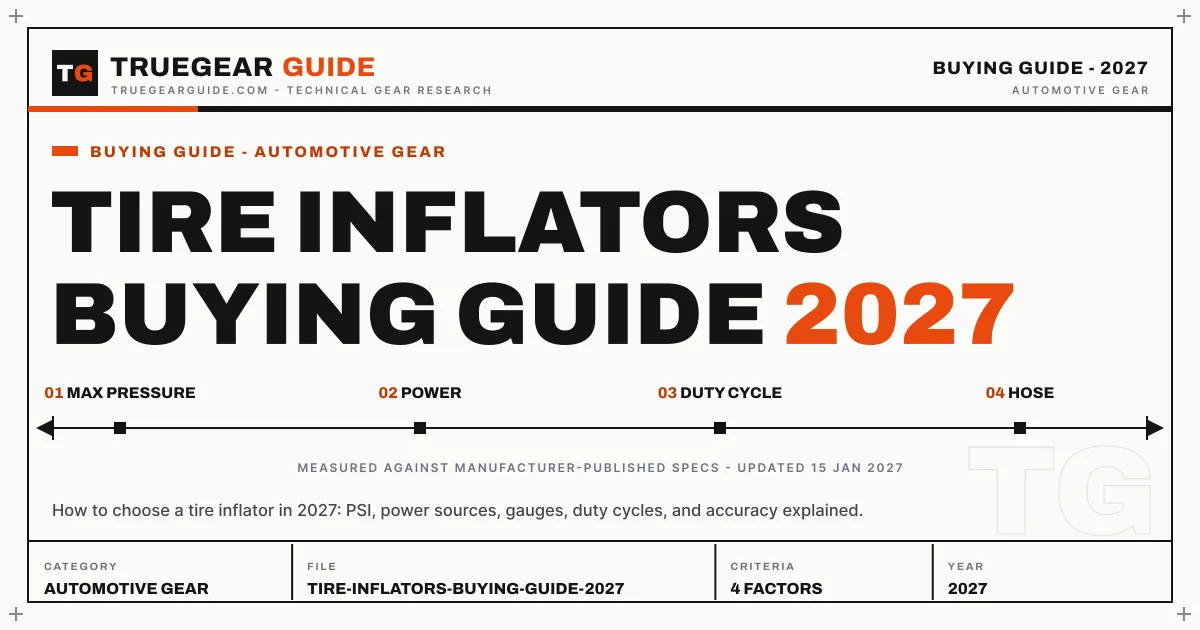
How to choose a tire inflator in 2027: PSI, power sources, gauges, duty cycles, and accuracy explained.
Match max PSI to your tires
Passenger cars need 30 to 35 PSI, so a 100 PSI inflator has plenty of headroom. Trucks and towing setups run 35 to 80 PSI, where a 120 to 150 PSI compressor fills faster and strains less. Buy headroom above your target: a compressor working near its max is slow and hot.
Power source: 12V socket, battery clips, or cordless
Accessory-socket inflators are the simplest: plug in and go, but current-limited to modest power. Battery-clip compressors draw 20 amps for serious airflow at the cost of popping the hood. Cordless tool-platform inflators offer total freedom if you own the batteries. Choose by where and how often you inflate.
Gauges and auto-shutoff
Digital gauges with programmable auto-shutoff are the biggest usability upgrade in the category: set the target and walk away. Analog gauges work but demand attention. Whatever you buy, verify monthly with a standalone gauge, since built-in sensors drift over time.
Duty cycle and heat
Compressors generate heat, and cheap ones overheat fast. Respect the rated duty cycle: 10 to 15 minutes for compacts, 25 minutes at 30 PSI for the VIAIR 88P. If you regularly fill four large tires, duty cycle matters more than top speed.
Hose reach and chuck style decide whether the fourth tire is easy or annoying. Measure the real job: from the power source, around the car, to the farthest valve stem, with slack to work. A hose that barely reaches forces you to move the inflator and re-route the cord at every corner, while a generous coil hose lets one setup serve the whole car. Screw-on chucks seal securely and suit careful top-offs; lever-lock chucks are faster when you check pressures often. Also confirm the chuck reaches valve stems recessed in deep wheel pockets, because a chuck that cannot seat fully leaks more air than the compressor can replace on small units.
Start with our top 3
The three highest-ranked products in our full tire inflators ranking. Read the in-depth review where one exists, or jump to the product in the ranked list.

VIAIR 88P
The 120 PSI workhorse for trucks and SUVs.
- Max pressure: 120 PSI
- Power: 12V, 20 amps via battery clips

AstroAI Portable Air Compressor
Digital accuracy with auto-shutoff for everyday cars.
- Max pressure: 100 PSI
- Power: 12V DC accessory socket

Ryobi 18V ONE+ High Pressure Digital Inflator PCL001
Cordless freedom on the ONE+ battery platform.
- Max pressure: 160 PSI
- Power: 18V ONE+ battery
Questions, answered
How often should I check tire pressure?
Monthly, and before long trips. Tires lose 1 to 2 PSI per month naturally, plus more in cold weather.
Should I inflate to the sidewall number?
No. The sidewall shows the maximum; the door jamb sticker shows the recommended pressure for your car.
Do inflators work on bike tires?
Yes, with Presta adapters. Digital models are excellent for hitting exact bike pressures.
Can I leave an inflator in a hot car?
Occasional heat is fine, but prolonged trunk baking shortens electronics life. Bring it inside in extreme summer heat.