Buying guide
Sleeping Pads Buying Guide (2027)
How to choose a sleeping pad in 2027: ASTM R-values by season, pad types, thickness and width, and insulation explained.
R-value: the only warmth number that matters
Since the ASTM F3340 standard, R-values are tested the same way by every major brand, so R-4.8 means the same warmth from Exped, Big Agnes, or Therm-a-Rest. Match the rating to your coldest expected night: R-2 for summer, R-4 to 5 for spring-through-fall, R-5.5-plus for winter and snow. Remember that your sleeping bag's temperature rating assumes a pad of roughly R-4 beneath it in three-season testing.
Pad types: air, foam, and self-inflating
Inflatable air pads offer the best warmth, comfort, and packability per ounce, at the price of puncture risk and cost. Closed-cell foam pads like the Z Lite Sol cannot fail and cost little, but they are bulky and firm. Self-inflating foam-core pads like the ProLite Plus split the difference: reliable and simple, heavier than air. Most backpackers end up with an air pad plus a foam pad for winter stacking.
Thickness, width, and shape
Thickness is comfort: 2.5 inches is the backpacking minimum, 3.5-plus transforms side sleeping. Width matters more than marketing suggests; the standard 20-inch pad feels narrow to anyone broad or restless, and 25-inch wide models exist for most premium pads. Mummy shapes save weight; rectangular shapes suit sprawlers and couples' double pads.
Valves and inflation systems
Modern valves like Therm-a-Rest's WingLock and NEMO's Laylow designs inflate and deflate in a fraction of old designs' time. Pump sacks are worth using: they keep breath moisture out of the insulation, which preserves R-value across seasons and matters most for winter pads. In camp, inflate firmly, lie down, and bleed air until your hip nearly touches; that pressure sleeps warmest and most comfortably.
Start with our top 3
The three highest-ranked products in our full sleeping pads ranking. Read the in-depth review where one exists, or jump to the product in the ranked list.
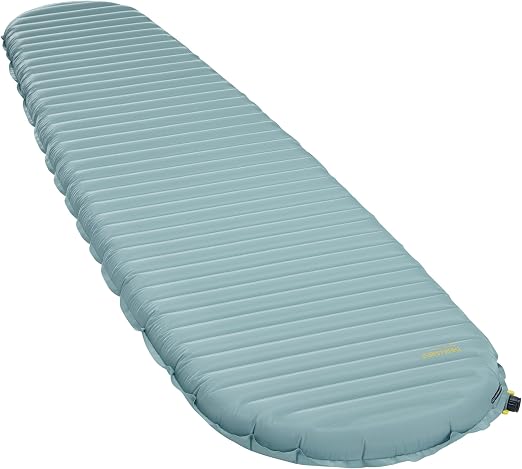
Therm-a-Rest NeoAir XTherm NXT
The warmest ultralight pad: R-7.3 at just over a pound.
- R-value (ASTM): 7.3
- Weight (regular): 1 lb 1 oz (482 g)
NEMO Tensor Extreme Conditions
NEMO's warmest pad: R-8.5 with a quiet, stable baffle design.
- R-value (ASTM): 8.5
- Weight (regular): 1 lb 6 oz (624 g)
Sea to Summit Ether Light XT Extreme
A 4-inch plush pad with R-6.2 for comfort-first cold camping.
- R-value (ASTM): 6.2
- Weight (regular): 1 lb 9 oz (720 g)
Questions, answered
How much should a backpacking pad weigh?
Under 1 lb 8 oz for three-season inflatables is the modern standard; winter pads like the XTherm NXT hit R-7.3 at 1 lb 1 oz. Foam pads weigh about 14 oz but pack bulky.
Why was I cold with a warm sleeping bag?
Almost always the pad. Your body compresses the bag's insulation beneath you to near zero, so the pad provides all the insulation from below. Match its R-value to the night, not the bag's rating alone.
Do I need a pump sack?
Not strictly, but it speeds inflation and keeps moisture out. For insulated and winter pads, it measurably protects long-term warmth.
How should I store an inflatable pad?
Unrolled, valve open, under a bed or behind a door. Storing pads compressed degrades foam cores in self-inflating models and stresses laminates in air pads.