Buying guide
Portable Jump Starters Buying Guide (2027)
How to choose a portable jump starter in 2027: peak amps, engine ratings, safety, and cold-weather performance explained.
Peak amps and engine ratings
Peak amps are the headline, but the engine-displacement rating is the number to shop by. 1000 peak amps covers most gas cars to 6.0L. Trucks and diesels need 2000 amps and explicit diesel ratings to 6.0L. Treat sky-high amp claims from unknown brands skeptically; established brands rate conservatively.
Safety features are non-negotiable
Spark-proof clamps and reverse-polarity protection prevent the two classic jump-start mistakes: reversed cables and shorted clamps. Never buy a unit that does not list these protections. They are the difference between a safe jump and damaged electronics.
Cold weather and storage
Batteries deliver less current when cold, so winter drivers should buy above their minimum rating and favor units with explicit low-temperature ratings like minus 22 F. Lithium packs hold charge 6 to 12 months; check twice a year. Lead-acid shop units need more frequent charging but deliver more repeated attempts.
Lithium vs lead-acid
Lithium packs are pocketable, hold charge longer, and add USB charging, which makes them the right choice for trunk emergency kits. Lead-acid units like the JNC660 are heavy but deliver sustained cranking stamina for shops, fleets, and stubborn diesels. Choose by use case, not by which technology sounds newer.
Start with our top 3
The three highest-ranked products in our full portable jump starters ranking. Read the in-depth review where one exists, or jump to the product in the ranked list.
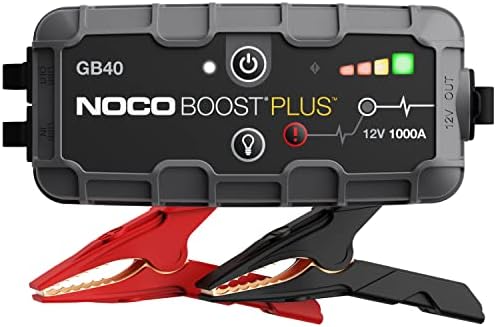
NOCO Boost Plus GB40
The benchmark 1000-amp jump starter.
- Peak current: 1000 amps
- Gas engines: Up to 6.0L

NOCO Boost HD GB70
2000 amps for trucks and diesels.
- Peak current: 2000 amps
- Gas engines: Up to 8.0L

Hulkman Alpha85
2000 amps with a driver-friendly display.
- Peak current: 2000 amps
- Gas engines: Up to 8.5L
Questions, answered
How do I use a portable jump starter?
Connect red to the dead battery's positive terminal, black to an unpainted metal ground, power on the pack, and start the car. Remove in reverse order.
Can I bring one on a plane?
Lithium jump starters fall under spare-battery rules: carry-on only, typically under 100 watt-hours without airline approval. Check current TSA guidance before flying.
How long do they last?
Quality lithium packs last several years with twice-yearly charging. Heat and full discharges shorten life; trunk storage in extreme summer heat is the main killer.
Do I still need jumper cables?
A charged portable starter replaces cables for self-rescue. Keep cables too if you ever need to help others when your pack is depleted.
What about Harbor Freight jump starters?
Harbor Freight sells jump starters under its own house brands in its stores, and those store-only lines are not sold on Amazon, so they are not part of this Amazon catalog. If you shop there, compare the same things this guide uses: an honest engine rating for your vehicle, spark-proof and reverse-polarity protection, and a warranty you can actually claim. The catalog alternatives with the same job are the NOCO Boost Plus GB40 for most cars and the Stanley J5C09 if you want a compressor combo unit.