Head to head
Philips HF3520 vs Hatch Restore 3 (2027)
Head-to-head: Philips HF3520 versus Hatch Restore 3 on light quality, routines, subscriptions, and philosophy.
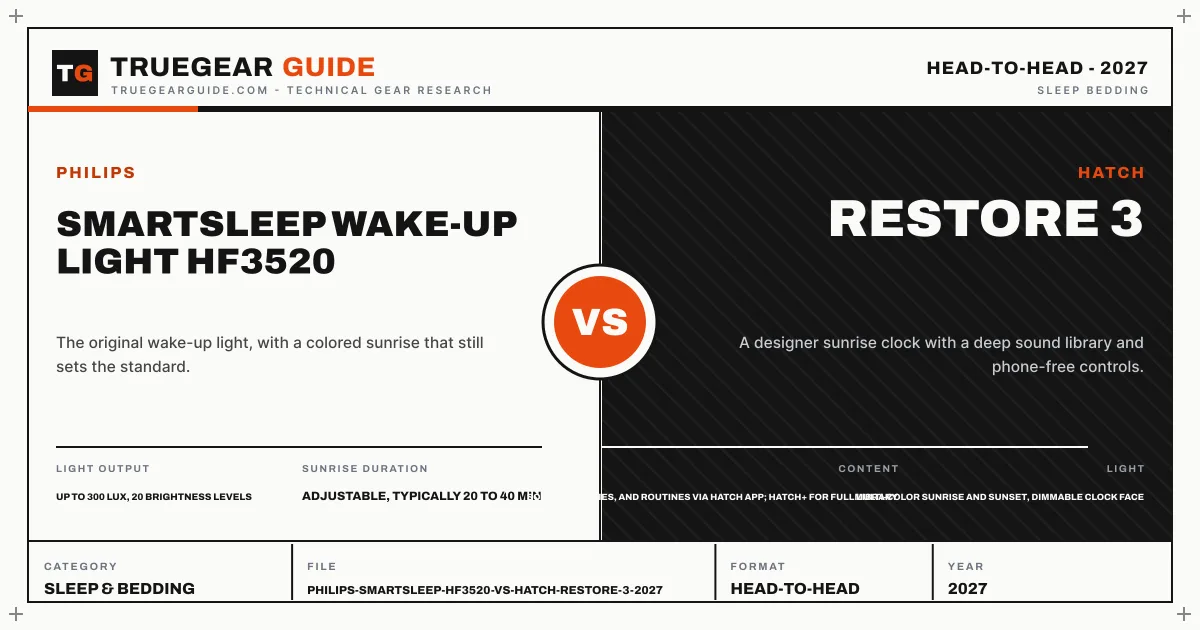

Philips SmartSleep Wake-Up Light HF3520
The original wake-up light, with a colored sunrise that still sets the standard.
- Light output: Up to 300 lux, 20 brightness levels
- Sunrise duration: Adjustable, typically 20 to 40 min

Hatch Restore 3
A designer sunrise clock with a deep sound library and phone-free controls.
- Light: Multi-color sunrise and sunset, dimmable clock face
- Content: Sounds, stories, and routines via Hatch app; Hatch+ for full library
Our recommendation
Buy the HF3520 for the brighter, better sunrise with no app and no subscription, forever. Buy the Restore 3 for a designed evening-to-morning routine and accept Hatch+ as part of the deal. This is the category's core fork: a lamp that wakes you, or a system that manages your sleep ritual.
Light
The Philips reaches about 300 lux with a spectrum-shifting colored dawn. The Hatch light is warm and pleasant but tuned for ambiance and pairs with audio to do its waking. In a bright test, Philips surfaces sleepers the Hatch misses.
Evening side
Hatch's unwind routines, stories, and sounds make it a bedtime product as much as a morning one. The Philips offers a simple sunset fade and then gets out of the way. Phone-replacement seekers belong with Hatch.
Cost model
The HF3520 is a one-time purchase with every feature in the box. The Restore 3's full library needs Hatch+, so the three-year cost favors Philips by a wide margin.
Choose Philips SmartSleep Wake-Up Light HF3520 if…
- Brightness and gradient quality lead your list
- No apps, accounts, or subscriptions near your bed
- You want a decade-proven, set-and-forget device
Choose Hatch Restore 3 if…
- You want guided wind-down routines and stories
- Tactile controls and design matter daily
- A curated sound library appeals, subscription included
Questions, answered
Which is better for kids and teens?
Hatch's routines and content suit family wind-down; the Philips suits a teen who just needs to surface for school without phone alarms.
Which display is darker at night?
Both dim well; the Hatch's hidden display aesthetic gives it a slight edge for the most light-sensitive sleepers.
Can either wake two people on different schedules?
Neither is truly dual-person. The Philips Connected and Dekala offer dual alarms; two separate clocks remain the honest couple solution.