In-depth review
Petzl Swift RL Review (2027)
In-depth review of the Petzl Swift RL: Reactive Lighting sensor performance, 1,100-lumen output, and runner fit.
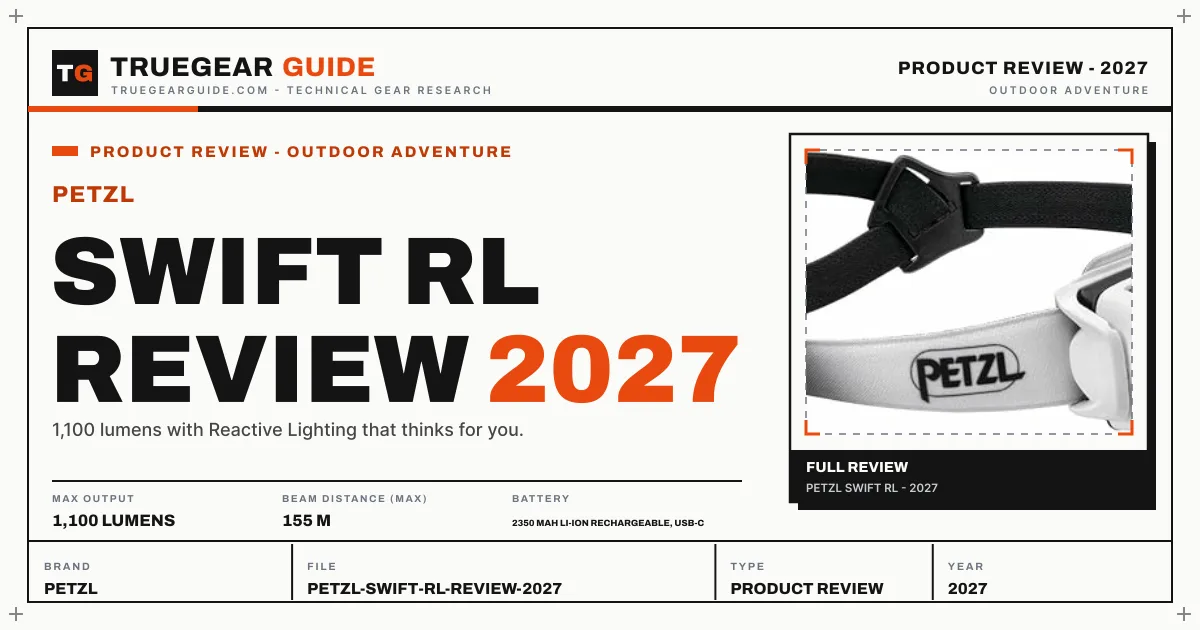

Our verdict
The Swift RL is the smartest lamp in this guide and one of the brightest per gram anywhere. Reactive Lighting genuinely works: brightness follows your gaze, extending battery while throwing 1,100 lumens when you look up-trail. Runners who try the sensor rarely return to manual lamps. The price and proprietary battery are the costs of admission to the best automatic lighting in the sport.
What we like
- Reactive Lighting sensor adjusts output to ambient need automatically
- 1,100 lumens in a compact single-unit design
- Two-part headband locks the fit for running
- Standard (manual) mode available when you want control
What to watch out for
- Premium price
- Reactive mode can surprise users new to it
- Battery is a proprietary rechargeable pack
What owners report: Petzl Swift RL
Synthesized from recurring themes in long-term owner feedback.
Most praised
- Reactive Lighting dims and brightens on its own as you glance from trail to map
- Serious output from a single compact unit suits fast, technical movement
- The two-part headband locks the fit down for running without constant readjustment
Common complaints
- Reactive mode can change brightness in ways that surprise first-time users mid-stride
- The rechargeable pack is proprietary, so replacements come from one source
- Weather sealing is rain-grade only on a premium lamp
Who it is for
Trail runners, skiers, and fast hikers who move at speed in the dark and value automation.
Reactive Lighting in practice
A light sensor reads reflected brightness and meters output continuously: dim for map checks and close trail, full throw for descents and route spotting. The practical effect is a lamp that feels clairvoyant and a battery that outlasts fixed-mode rivals at similar perceived brightness. A standard manual mode exists for users who prefer predictability, which is good design rather than hedging.
Fit for speed
The two-part elastic headband splits tension around the head and locks the compact front unit in place; at 100 g total there is little mass to bounce. Reflective elements add road-crossing safety. Runners report the rare experience of forgetting the lamp entirely until they take it off, which is the highest praise a running light can earn.
Battery and limits
The 2350 mAh pack recharges via USB-C and is replaceable as a unit, but it is proprietary: no AAA improvisation at a mountain hut. IPX4 covers rain, not immersion. Neither limit matters to its target user, and both matter to expedition hikers, who should look at the Actik Core instead.
Key specifications
- Max output
- 1,100 lumens
- Beam distance (max)
- 155 m
- Battery
- 2350 mAh Li-ion rechargeable, USB-C
- Weight
- 3.5 oz (100 g)
- Water resistance
- IPX4
Also consider

BioLite HeadLamp 800 Pro
800 lumens with a rear battery that balances like a runner's lamp should.
Why consider it: Balanced rear-battery design with pass-through charging for ultras.
- Max output: 800 lumens (burst)
- Beam distance (max): 150 m

Petzl Actik Core
Petzl's 600-lumen hybrid: rechargeable CORE pack or AAAs.
Why consider it: Manual control and AAA hybrid power from the same maker for less.
- Max output: 600 lumens
- Beam distance (max): 115 m
Research-based assessment. TrueGear has not hands-on tested this product; this evaluation synthesizes manufacturer specifications, retailer documentation, and published expert reviews.
Questions, answered
Can I turn Reactive Lighting off?
Yes. A long press switches to standard mode with fixed brightness levels, handy for group runs where you want predictable behavior.
Does the sensor react to other runners' lights?
It reads ambient reflected light, so nearby lamps can dim yours briefly. In group runs most users switch to standard mode for consistency.
How long does the battery last on Reactive?
It depends on how often you look far. Petzl rates multi-hour runtimes in reactive mode that typically exceed fixed high modes significantly, exactly the point of the system.