In-depth review
Peak Design Travel Tripod Review (2027)
In-depth research review of the Peak Design Travel Tripod: packability, 60-inch height, 20 lb capacity, and the triangular leg design.
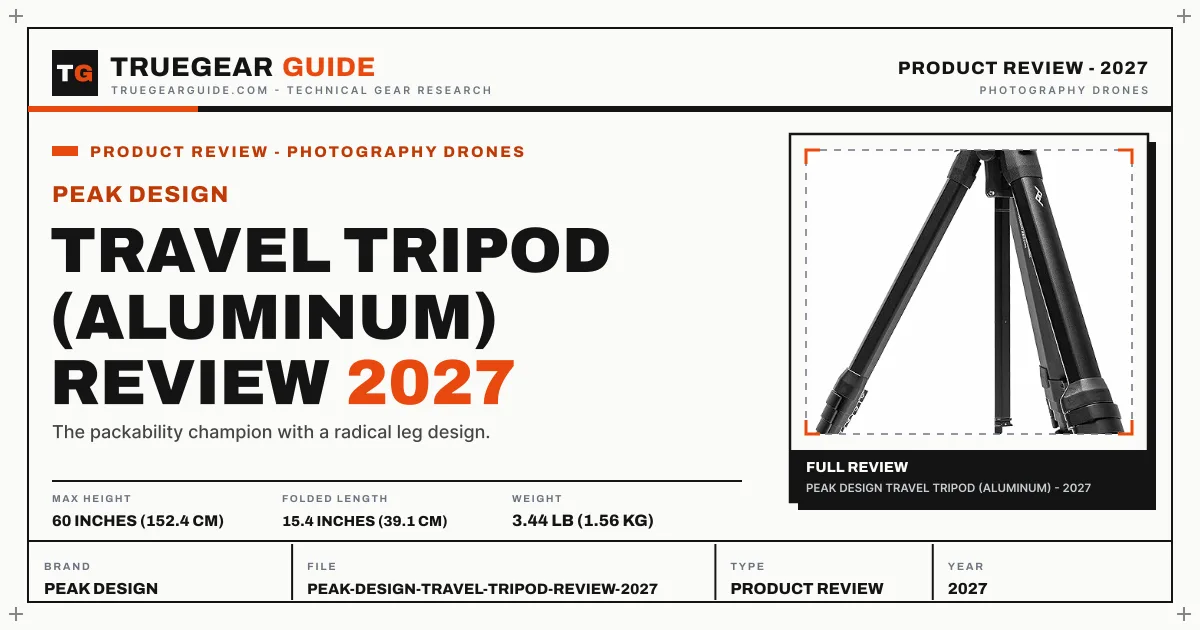

Peak Design Travel Tripod (Aluminum)
The packability champion with a radical leg design.
Our verdict
The Peak Design rethought the tripod around the constraint that matters for travel: packed size. Its water-bottle footprint means it actually comes on trips, and 60 inches plus 20 lb capacity mean it performs when it gets there. Taller shooters and Arca purists should look elsewhere; everyone else should look here first.
What we like
- Nests to the diameter of a water bottle: 15.4 inches collapsed
- Triangular leg profile packs tighter than round legs
- Deploys fast with ergonomic leg cams
- 20 lb load capacity handles full-frame kits
What to watch out for
- 60-inch max height is modest for tall shooters
- Proprietary plate system limits quick-release compatibility
- Center column raises height but sacrifices stability
What owners report: Peak Design Travel Tripod (Aluminum)
Synthesized from recurring themes in long-term owner feedback.
Most praised
- Owners praise packing it inside a bag at water bottle diameter instead of strapping it outside
- Leg cams deploying the whole tripod in seconds at a viewpoint
- Load capacity handling full frame kits despite the tiny packed form
Common complaints
- Tall shooters find the maximum height modest without the stability costing center column
- The proprietary plate complicates mixing with standard gear owners already own
- Five thin lower sections giving good rather than great stability in wind
Who it is for
Travelers and commuters who need a full-height tripod that disappears into a bag when folded.
Design and packability
The triangular leg profile is the innovation: legs nest together with zero dead space, collapsing to 15.4 inches with a slim diameter no round-leg tripod matches. The leg cams deploy with a satisfying mechanical action, and the whole package genuinely fits in a water-bottle pocket.
Height and stability
60 inches of maximum height serves most shooters, and the 20 lb load rating covers full-frame bodies with mid telephotos. Five leg sections mean the lowest segments are thin, so stability is good rather than great: fine for landscapes, less ideal for long lenses in wind.
Head and compatibility
The integrated ball head is compact and smooth, with a clever quick-release that stows neatly. The proprietary plate is the real compromise: it works beautifully within Peak Design's ecosystem but complicates mixing with standard Arca gear. Commit to the system or accept adapter friction.
Key specifications
- Max height
- 60 inches (152.4 cm)
- Folded length
- 15.4 inches (39.1 cm)
- Weight
- 3.44 lb (1.56 kg)
- Load capacity
- 20 lb (9.1 kg)
- Leg sections
- 5
Also consider

Manfrotto Befree Advanced (Aluminum)
The mainstream travel tripod done right.
Why consider it: Choose the Befree for standard Arca compatibility and proven mainstream reliability.
- Max height: 59.06 inches (150 cm)
- Folded length: 15.75 inches (40 cm)

Gitzo Traveler Series 1 (GT1545T)
The carbon benchmark for weight and stability.
Why consider it: Choose the Gitzo when rigidity and light weight matter more than packed diameter.
- Max height: 60.24 inches (153 cm)
- Folded length: 16.73 inches (42.5 cm)
Research-based assessment. TrueGear has not hands-on tested this product; this evaluation synthesizes manufacturer specifications, retailer documentation, and published expert reviews.
Questions, answered
Is the aluminum version worth it over carbon?
Yes for most travelers: the aluminum version costs far less, weighs only modestly more, and survives baggage handling with less anxiety. Carbon saves weight for backpackers who count ounces.
Can I use my Arca plates with it?
Not directly; the head uses a proprietary quick-release. Adapters exist but add bulk. This is a system commitment, so evaluate it as one.
How tall is too tall for the center column?
Extending the center column raises the camera but notably reduces stability; treat it as a last resort for eye-level framing, not a routine setting. For critical sharpness, keep it down.