Head to head
NOCO GENIUS10 vs GENIUS5 (2027)
Head-to-head: NOCO GENIUS10 versus GENIUS5 on charge speed, battery capacity, and which one your garage actually needs.
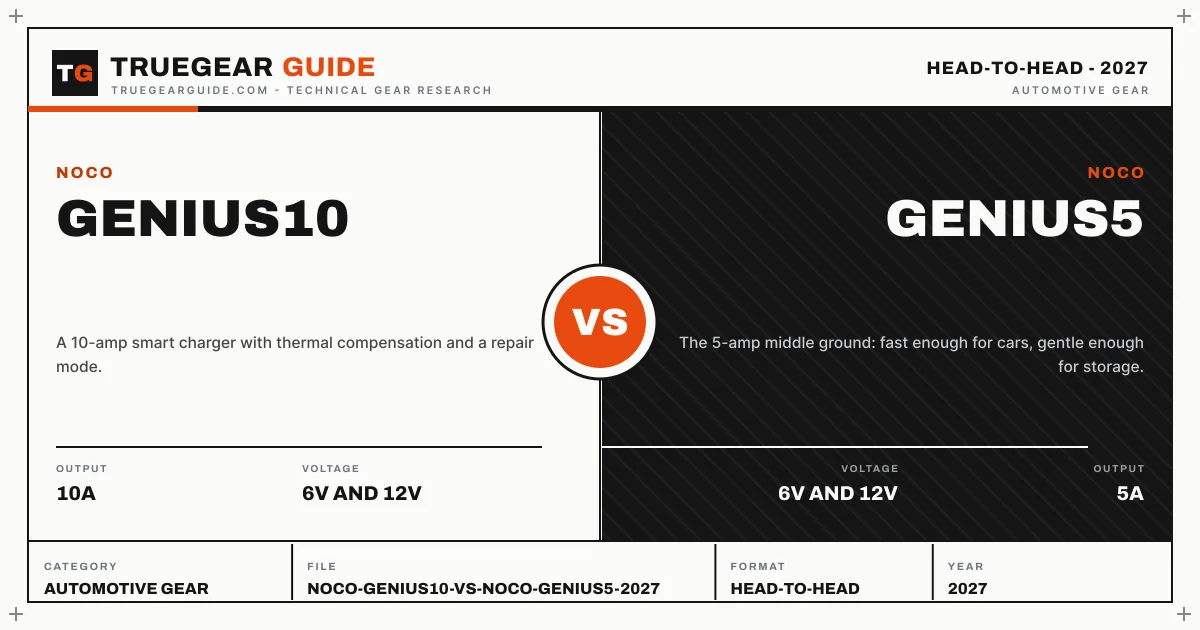

NOCO GENIUS10
A 10-amp smart charger with thermal compensation and a repair mode.
- Output: 10A
- Voltage: 6V and 12V

NOCO GENIUS5
The 5-amp middle ground: fast enough for cars, gentle enough for storage.
- Output: 5A
- Voltage: 6V and 12V
Our recommendation
Buy the GENIUS10 if you charge truck, SUV, boat, or deeply discharged batteries, or simply hate waiting. Buy the GENIUS5 if your batteries live in ordinary cars and crossovers; it has the same chemistry support, thermal sensor, and repair features, and 5 amps is an overnight charge for them. The difference is speed and capacity headroom, nothing else.
Charge speed and capacity
The GENIUS10 charges at 10 amps and is rated for batteries up to 230Ah; the GENIUS5 runs 5 amps up to 120Ah. On a half-discharged car battery that is roughly three hours versus six. Both maintain batteries of any size once full.
Features
Feature sets are essentially identical: 6V and 12V, flooded, AGM, gel, and lithium profiles, thermal compensation, force mode for zero-volt batteries, and a repair mode on the GENIUS10 class. You are paying for amperage, not capability.
Price and value
The GENIUS5 costs meaningfully less and covers the majority of households. The GENIUS10 earns its premium in larger garages, with diesel trucks, or where a boat battery must recover between weekends.
Choose NOCO GENIUS10 if…
- You own a truck, diesel, or boat with a large battery
- You revive neglected or deeply discharged batteries
- Faster turnaround matters more than the price gap
Choose NOCO GENIUS5 if…
- Your vehicles are ordinary cars and crossovers
- Overnight charging is perfectly acceptable
- You want GENIUS features at the lowest price
Questions, answered
Will the GENIUS5 maintain a truck battery?
Yes. Maintenance current needs are small; the 120Ah figure is about charging capacity. It will simply charge a big discharged battery slowly.
Do both support lithium batteries?
Yes, both include a lithium LiFePO4 profile with the safeguards lithium charging requires.
Which is better for winter storage?
Equal. Both switch to the same style of temperature-compensated maintenance. Buy on charging needs, not storage.