In-depth review
Metabo HPT EC914S The Tank Review (2027)
In-depth review of Metabo HPT The Tank: 200 PSI framing performance, weight trade-offs, and crew value.
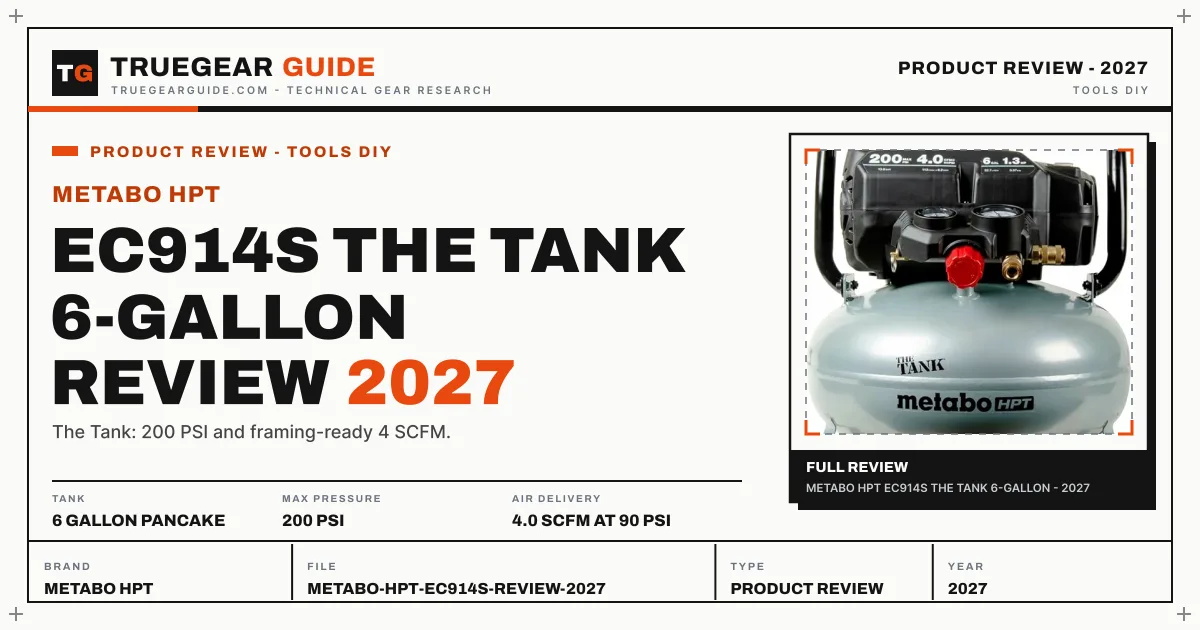

Metabo HPT EC914S The Tank 6-Gallon
The Tank: 200 PSI and framing-ready 4 SCFM.
Our verdict
The Tank earns its name. It is the pancake that framers spec when a shop compressor cannot come along: 200 PSI, 4.0 SCFM, and a pump built like rental equipment. You pay in pounds and dollars, and crews pay it gladly. Crews that have run one rarely go back to asking a trim pancake to do framing work.
What we like
- 200 PSI max with 4.0 SCFM at 90 PSI is class-leading
- Simultaneously runs two framing nailers credibly
- Industrial oil-free pump built for rental-grade abuse
- Top handle and 41-lb build prioritize durability over daintiness
What to watch out for
- Heaviest pancake here at about 41 lb
- Premium price
- Overkill and over-loud for indoor finish work
What owners report: Metabo HPT EC914S The Tank 6-Gallon
Synthesized from recurring themes in long-term owner feedback.
Most praised
- Framing crews praise running two guns hard without waiting on recovery
- Higher storage pressure stretching each cycle so nail depth stays steady late in the day
- The industrial pump feeling like rental-grade equipment built for abuse
Common complaints
- It is the heaviest pancake here, making the carry a deliberate decision
- Indoor finish work gets no benefit from its muscle and plenty of its noise
- Premium cost is wasted on trim-only users who never tap the airflow
Who it is for
Framing and roofing crews, deck builders, and contractors running two nailers from one portable unit.
Airflow that changes staffing math
At 4.0 SCFM at 90 PSI the Tank sustains two framing nailers at working pace, a feat no other pancake here attempts. The 200 PSI storage stretches each cycle, so the motor rests instead of droning.
Build and burden
At about 41 lb it is a deliberate carry, with a top handle designed for it. The industrial pump and steel construction read as buy-it-once equipment, and the noise is crew-grade loud, as expected.
Who should skip it
Trim carpenters, homeowners, and indoor specialists gain nothing from its muscle and lose quiet, weight, and money. The Tank is a specialist tool whose specialty is volume.
Recovery behavior under crew pace
What sells The Tank on a framing crew is not the first ten nails, it is the five hundredth. Standard pancakes begin to sound busy by mid-morning, cycling constantly as two guns alternate. The Tank's larger effective delivery keeps its cycles spaced out, so gun pressure at the hose end feels the same at four in the afternoon as it did at eight. That steadiness is what consistent nail depth actually comes from.
Key specifications
- Tank
- 6 gallon pancake
- Max pressure
- 200 PSI
- Air delivery
- 4.0 SCFM at 90 PSI
- Power
- 1.3 HP running class
- Weight
- 41 lb
Also consider

DEWALT DWFP55126 6-Gallon Pancake
165 PSI, quick recovery, job-site ready pancake.
Why consider it: Lighter, cheaper all-round pancake for mixed and single-gun work.
- Tank: 6 gallon pancake
- Max pressure: 165 PSI

Bostitch BTFP02012 6-Gallon Pancake
Light 29-lb pancake with 150 PSI storage.
Why consider it: The lightest 6-gallon carry for installation-focused days.
- Tank: 6 gallon pancake
- Max pressure: 150 PSI
Research-based assessment. TrueGear has not hands-on tested this product; this evaluation synthesizes manufacturer specifications, retailer documentation, and published expert reviews.
Questions, answered
Can The Tank run a roofing coil nailer all day?
Yes, roofing bursts are within its delivery class, making it a favorite for repair and small-to-mid roof work.
Is it too much for a homeowner?
For nearly all homeowners, yes. Its virtues appear only under crew airflow demands.
What cord does it need?
A short, heavy-gauge (12 AWG) extension at most; high-draw pumps punish thin cords with voltage drop and hot starts.
Does it need a dedicated circuit?
It is happiest on a lightly loaded 15-amp circuit or better. High-draw pumps punish shared circuits and long thin cords with slow starts and tripped breakers, especially on cold mornings when every tool on site starts at once.