In-depth review
K&F Concept Nano-X Variable ND Review (2027)
In-depth review of the K&F Concept Nano-X Variable ND2-ND400: Japanese glass value, colour cast limits and who should upgrade past it.
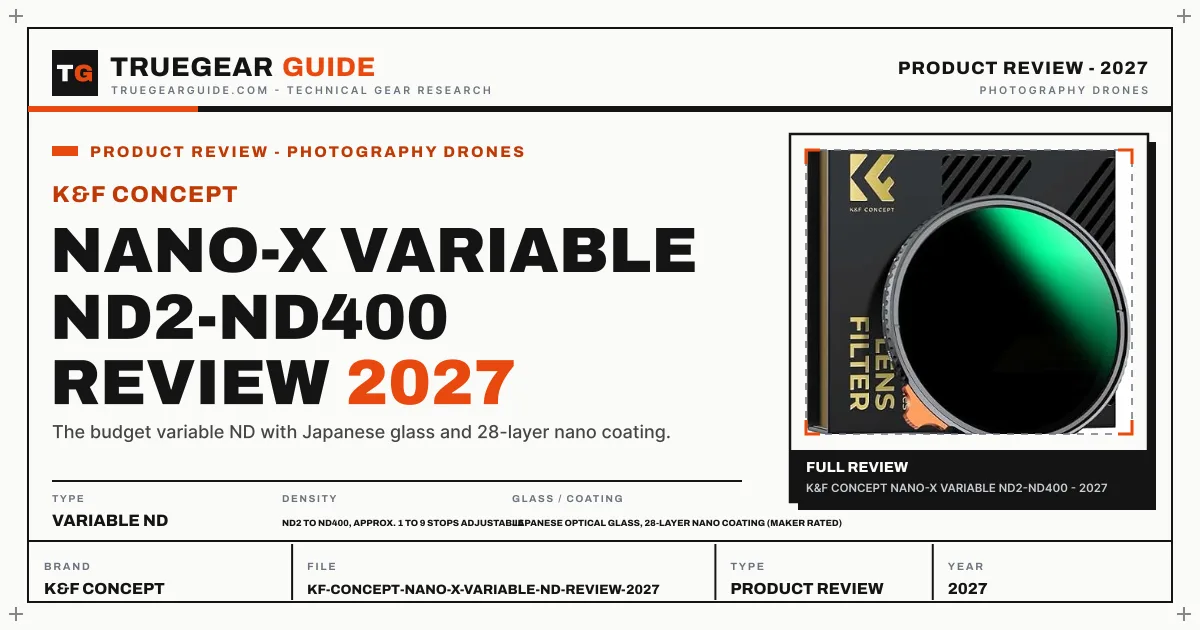

K&F Concept Nano-X Variable ND2-ND400
The budget variable ND with Japanese glass and 28-layer nano coating.
Our verdict
The Nano-X is the correct first variable ND: real Japanese glass, competent coatings and the full ND2 to ND400 playground for the price of a nice dinner. Its casts at deep density are documented and manageable within the first two thirds of its range. Buy it to learn, keep it as a backup when you upgrade, and never apologise for it.
What we like
- Japanese optical glass with multi-layer nano coating at a budget price
- Full ND2 to ND400 range for video and long-exposure experiments
- Slim frame with smooth rotation and clear markings
- Includes a quality storage case unusual at this price
What to watch out for
- Colour cast increases toward maximum density, especially on skin
- Sharpness on long telephotos trails premium glass
- Brand's many similar SKUs require careful model selection
What owners report: K&F Concept Nano-X Variable ND2-ND400
Synthesized from recurring themes in long-term owner feedback.
Most praised
- Beginners get a full density range and coated optical glass without a premium bill
- Clear markings and smooth rotation make learning shutter discipline easier
- An included storage case at this price is a detail owners mention approvingly
Common complaints
- A colour cast grows toward maximum density, especially visible on skin
- Sharpness on long telephotos trails premium glass
- The brand many similar models make choosing the exact version confusing
Who it is for
Beginner and intermediate video creators learning shutter discipline and ND craft on mirrorless and compact systems.
Performance in the honest range
From ND2 through roughly ND64, the Nano-X delivers clean, sharp results that embarrass its price: the 180-degree shutter look, wide apertures in daylight, and respectable colour. Push toward ND400, especially on lenses wider than 24mm, and the familiar variable taxes appear: cast, softness at the edges and the beginnings of unevenness.
Glass and build
The Japanese optical glass and 28-layer nano coating claims translate to flare behaviour and cleanability that feel a class above generic budget filters. The slim aluminium frame rotates smoothly with legible markings, and the included case is genuinely protective. It feels like a product from a company competing upward.
The upgrade path
Owners typically upgrade when paid work makes grading time expensive or when a wide lens exposes the deep-range limits. The Nano-X then becomes the second-lens or backup filter, a role it serves for years. As a total cost of learning, nothing in this guide beats it.
Key specifications
- Type
- Variable ND
- Density
- ND2 to ND400, approx. 1 to 9 stops adjustable
- Glass / coating
- Japanese optical glass, 28-layer nano coating (maker rated)
- Frame
- Slim aluminium, knurled rotation ring
- Thread sizes
- 43mm to 82mm depending on SKU
Also consider

Tiffen Variable ND Filter
The long-running ND2 to ND400 variable from the cinema filter house.
Why consider it: A similar range with cinema-brand glass heritage at a modest step up in price.
- Type: Variable ND
- Density: ND2 to ND400, approx. 1 to 8 stops

Moment Variable ND Filter
A creator-focused variable ND in 2 to 5 and 6 to 9 stop editions.
Why consider it: The natural upgrade: hard stops, Schott glass and cleaner deep-range colour.
- Type: Variable ND, hard-stop editions
- Density: 2 to 5 stops or 6 to 9 stops editions
Research-based assessment. TrueGear has not hands-on tested this product; this evaluation synthesizes manufacturer specifications, retailer documentation, and published expert reviews.
Questions, answered
At what density does the Nano-X start to cast?
Most shooters notice shift creeping in beyond about 6 stops, varying by scene and lens. White-balance discipline and staying in the first two thirds of the range keep footage clean.
Is it safe for a 70-200mm lens?
Usable, with some softening at deep densities versus premium glass. For telephoto video at moderate densities it performs well above its price class.
Which size should a beginner buy?
The largest thread among your lenses, plus step-up rings for the rest. The Nano-X's price makes the one-filter strategy painless.