In-depth review
Google Nest Protect (2nd Gen) Review (2027)
In-depth review of Nest Protect: split-spectrum sensing, voice alerts, self-testing, and whole-home cost reality.
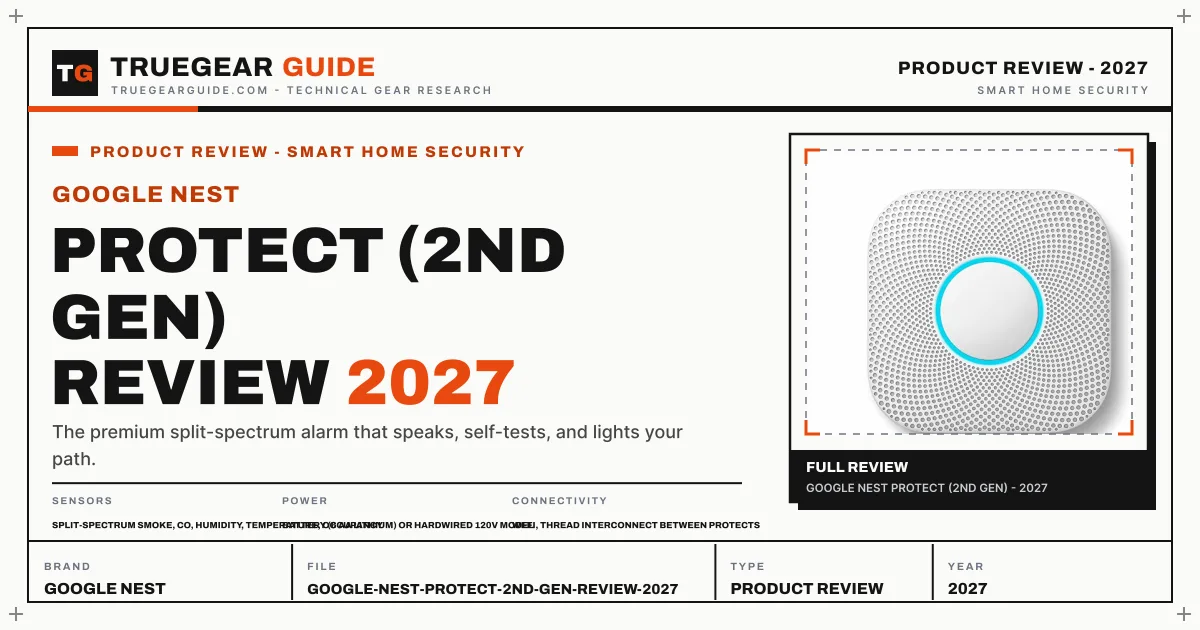

Google Nest Protect (2nd Gen)
The premium split-spectrum alarm that speaks, self-tests, and lights your path.
Our verdict
Protect remains the alarm every competitor is judged against because it attacks the real enemy, alarm fatigue, with better sensing, spoken warnings, and self-testing, not just an app. The whole-home bill is steep; the case for paying it is written in every nuisance alarm you will never hear.
What we like
- Split-spectrum photoelectric sensor reduces cooking false alarms
- Voice alerts name the room and threat before the siren
- Silence from the app when you are nearby
- Nightly Promise self-check and a pathlight that glows on motion
What to watch out for
- Premium price multiplies across a whole home
- 10-year sealed life means full unit replacement at expiry
- Google Home migration left some legacy Nest app users frustrated
What owners report: Google Nest Protect (2nd Gen)
Synthesized from recurring themes in long-term owner feedback.
Most praised
- A calm voice naming the room and the threat before any siren is what owners rave about to visitors
- The split-spectrum sensing cut the burnt-toast false alarms that plagued their old ionization units
- Silencing a nuisance alarm from the app in the hallway beats waving a towel at the ceiling
Common complaints
- Outfitting every room at this price turns whole-home coverage into a phased, expensive project
- When the sealed life ends, the entire unit is replaced, which owners resent at year ten
- The move between apps left some long-time owners annoyed at re-setting up their homes
Who it is for
Homeowners planning long-term, whole-home connected coverage who value calm, informative alerts.
Sensing and alerts
The split-spectrum sensor samples smoke particles at two wavelengths, distinguishing steam and cooking aerosols from real smoldering fires better than single-spectrum photoelectric units. When it does alarm, a calm voice names the room and threat first, escalating only if conditions persist, a sequence that prevents panic and teaches occupants to trust it.
Self-testing and ownership
Nightly Promise gives a green glow confirming sensors and batteries passed a silent self-check, and Sound Check periodically tests speaker and horn. Over a 10-year sealed life the ownership burden approaches zero, until the non-negotiable full-unit replacement at expiry.
Cost and ecosystem
Outfitting five rooms costs multiples of any rival here, and Protect pathlights and occupancy sensing tie it to the Google Home ecosystem. Buyers should phase Protect into bedrooms and hallways first, where its voice and pathlight matter most, and value alarms elsewhere.
Key specifications
- Sensors
- Split-spectrum smoke, CO, humidity, temperature, occupancy
- Power
- Battery (6 AA lithium) or hardwired 120V model
- Connectivity
- Wi-Fi, Thread interconnect between Protects
- Lifespan
- 10 years, CO sensor rated 10 years
- Certification
- UL 217 and UL 2034 listed
Also consider

Kidde Smart Smoke & CO Detector 30CUAR-W
Kidde hardwired smart combo alarm with voice alerts and app notifications.
Why consider it: Hardwired combo alerts with voice announcements at a mid price.
- Sensors: Photoelectric smoke, electrochemical CO
- Power: Hardwired with 2 AA battery backup (included)

X-Sense SC07-W Wireless Interconnected
Interconnected combo alarms that all sound together, with a 10-year sealed battery.
Why consider it: Interconnected whole-home sounding on sealed batteries for far less per room.
- Sensors: Photoelectric smoke, electrochemical CO
- Power: 10-year sealed lithium battery
Research-based assessment. TrueGear has not hands-on tested this product; this evaluation synthesizes manufacturer specifications, retailer documentation, and published expert reviews.
Questions, answered
Battery or wired Protect?
Same sensing; choose wired where alarm boxes exist for zero battery concerns, battery for retrofits. Both interconnect wirelessly with other Protects.
Does Protect detect CO fast enough?
Yes, it is UL 2034 listed with a 10-year CO sensor, and its display-free design reports levels in the app history after events.
What happens at year ten?
The unit announces end of life and must be replaced entirely; sensors cannot be swapped. Budget for it as a decade subscription to safety.