In-depth review
EcoNet Bulldog Valve Robot EVC200 Review (2027)
In-depth review of the EcoNet Bulldog Valve Robot: clamp-on installation over ball valves up to 1.5 inches, Z-Wave control, and 18-second shutoff action.
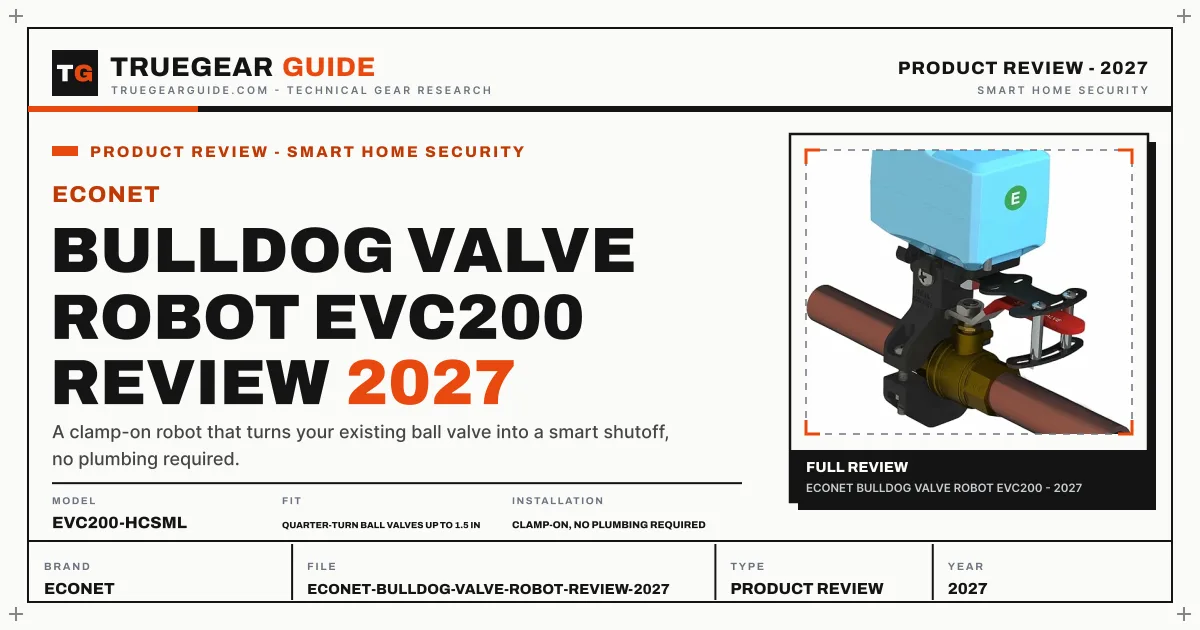

EcoNet Bulldog Valve Robot EVC200
A clamp-on robot that turns your existing ball valve into a smart shutoff, no plumbing required.
Our verdict
The Bulldog takes the opposite approach to inline shutoffs: instead of replacing your main valve, it clamps over the existing quarter-turn ball valve and turns the handle for you. That keeps a proven valve in service and avoids a plumber entirely. The trade is ecosystem dependence, since it needs a Z-Wave hub and separate leak sensors to act on its own, but for Z-Wave homes it is the least invasive route to automatic shutoff.
What we like
- Clamps over existing quarter-turn ball valves up to 1.5 inches with no plumbing changes
- High-torque motor closes the valve in about 18 seconds
- Pairs through a Z-Wave hub with leak sensors for automatic shutoff rules
- Keeps the proven manual valve in place instead of substituting a new one
What to watch out for
- Requires a Z-Wave Plus hub; it does not connect to Wi-Fi directly
- Detects nothing by itself; leak sensors are a separate purchase
- Fits ball valves only, not gate or globe valves
What owners report: EcoNet Bulldog Valve Robot EVC200
Synthesized from recurring themes in long-term owner feedback.
Most praised
- Clamping over the existing ball valve avoids cutting plumbing and keeps a proven manual valve in service
- The high-torque motor handles stiff, older main valves that owners worried a robot could not turn
- Z-Wave owners like building local shutoff rules with the leak sensors they already own
Common complaints
- It detects nothing on its own, so the total system cost includes separate leak sensors
- A Z-Wave hub is mandatory, making it a poor fit for Wi-Fi-only smart homes
- Gate and globe valves are unsupported, which rules out many older houses
Who it is for
Z-Wave smart home owners who want automatic water shutoff without cutting into the main line.
Clamp-on mechanics
The robot mounts over a standard quarter-turn ball valve, sized for valves up to 1.5 inches, and its motor drives the handle through its arc in about 18 seconds. EcoNet rates the motor as high torque, which matters because main valves stiffen with age. Because nothing in the plumbing changes, the install is reversible and renter-of-the-house projects stay simple; the existing valve also remains manually operable.
The Z-Wave arrangement
The Bulldog speaks Z-Wave Plus, so a compatible hub is the brain: pair the robot with leak sensors around the house and the hub closes the valve when a sensor reports water. That architecture is flexible and local, but it means the robot alone is only a remote-controlled valve. Buyers without a hub should price the whole system, not just the robot, before comparing it with Wi-Fi inline valves.
Fit limits to check first
It fits ball valves with lever handles, not gate valves, and the pipe and valve need clearance for the clamp and motor body. AC power is required at the valve location. Owners whose main valve is a modern quarter-turn ball valve in an accessible spot are the ideal match; everyone else should look at inline replacements instead.
Key specifications
- Model
- EVC200-HCSML
- Fit
- Quarter-turn ball valves up to 1.5 in
- Installation
- Clamp-on, no plumbing required
- Protocol
- Z-Wave Plus, hub required
- Action time
- About 18 seconds open or close
Sources: Amazon listing, CamelCamelCamel, EcoNet product documentation
Also consider

Moen Flo Smart Water Monitor and Shutoff
Main-line flow, pressure, and temperature monitoring with an automatic shutoff valve.
Why consider it: An inline Wi-Fi shutoff with its own leak learning if you prefer one self-contained device over a hub-based setup.
- Installation: Main water line, inline
- Sensing: Flow, pressure, and temperature sensing, whole-home

YoLink Water Leak Sensor 2
LoRa long-range leak sensing that reaches basements and outbuildings Wi-Fi cannot.
Why consider it: The detection half of a system like this: sensors to pair with a valve actuator if you are building the setup piece by piece.
- Sensing: Probe contacts; cable probe variant available
- Power: 2 AAA batteries, up to 5 years typical
Research-based assessment. TrueGear has not hands-on tested this product; this evaluation synthesizes manufacturer specifications, retailer documentation, and published expert reviews.
Questions, answered
Does the Bulldog work on a gate valve?
No. It is built for quarter-turn ball valves with lever handles, up to 1.5 inches. Gate and globe valves are not supported.
Does it detect leaks by itself?
No. It is a valve actuator. Automatic shutoff happens when leak sensors paired through your Z-Wave hub tell it water is present.