Head to head
DEWALT DCS356 vs Ryobi PCL430 (2027)
Head-to-head: DEWALT DCS356 versus Ryobi PCL430, brushless versatility against ONE+ value.
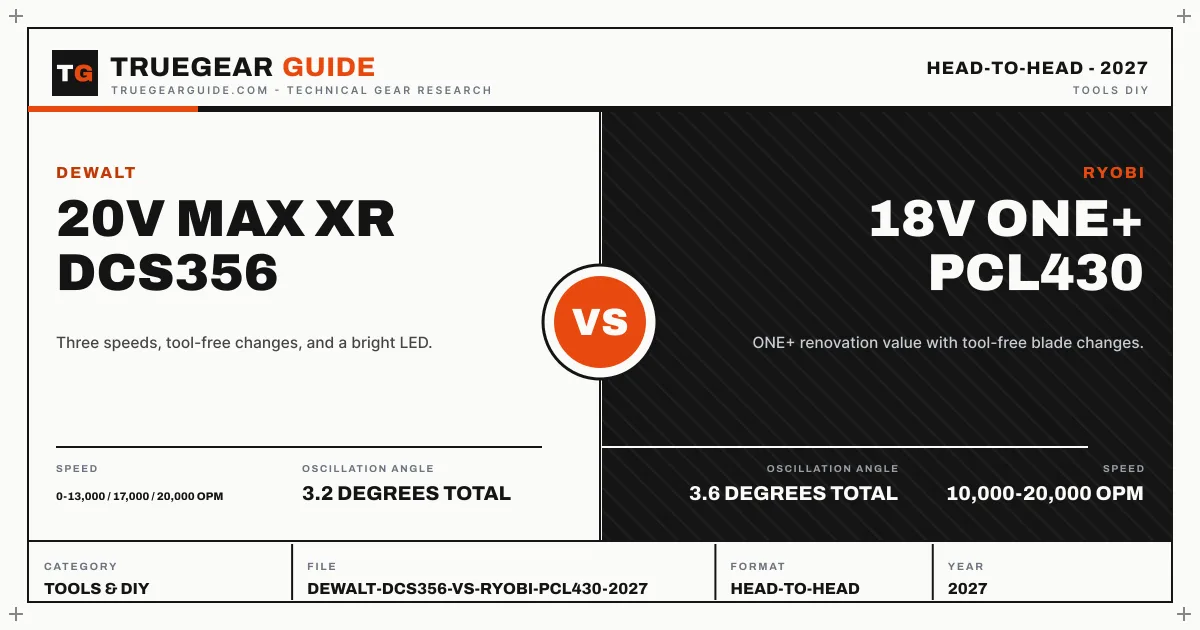

DEWALT 20V MAX XR DCS356
Three speeds, tool-free changes, and a bright LED.
- Speed: 0-13,000 / 17,000 / 20,000 OPM
- Oscillation angle: 3.2 degrees total

Ryobi 18V ONE+ PCL430
ONE+ renovation value with tool-free blade changes.
- Speed: 10,000-20,000 OPM
- Oscillation angle: 3.6 degrees total
Our recommendation
Buy the DCS356 for brushless life, three speeds, and dual-grip control. Buy the PCL430 when the multi-tool is an occasional renovation helper and ONE+ value rules the garage. Many garages end up with both: the Ryobi first, the DEWALT when project pace justifies it.
Motor and control
DEWALT's brushless motor and 3-speed selector with dual-grip trigger offer finer starts. Ryobi's dial-only control is simpler and entirely adequate for DIY pacing.
Vibration and noise
The DCS356 runs smoother at high OPM, which matters for sanding. The PCL430 makes you feel its price on long scrape jobs.
Total cost
Both use universal blades, so running costs tie. The gap is tool and battery buy-in, where Ryobi wins decisively for new buyers.
Blade changes and accessories
Both tools change blades without a hex key and both draw from the same universal accessory pool, so a blade bought for one fits the other. The DEWALT clamp feels more positive under heavy side loads, while the Ryobi mechanism is simpler and perfectly adequate at DIY forces. Shared blades mean upgrading later strands no accessory investment.
Choose DEWALT 20V MAX XR DCS356 if…
- You own DEWALT 20V MAX batteries
- You remodel regularly and value brushless longevity
- Dual-grip trigger control appeals for awkward cuts
Choose Ryobi 18V ONE+ PCL430 if…
- You own ONE+ batteries or none
- The tool serves occasional projects
- Lowest total spend is the priority
Questions, answered
Is brushless worth double the price here?
For weekly use, yes: runtime, life, and smoothness compound. For a few projects a year, the PCL430's savings buy a lot of blades.
Which is better for sanding corners?
The DEWALT, on smoothness at speed. Both use the same triangular pads.
Do both accept the same blades?
Largely yes: both use universal-fit accessories, the homeowner-friendly standard.
Which handles overhead work better?
The Ryobi, slightly, thanks to its light 2.2 lb body and compact ONE+ packs, which keep the nose manageable during ceiling outlet cuts and soffit trimming, where every extra ounce argues with your shoulder by the tenth cut.