Buying guide
Cordless Drill Kits Buying Guide (2027)
How to buy a cordless drill kit in 2027: voltage platforms, brushed vs brushless, reading torque specs, and the decision framework.
Voltage: what 12V, 18V, and 20V actually mean
18V and 20V MAX describe the same battery class: 20V MAX is the no-load voltage, 18V the nominal working voltage. Do not cross-shop them as different tiers. True 12V drills are lighter and genuinely useful for cabinet and overhead work, but give up roughly half the torque. For a first and possibly only drill, 18V/20V is the correct default.
Brushed vs brushless motors
Brushed motors are cheaper and proven; brushless motors convert more battery into work, run cooler, and never need brush replacement. The runtime difference is typically 30 to 50 percent per amp-hour, which is why brushless drills ship with smaller batteries yet outwork brushed rivals. Buy brushed to minimize entry cost, brushless to minimize cost per year of ownership.
Chuck, clutch, and torque: reading the spec sheet
Chuck size (1/2 in vs 3/8 in) sets the maximum bit shank; 1/2 in is the versatile choice. Clutch settings (16+1, 20+1, 24+1) set driving finesse; more detents mean finer control. Torque is quoted as UWO by DeWalt and inch-pounds by everyone else; compare within one unit only. Speed ranges like 0-450 / 0-1,500 RPM tell you low gear is for driving and high gear for drilling.
Buy this type if, avoid if: the decision framework
Buy the budget brushed kit (DeWalt DCD771C2 class) if you drill monthly and want maximum kit for minimum cost; avoid it if you drill weekly, where brushless efficiency pays back fast. Buy the brushless mid-tier (Milwaukee 2801-20 class) if this is your daily driver and platform depth matters; avoid it if you will only hang pictures. Buy the torque leader (Makita XFD13 class) if you drive structural fasteners or run hole saws; avoid it if you have small hands or work overhead, where a compact 12V drill is the honest answer.
Start with our top 3
The three highest-ranked products in our full cordless drill kits ranking. Read the in-depth review where one exists, or jump to the product in the ranked list.

DeWalt DCD771C2
The proven 20V workhorse for first kits.
- Platform: 20V MAX
- Power: 300 UWO
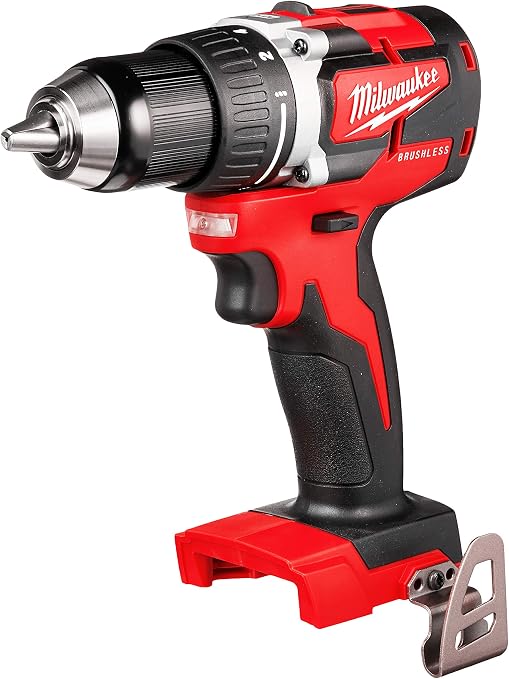
Milwaukee M18 2801-20
Brushless 18V power in a compact frame.
- Platform: M18 18V
- Motor: Brushless

Makita XFD13
The torque leader for demanding driving.
- Platform: 18V LXT
- Motor: Brushless
Questions, answered
What is the best voltage for a first drill?
18V/20V MAX. It is the industry standard with the deepest tool lineups, and the drills are capable enough for 95 percent of tasks without the weight penalty of higher-voltage platforms.
How many clutch settings do I need?
16+1 is plenty for home use. More settings help with delicate materials, but clutch quality matters more than count; a well-made 16+1 beats a sloppy 24+1.
Do I need a hammer drill?
Only for regular masonry work. A standard drill/driver handles wood, metal, drywall, and plastic. Do not pay for hammer mode you will never engage.
When should I replace my drill batteries?
When runtime drops noticeably, typically after 3 to 5 years of regular use. One weak battery in a two-battery kit is normal; replace the weak one rather than the whole kit.