Buying guide
Cooling Sheets Buying Guide (2027)
How to choose cooling sheets in 2027: wicking versus chill-touch versus transport, fibers compared, pocket depth, and care rules.
Name your overheating problem first
Three different problems hide under hot sleeper. If you cannot fall asleep on a warm bed, chill-touch fabric like Regency Heights targets your first twenty minutes. If you wake sweaty, moisture transport like Coolmax, or high-absorption Tencel, is the fix. If you are simply warm all night, breathable wicking bamboo hits the balance at the best price.
Fiber decoder
Bamboo viscose: cool, silky, inexpensive, delicate. Tencel lyocell: smoother, stronger moisture manager, premium price. Coolmax polyester: athletic transport and fast drying, sporty feel. Chill-touch nylon blends: instant cold contact, effect fades as it warms. Microfiber: durable and cheap, modest cooling. Blends trade a little performance in whichever direction they lean for durability or price.
Weave and pocket depth
Sateen weaves feel smoother and slightly warmer; percale weaves feel crisper and airier. Most cooling sets here use sateen because their fibers do the cooling work. Pocket depth is non-negotiable: measure mattress plus topper, then add an inch. A popped corner at 2 a.m. ends the cooling experiment regardless of fiber.
Care is part of the product
Every natural cooling fiber here wants cold gentle washing, low drying, and no fabric softener. Households that wash hot should honestly choose blends or microfiber: a tougher sheet that survives your laundry cools better in year two than a ruined premium set. Buy two sets so rotation halves the wash frequency per set.
Start with our top 3
The three highest-ranked products in our full cooling sheets ranking. Read the in-depth review where one exists, or jump to the product in the ranked list.

Bedsure Cooling Sheets Bamboo
Bamboo viscose cooling at the price hot sleepers actually pay.
- Fiber: 100% viscose from bamboo
- Weave: Sateen

CGK Unlimited Cooling Sheets
Hotel-style microfiber cooling sheets in extra-deep pockets.
- Fiber: Brushed microfiber polyester
- Pocket depth: Extra deep, fits up to 20 in
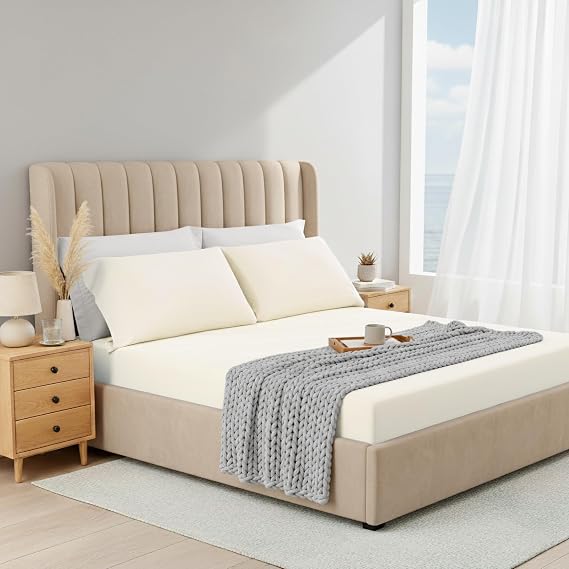
Regency Heights Cooling Sheet Set
Q-Max nylon-spandex fabric that feels cold the moment you lie down.
- Fiber: 90% nylon, 10% spandex (Q-Max 0.40+)
- Certification: OEKO-TEX Standard 100
Questions, answered
Do cooling sheets replace a cooling mattress?
They fix the skin-contact layer, which is where most heat discomfort is felt. A heat-trapping foam mattress can still overwhelm them, but sheets are the cheapest layer to fix first.
What about cooling pillowcases alone?
A cooling pillowcase, especially in Tencel or a Q-Max nylon blend, is a legitimate low-cost trial. The head and neck drive much of perceived overheating.
Are bamboo sheets environmentally better?
Bamboo grows fast, but viscose production is chemical-intensive; closed-loop lyocell like Tencel has the cleaner process. Certified sourcing, as with Bampure, narrows the gap.
How often should cooling sheets be washed?
Weekly for most sleepers, more often for night sweaters. That frequency is why durability and owning two sets matter more than a marginal cooling edge.