Head to head
AUTO-VOX CS-2 vs AMTIFO A8 (2027)
Head-to-head: AUTO-VOX CS-2 versus AMTIFO A8 on monitor size, signal stability, and installation.
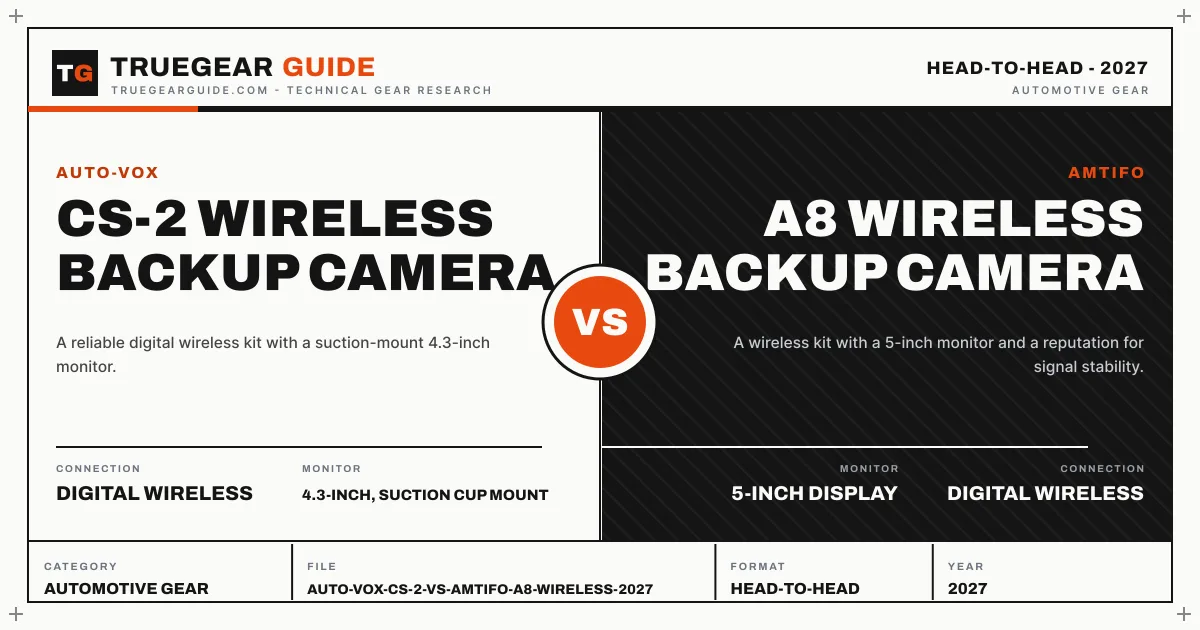

AUTO-VOX CS-2 Wireless Backup Camera
A reliable digital wireless kit with a suction-mount 4.3-inch monitor.
- Connection: Digital wireless
- Monitor: 4.3-inch, suction cup mount

AMTIFO A8 Wireless Backup Camera
A wireless kit with a 5-inch monitor and a reputation for signal stability.
- Connection: Digital wireless
- Monitor: 5-inch display
Our recommendation
Choose the AMTIFO A8 if screen readability matters: its 5-inch display is the meaningful upgrade and its signal is equally stable. Choose the AUTO-VOX CS-2 if you prefer the most established name in this class and a compact suction-mount monitor that disappears when parked. Both wire their cameras to the reverse light, so neither depends on the sun.
Monitor
Five inches versus 4.3 inches sounds small and reads big, especially for older eyes and bright cabins. The CS-2 counters with a tidier suction mount and a smaller dash footprint.
Brand and refinement
AUTO-VOX is the longer-established specialist in this niche, with polished documentation. AMTIFO competes on hardware value, putting the budget into the screen and signal.
Installation
Effectively tied: both tap the reverse-light circuit for camera power and transmit digitally to a socket-powered monitor. Expect under an hour for a confident DIY install on either.
Choose AUTO-VOX CS-2 Wireless Backup Camera if…
- You want the established brand and compact monitor
- Your dash space is limited
- You remove the monitor when parked
Choose AMTIFO A8 Wireless Backup Camera if…
- You want the larger, easier-to-read screen
- The car is an SUV or truck with dash room
- Hardware value matters more than brand
Questions, answered
Do both work in a garage-kept car?
Yes. Both cameras are vehicle-powered, so neither depends on solar charging. This is their shared advantage over the solar kits.
Which has less signal delay?
Both use digital wireless with similar minimal latency. In practice the difference is not noticeable in normal reversing.
Can either show the view while driving?
Both are reverse-triggered systems; the camera powers with the reverse light. For continuous observation, look at the Furrion Vision S class instead.